
Weight Loss Without Starving: How to Actually Eat More Food and Still Lose Fat
Most people start their weight loss journey by eating less. They skip breakfast, shrink portions to half, replace lunch with a sad salad, and go to bed hungry. It works for about two weeks. Then the cravings, fatigue, and irritability take over, and the weight comes back with a few bonus kilograms.
The problem is not a lack of willpower. The problem is the strategy. Starving yourself triggers a biological survival response that makes sustainable weight loss nearly impossible. But here is the good news: you can eat more food, feel full after every meal, and still lose fat consistently. The key is understanding what to eat, not just how much.
This guide explains why starvation diets fail, how your body actually loses fat, and what real meals look like when you do it right. Every meal example includes full macros and prices so you can see exactly what smart weight loss eating looks like in practice.
Why Starvation Diets Always Fail
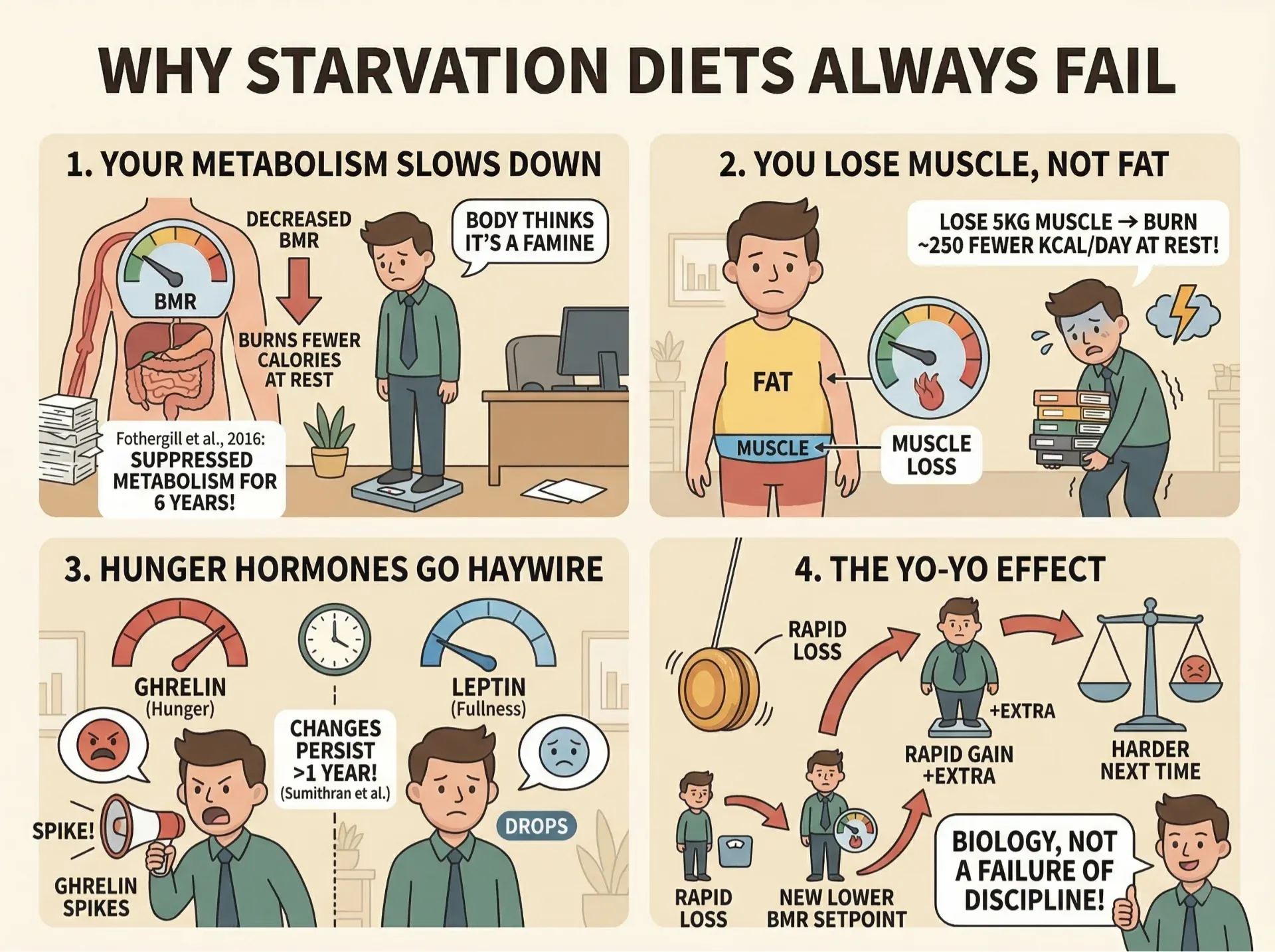
The logic behind starvation diets sounds simple: eat fewer calories, lose more weight. But your body is not a calculator. It is an adaptive survival machine that has been refining its responses for millions of years.
Your Metabolism Slows Down
When your calorie intake drops significantly below your body's needs, your Basal Metabolic Rate (BMR) decreases. Your body literally burns fewer calories at rest because it interprets the food shortage as a famine. A landmark study published in Obesity (Fothergill et al., 2016) tracked contestants from "The Biggest Loser" and found that their metabolisms remained suppressed for at least six years after extreme dieting. They had to eat far fewer calories than people of the same weight just to avoid gaining fat back.
You Lose Muscle, Not Just Fat
Severe calorie restriction causes your body to break down muscle tissue for energy. This is catastrophic for long-term weight management because muscle is your primary calorie-burning tissue. Lose 5 kg of muscle and your body burns roughly 250 fewer calories per day at rest. That deficit compounds over months, making weight regain almost inevitable.
Hunger Hormones Go Haywire
Crash dieting spikes your levels of ghrelin (the hunger hormone) and suppresses leptin (the fullness hormone). A 2011 study in The New England Journal of Medicine (Sumithran et al.) found that these hormonal changes persisted for at least one year after dieting, meaning your body was actively fighting to regain the lost weight long after the diet ended.
The Yo-Yo Effect
The result of all this biological pushback is the yo-yo effect: lose weight rapidly, regain it all plus extra, diet again, repeat. Each cycle makes the next one harder because your metabolism resets lower and your body becomes more efficient at storing fat. This is not failure of discipline. It is biology doing exactly what it evolved to do.
How Fat Loss Actually Works (Without Starvation)
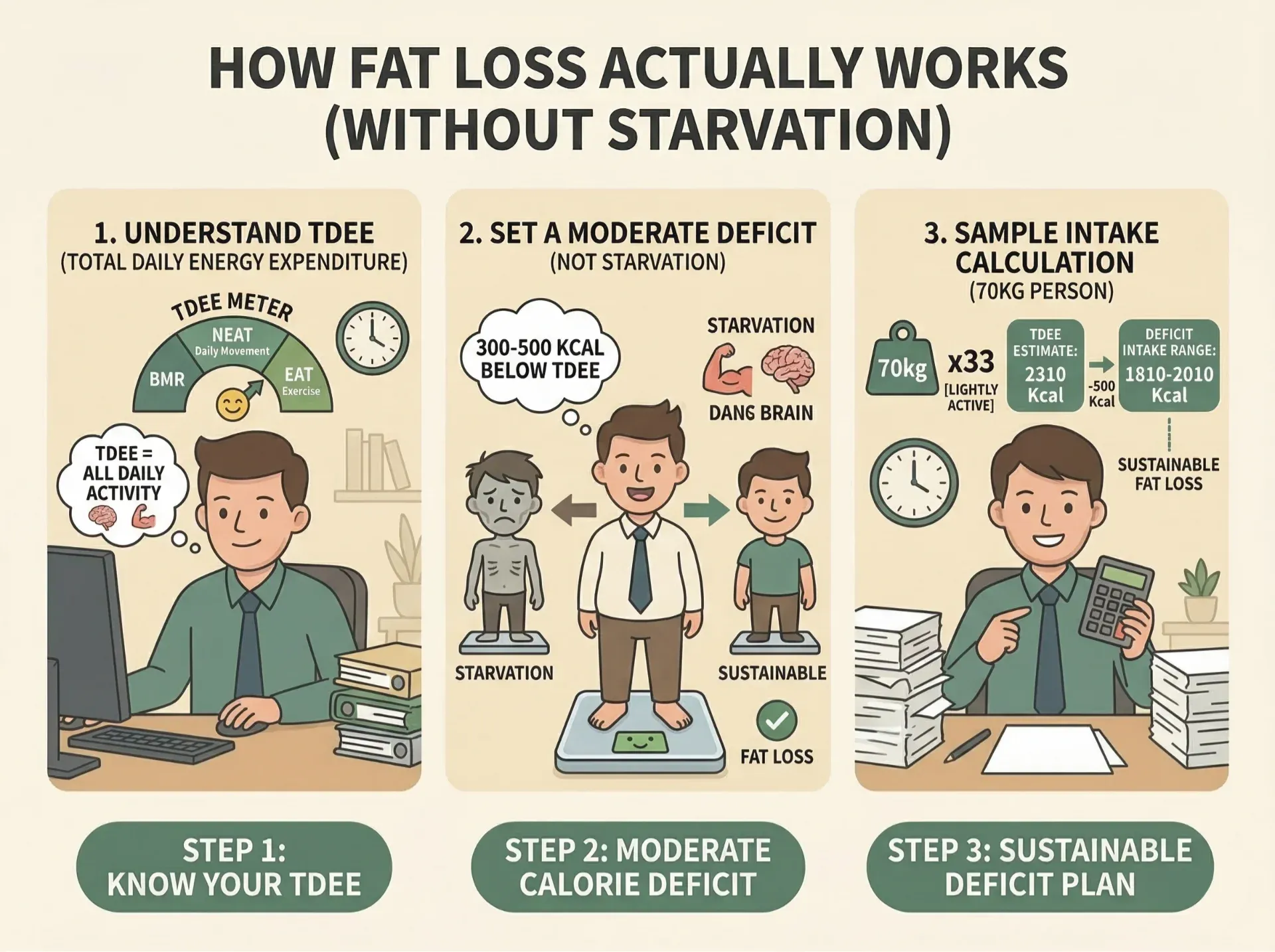
Real, sustainable fat loss requires a calorie deficit, but a moderate one. The sweet spot is typically 300-500 calories below your Total Daily Energy Expenditure (TDEE). At this level, your body burns stored fat for the shortfall without triggering the starvation response.
Step 1: Know Your Numbers
Your TDEE is the total calories you burn in a day, including activity. A rough estimate:
Sedentary office worker: Body weight (kg) x 28-30
Lightly active (exercise 2-3x/week): Body weight (kg) x 32-34
Active (exercise 4-5x/week): Body weight (kg) x 35-38
For a 70 kg person who exercises 3 times per week: 70 x 33 = roughly 2,310 calories/day. A moderate deficit would be 1,810-2,010 calories per day. Notice that this is still substantial. You are not starving.
Step 2: Prioritise Protein
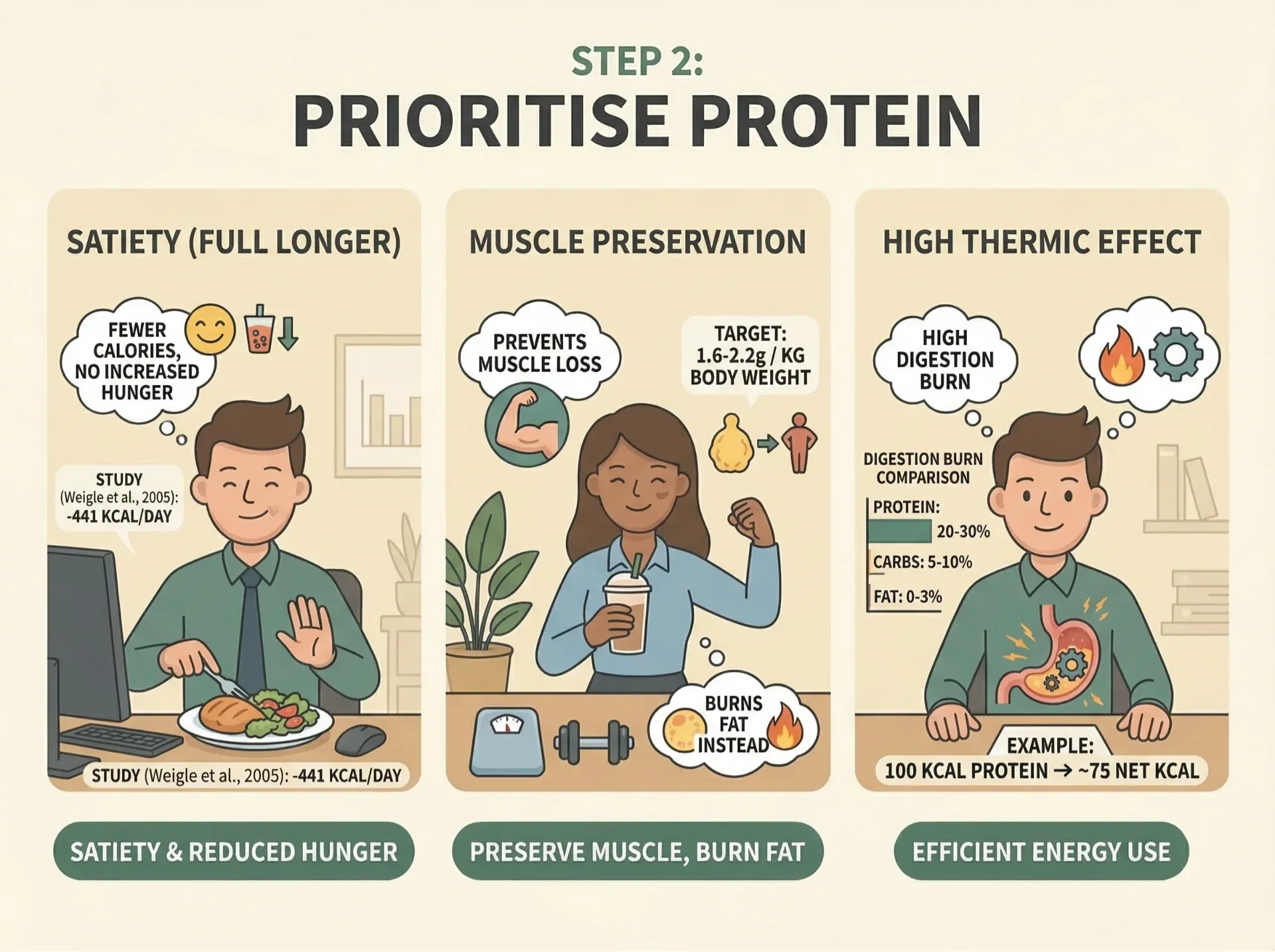
Protein is the most important macronutrient for weight loss without starving, for three reasons:
Satiety. Protein keeps you full longer than carbs or fat. A 2005 study in The American Journal of Clinical Nutrition (Weigle et al.) found that increasing protein from 15% to 30% of calories caused participants to spontaneously eat 441 fewer calories per day without feeling more hungry.
Muscle preservation. Adequate protein (1.6-2.2g per kg of body weight) prevents muscle loss during a calorie deficit. Your body burns fat instead.
Thermic effect. Your body burns 20-30% of protein calories just digesting them, compared to 5-10% for carbs and 0-3% for fat. Eating 100 calories of protein results in roughly 75 net calories. Eating 100 calories of fat results in roughly 98 net calories.
Step 3: Choose High-Volume, Low-Calorie-Density Foods
Calorie density is the concept that changes everything. Some foods pack thousands of calories into a small volume (fried food, sweets, fast food). Others give you a massive plate of food for very few calories (vegetables, lean protein, soups).
Weight loss without starving means choosing foods where a large, satisfying plate contains 400-600 calories instead of 1,200. You eat until full. You just eat the right things.
Step 4: Eat Consistently, Not Sporadically
Skipping meals does not save calories. It creates binge-rebound cycles. Eating 3-4 structured meals with adequate protein and fibre at each one keeps blood sugar stable, hunger low, and energy consistent throughout the day.
What Real Weight Loss Meals Look Like
Theory means nothing if you cannot execute it. Here are real meals from the Easy Health menu that demonstrate what smart weight loss eating looks like in practice. Every meal is cooked fresh daily in Bangkok with zero MSG, zero added sugar, and full macro transparency.
High-Protein, Low-Calorie Options
Morning Omelette
366 kcal · 28g protein · 3g carbs · 27g fat
225 THB
Why it works for weight loss: 28g protein in under 370 calories. Keeps you full through the morning. Only 3g carbs means minimal insulin response.
Tom Jued Soup
93 kcal · 14g protein · 6g carbs · 1g fat
75 THB
Why it works for weight loss: Only 93 calories with 14g protein. High-volume, liquid-based, incredibly filling relative to its calorie content. This is calorie density in action.
Pumpkin Soup
165 kcal · 4g protein · 14g carbs · 10g fat
75 THB
Why it works for weight loss: 165 calories for an entire bowl of soup. Volume eating at its best. The fibre from pumpkin slows digestion and keeps you satisfied.
Balanced Meals for Sustained Energy
Farmer Omelette
385 kcal · 33g protein · 13g carbs · 23g fat
229 THB
Why it works for weight loss: 33g protein with moderate carbs. The combination of eggs and vegetables provides sustained energy without the 2 PM crash that comes from rice-heavy lunches.
Hearty Breakfast Wrap
375 kcal · 27g protein
179 THB
Why it works for weight loss: Under 400 calories with 27g protein in a format that feels substantial and satisfying. Good for people who need something portable.
Hummus Bowl
239 kcal · 13g protein
195 THB
Why it works for weight loss: Plant-based option under 240 calories. Chickpea protein plus healthy fats from olive oil provide a different flavour profile that prevents meal fatigue.
High-Protein Power Meals
Ranchero Skillet
589 kcal · 56g protein · 27g carbs · 29g fat
289 THB
Why it works for weight loss: 56g protein in a single meal. If you are active and targeting 1,800+ calories per day, this delivers nearly a third of your daily protein needs in one sitting.
Power Fit Combo
1,043 kcal · 83g protein
319 THB
Why it works for weight loss: For larger individuals or serious athletes in a moderate deficit, this single meal covers half a day's protein. Not suitable for everyone, but transformative for those who need high-calorie, high-protein eating.
Pad Thai (Clean Version)
615 kcal · 39g protein
135 THB
Why it works for weight loss: You can eat Pad Thai and still lose weight. This clean version uses real tamarind sauce and free-range chicken. 39g protein makes it far more filling than the street version.
Sample Weight Loss Day: 3 Calorie Levels
Lean Day (~1,200 kcal, ~75g protein)
Breakfast: Tom Jued Soup (93 kcal, 14g protein) - 75 THB
Lunch: Morning Omelette (366 kcal, 28g protein) - 225 THB
Dinner: Farmer Omelette (385 kcal, 33g protein) - 229 THB
Daily total: ~844 kcal · ~75g protein
Daily cost: ~529 THB
Best for: Smaller individuals (under 55 kg) with sedentary lifestyles. Add a Pumpkin Soup (165 kcal, 75 THB) if you need a snack, bringing the total to ~1,009 kcal.
Balance Day (~1,500 kcal, ~95g protein)
Breakfast: Hearty Breakfast Wrap (375 kcal, 27g protein) - 179 THB
Lunch: Farmer Omelette (385 kcal, 33g protein) - 229 THB
Snack: Pumpkin Soup (165 kcal, 4g protein) - 75 THB
Dinner: Morning Omelette (366 kcal, 28g protein) - 225 THB
Daily total: ~1,291 kcal · ~92g protein
Daily cost: ~708 THB
Best for: Most women and smaller men targeting steady weight loss of 0.5-1 kg per week.
Active Day (~1,800 kcal, ~120g protein)
Breakfast: Morning Omelette (366 kcal, 28g protein) - 225 THB
Lunch: Ranchero Skillet (589 kcal, 56g protein) - 289 THB
Snack: Hummus Bowl (239 kcal, 13g protein) - 195 THB
Dinner: Farmer Omelette (385 kcal, 33g protein) - 229 THB
Daily total: ~1,579 kcal · ~130g protein
Daily cost: ~938 THB
Best for: Active men or larger women who exercise 3-5 times per week. High protein supports muscle preservation while in a deficit.
The Cost Comparison: Eating Clean vs Eating Cheap
One of the biggest objections to healthy eating in Bangkok is cost. Street food meals cost 40-60 THB. Easy Health meals cost 75-319 THB. But this comparison misses the full picture.
Hidden costs of cheap food: A 50 THB pad kra pao from a street vendor typically contains 800-1,000 calories, excessive sodium, MSG, and low-quality oil. If you eat this three times daily, you consume 2,400-3,000 calories with poor nutrient density. Weight gain, energy crashes, and long-term health costs follow.
What you actually pay for with clean food: When you pay 229 THB for a Farmer Omelette (385 kcal, 33g protein, 13g carbs, 23g fat), you are paying for precision. You know exactly what you are eating. The protein content is verified. The cooking method preserves nutrients. There is no guesswork.
Daily cost breakdown for weight loss eating:
Lean budget: ~529-708 THB/day (Tom Jued Soup + 2 main meals)
Balance budget: ~708-938 THB/day (3 main meals + 1 snack)
Monthly cost: approximately 15,870-28,140 THB
Compare that to the cost of a gym membership you do not use (2,000-5,000 THB/month), supplements that may or may not work (1,500-3,000 THB/month), or medical bills from diet-related health issues down the road. Investing in proper nutrition is the highest-return health decision you can make.
The meal plan option is even more cost-effective. The Balance Plan at 3,399 THB for 5 days provides full daily nutrition at roughly 680 THB/day, less than what most office workers in central Bangkok spend on food when factoring in coffee, snacks, and meals.
Why Most "Diet Food" in Bangkok Fails
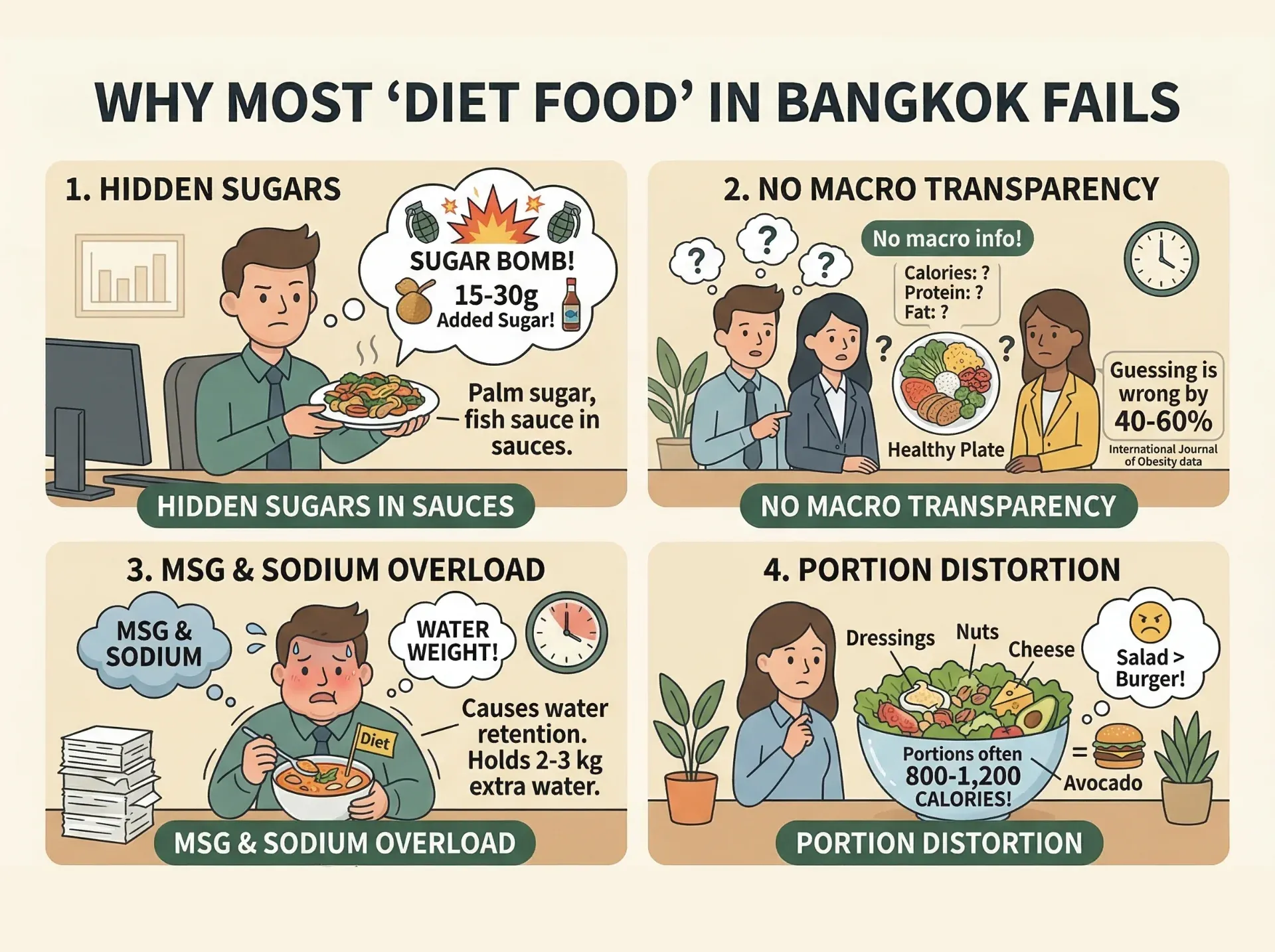
Bangkok is full of places that claim to sell healthy food. But most of what is marketed as "diet food" in the city has serious problems:
Hidden sugars in sauces. Thai cooking relies on palm sugar, fish sauce, and oyster sauce. Even dishes that look healthy often contain 15-30g of added sugar per serving. That turns your "clean" meal into a sugar bomb.
No macro transparency. Most restaurants, even those labelled "healthy," do not tell you the calorie count, protein content, or macronutrient breakdown. You are guessing. And most people guess wrong by 40-60% according to research from the International Journal of Obesity.
MSG and sodium overload. Excess sodium causes water retention that masks fat loss on the scale. You might be losing fat but the number does not move because you are holding 2-3 kg of extra water.
Portion distortion. "Healthy" restaurants often serve portions that contain 800-1,200 calories because they assume you want value for money. A salad with dressing, nuts, cheese, and avocado can easily exceed the calorie count of a Big Mac.
Every meal on the Easy Health menu displays exact calories, protein, carbs, and fat. No guessing. No hidden ingredients. No marketing tricks. Just real numbers so you can make informed decisions about what you eat.
The 7-Day Kickstart Plan
If you have never tried structured eating for weight loss, here is a simple plan to get started without feeling overwhelmed:
Day 1-2: Swap dinner only. Replace your usual dinner with one Easy Health meal. Keep everything else the same. This builds the habit without drastic change.
Day 3-4: Add breakfast. Start your morning with a high-protein Easy Health meal. Two meals replaced, one still flexible.
Day 5-7: Full day. All three meals from the Easy Health menu. By now your body is adjusting to consistent protein intake and controlled portions. Most people notice reduced cravings by day 5.
After week 1: Choose a meal plan that matches your calorie target. Easy Health offers 6 plans:
Lean Plan: 800-1,000 kcal/day, 1,899 THB/5 days. Maximum fat loss for smaller individuals.
Balance Plan: 1,400-1,600 kcal/day, 3,399 THB/5 days. The most popular plan for steady weight loss.
Active Plan: 1,800-2,000 kcal/day, 3,499 THB/5 days. For regular exercisers maintaining muscle.
Athlete Plan: 2,400-2,600 kcal/day, 4,799 THB/5 days. High-performance fuel.
Keto Plan: Low-carb, high-fat, 3,499 THB/5 days. For those following a ketogenic approach.
Vegetarian Plan: 1,400-1,600 kcal/day, 2,799 THB/5 days. Plant-based nutrition.
All plans include meals cooked fresh daily, full macro transparency, zero MSG, zero added sugar, and delivery across Bangkok.
8 Habits That Accelerate Weight Loss (Without Eating Less)
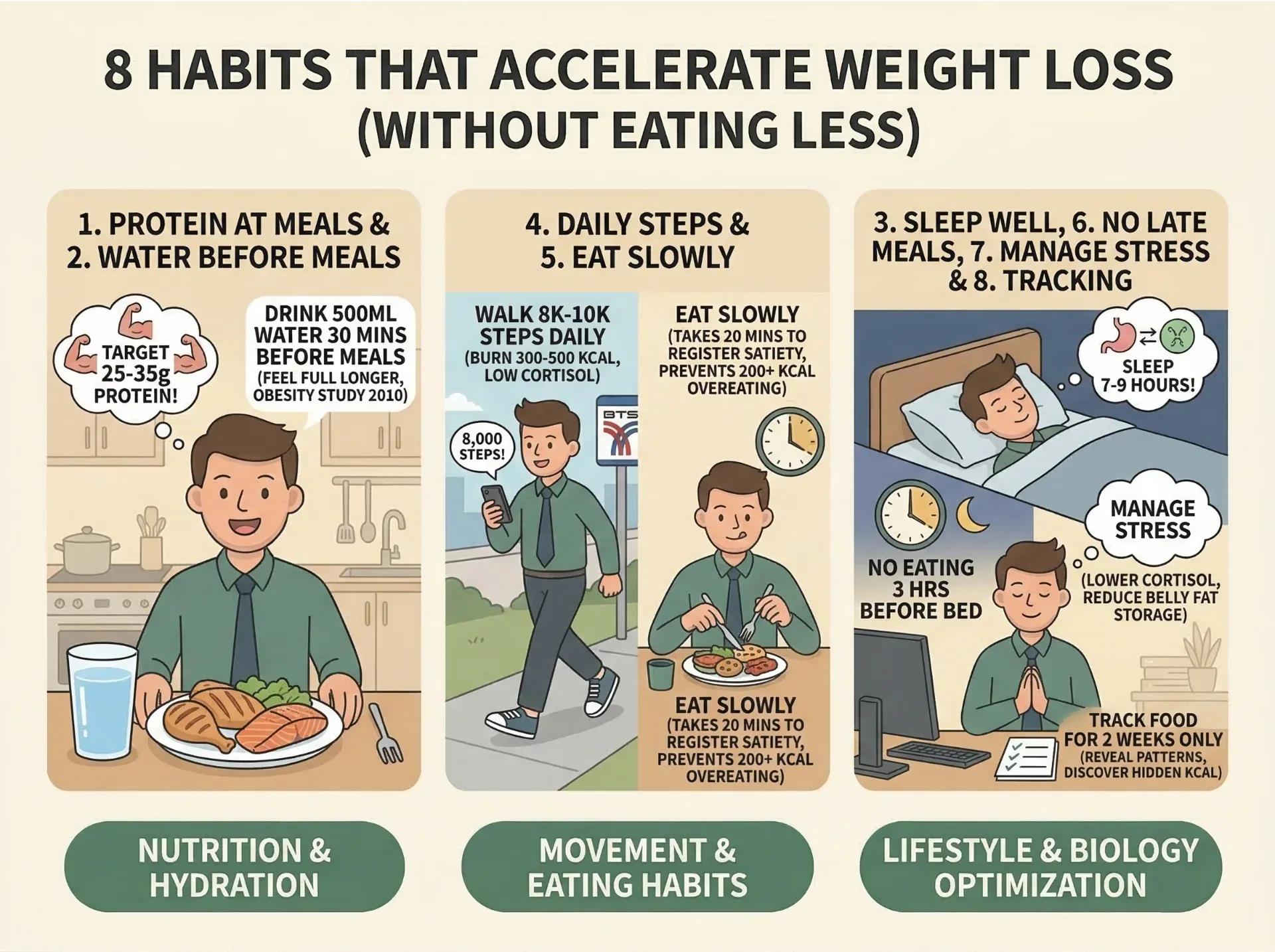
These habits work alongside proper nutrition to speed up results without requiring you to reduce food intake:
1. Eat protein at every meal. Target 25-35g per meal. This is the single most impactful habit for weight loss without hunger.
2. Drink water before meals. A study in Obesity (Dennis et al., 2010) found that drinking 500ml of water 30 minutes before meals increased weight loss by 44% over 12 weeks. The water creates volume in your stomach, reducing how much food you need to feel full.
3. Sleep 7-9 hours. Sleep deprivation increases ghrelin (hunger hormone) by up to 28% and decreases leptin (fullness hormone) by 18%. Poor sleep makes you biologically hungrier the next day regardless of what you eat.
4. Walk 8,000-10,000 steps daily. Walking burns 300-500 extra calories per day without spiking cortisol or increasing appetite the way intense exercise can. In Bangkok, this means taking the BTS one stop early and walking the rest, or choosing stairs over elevators.
5. Eat slowly. It takes roughly 20 minutes for satiety signals to reach your brain. Eating fast means you consume 200-300 extra calories before your brain registers that you are full.
6. Stop eating 3 hours before bed. Late-night eating disrupts sleep quality and insulin sensitivity. Both impair fat loss.
7. Manage stress. Cortisol, the stress hormone, directly promotes abdominal fat storage. Bangkok traffic, work pressure, and sleep deprivation all elevate cortisol. Find one stress management practice that works for you: walking, meditation, or simply eating lunch away from your desk.
8. Track what you eat for 2 weeks. You do not need to track forever. But two weeks of honest tracking reveals patterns you did not know existed. Most people discover they eat 20-40% more calories than they think.
Common Weight Loss Myths That Keep People Stuck
"Carbs make you fat." Excess calories make you fat, regardless of the source. Carbohydrates from whole foods (vegetables, brown rice, quinoa) provide energy, fibre, and essential nutrients. The problem is refined carbs (white bread, sugary drinks, processed snacks), not carbohydrates as a category.
"You need to exercise intensely to lose weight." Exercise is beneficial for health, mood, muscle maintenance, and cardiovascular fitness. But for pure fat loss, nutrition accounts for roughly 70-80% of results. You cannot out-exercise a bad diet. A single pad see ew from a street vendor can contain 900 calories. Burning that off requires roughly 90 minutes of running. It is far easier to simply eat a 400-calorie meal with the same satisfaction level.
"Fat-free and sugar-free products help you lose weight." These products typically replace fat or sugar with artificial alternatives that do not satisfy your appetite. You end up eating more because your body does not register the same fullness signals. Whole foods with naturally occurring fats (avocado, nuts, olive oil, eggs) are consistently more effective for weight management than engineered low-fat products.
"You should weigh yourself every day." Daily weighing can be useful for data, but only if you understand that weight fluctuates 0.5-2 kg daily from water, food volume, and hormones. If daily numbers cause anxiety or emotional eating, weigh weekly or track body measurements instead.
FAQ
How many calories should I eat to lose weight without starving?
A moderate deficit of 300-500 calories below your TDEE (Total Daily Energy Expenditure) is the sweet spot. For most adults, this means 1,200-1,800 calories per day depending on your size, age, and activity level. You should feel satisfied after meals, not hungry. If you are constantly hungry, your deficit is too aggressive.
How much protein do I need for weight loss?
Research consistently shows that 1.6-2.2g of protein per kilogram of body weight optimises fat loss while preserving muscle. For a 65 kg person, that is 104-143g of protein daily. This is higher than most people eat naturally, which is why protein-focused meals are so important during weight loss.
Can I eat carbs and still lose weight?
Absolutely. Carbohydrates are not the enemy. The type and amount matter. Complex carbs like brown rice, quinoa, sweet potatoes, and vegetables provide energy and fibre without spiking blood sugar. Even the WHO recommends that 45-65% of calories come from carbohydrates for healthy adults. The key is choosing whole, unprocessed sources.
Why does my weight fluctuate so much day to day?
Daily weight fluctuations of 0.5-2 kg are completely normal and caused by water retention (sodium, carbs, hormones), food volume in your digestive system, and hydration levels. This is not fat gain. True fat loss happens over weeks, not days. Weigh yourself at the same time each morning and look at the weekly average rather than any single number.
How long before I see results from changing my diet?
Most people notice reduced bloating and better energy within 3-5 days. Visible fat loss typically becomes noticeable at 2-4 weeks when following a consistent moderate deficit. Scale weight may drop faster in the first week (water weight) then settle to 0.5-1 kg per week, which is the healthy sustainable rate.
Is it better to eat 3 meals or 6 small meals for weight loss?
Total daily calories and protein matter more than meal frequency. A 2015 systematic review in Nutrition Reviews found no significant difference in weight loss between different meal frequencies when calories were equal. Choose whatever pattern helps you stay consistent. For most people in Bangkok, 3 structured meals with one optional snack works best because it fits the typical work schedule.
Ready to Start? Download the App
Stop guessing about calories and nutrition. Every meal on the Easy Health menu shows exact macros so you know precisely what you are eating.
Over 160 menu items, all cooked fresh daily
Full macro info (calories, protein, carbs, fat) for every meal
Zero MSG, zero added sugar, zero preservatives
6 meal plans from 1,899 to 4,799 THB/5 days
Download the Easy Health app:
Or explore online:
References
Fothergill, E., et al. (2016). Persistent metabolic adaptation 6 years after "The Biggest Loser" competition. Obesity, 24(8), 1612-1619. https://doi.org/10.1002/oby.21538
Sumithran, P., et al. (2011). Long-term persistence of hormonal adaptations to weight loss. The New England Journal of Medicine, 365(17), 1597-1604. https://doi.org/10.1056/NEJMoa1105816
Weigle, D. S., et al. (2005). A high-protein diet induces sustained reductions in appetite, ad libitum caloric intake, and body weight. The American Journal of Clinical Nutrition, 82(1), 41-48. https://doi.org/10.1093/ajcn/82.1.41
Dennis, E. A., et al. (2010). Water consumption increases weight loss during a hypocaloric diet intervention in middle-aged and older adults. Obesity, 18(2), 300-307. https://doi.org/10.1038/oby.2009.235
Leidy, H. J., et al. (2015). The role of protein in weight loss and maintenance. The American Journal of Clinical Nutrition, 101(6), 1320S-1329S. https://doi.org/10.3945/ajcn.114.084038
Harvard T.H. Chan School of Public Health. The Nutrition Source: Healthy Weight. https://nutritionsource.hsph.harvard.edu/healthy-weight/
World Health Organization. (2020). Healthy Diet. Fact Sheet. https://www.who.int/news-room/fact-sheets/detail/healthy-diet
Schoenfeld, B. J., Aragon, A. A., & Krieger, J. W. (2015). Effects of meal frequency on weight loss and body composition: a meta-analysis. Nutrition Reviews, 73(2), 69-82. https://doi.org/10.1093/nutrit/nuu017