
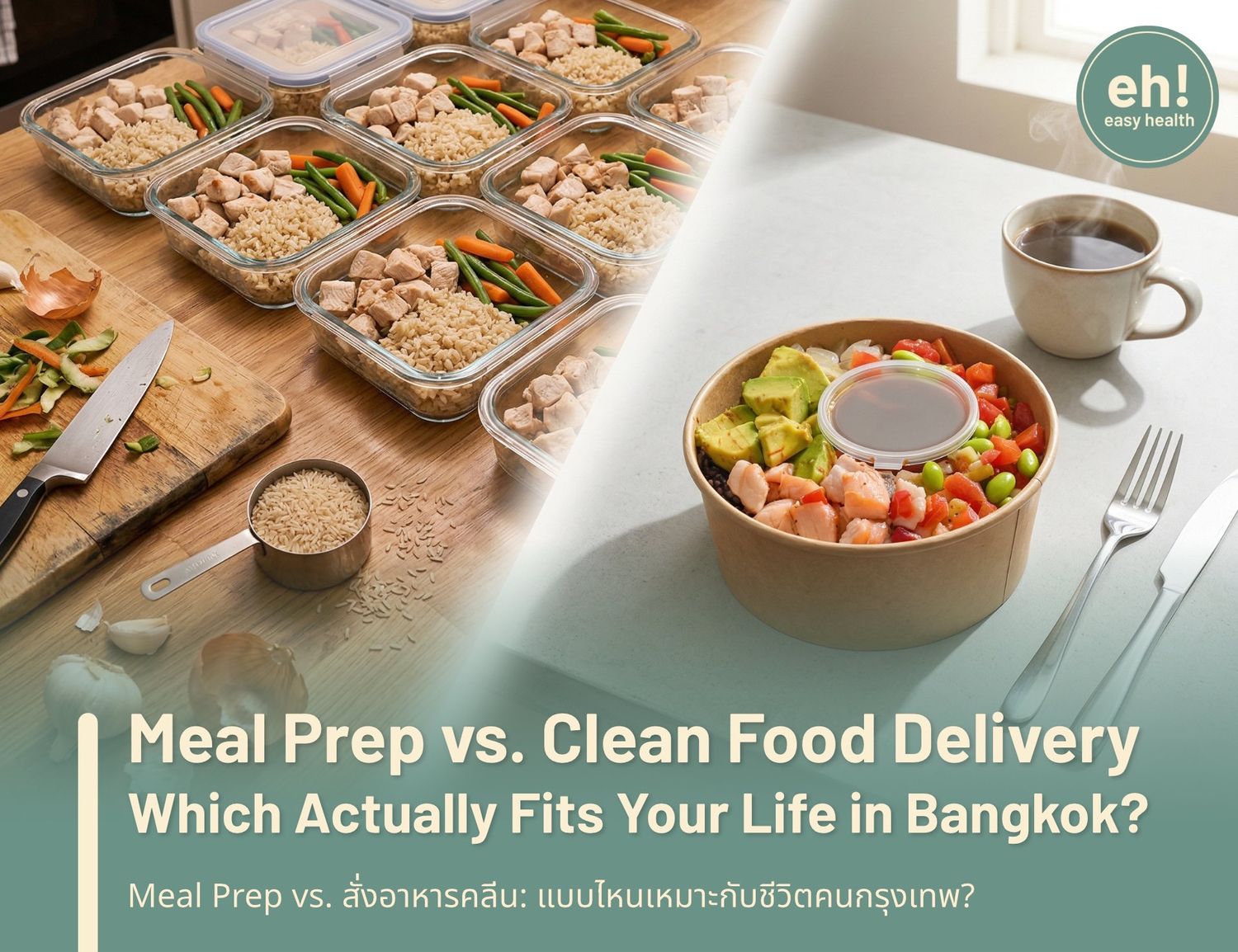
Meal Prep vs. Clean Food Delivery: Which Actually Fits Your Life in Bangkok?
You Know You Should Eat Better. The Question Is How.
Let's skip the motivational speech. You already know that eating clean, macro-balanced meals is better for your body, your energy, and your goals. That part isn't the problem.
The problem is execution.
Every Sunday night, thousands of people in Bangkok tell themselves "this is the week I meal prep." Some of them actually do it. They spend 2 to 3 hours cooking chicken breast, portioning out brown rice, and stacking containers in the fridge. By Wednesday, the food tastes like cardboard. By Thursday, they're ordering pad kra pao from GrabFood. By the following Sunday, the unused containers are still sitting in the fridge and the cycle restarts.
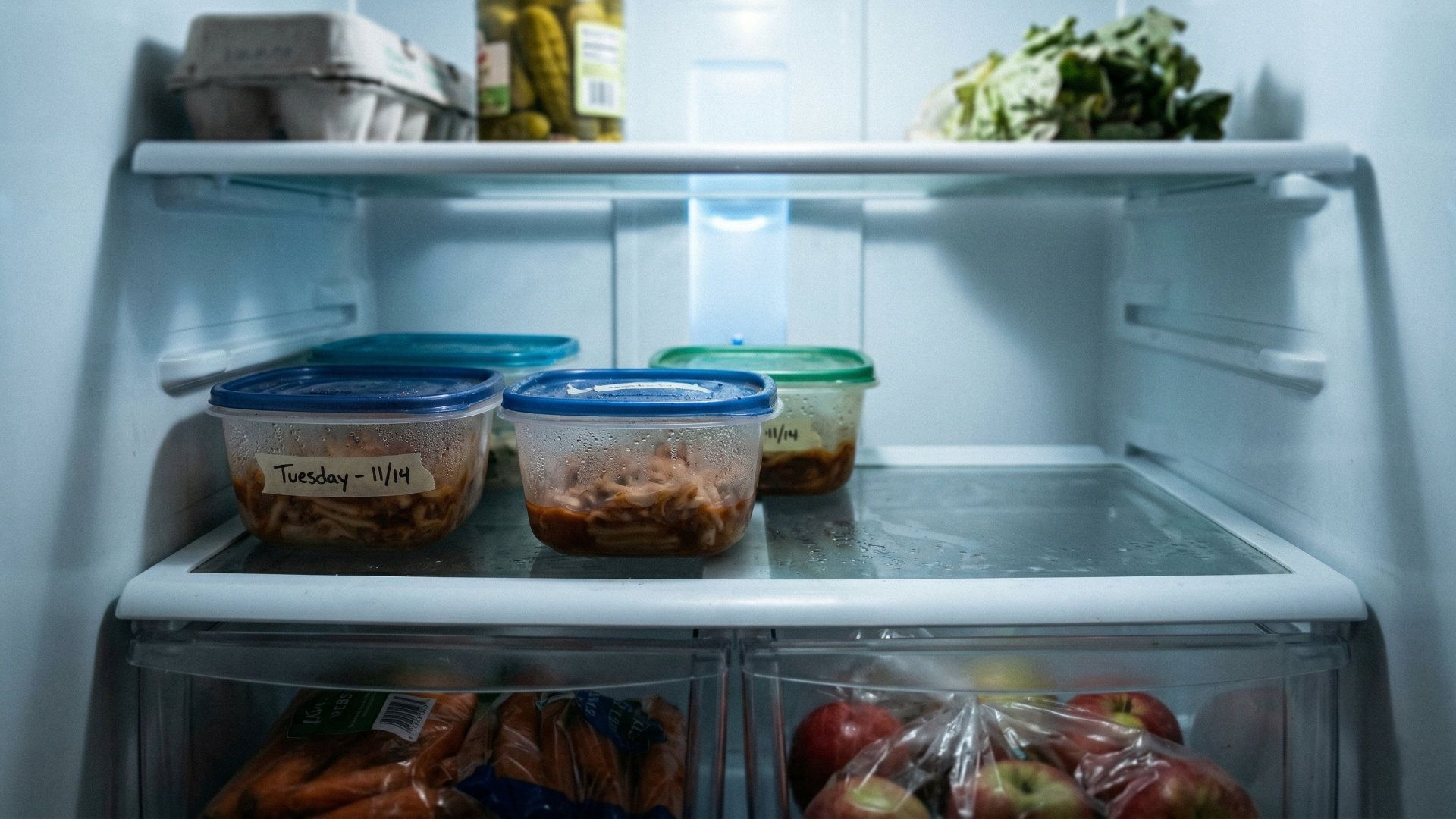
On the other side, a growing number of people have switched to clean food delivery services. They order online, meals arrive fresh, and they eat without thinking about shopping lists or Tupperware. Simple. But is it actually better? Is it worth the cost? Does it deliver the same nutritional results?
This guide is an honest comparison of meal prep versus clean food delivery for people living in Bangkok. We'll cover the real costs, the real time investment, the nutritional outcomes, and the practical reality of each approach. No sales pitch. Just the facts so you can decide which one actually works for your lifestyle.
What Is Meal Prep, Really?
Meal prep means preparing multiple meals in advance, usually on a weekend, so you have ready-to-eat food throughout the week. The concept is simple: cook once, eat all week.
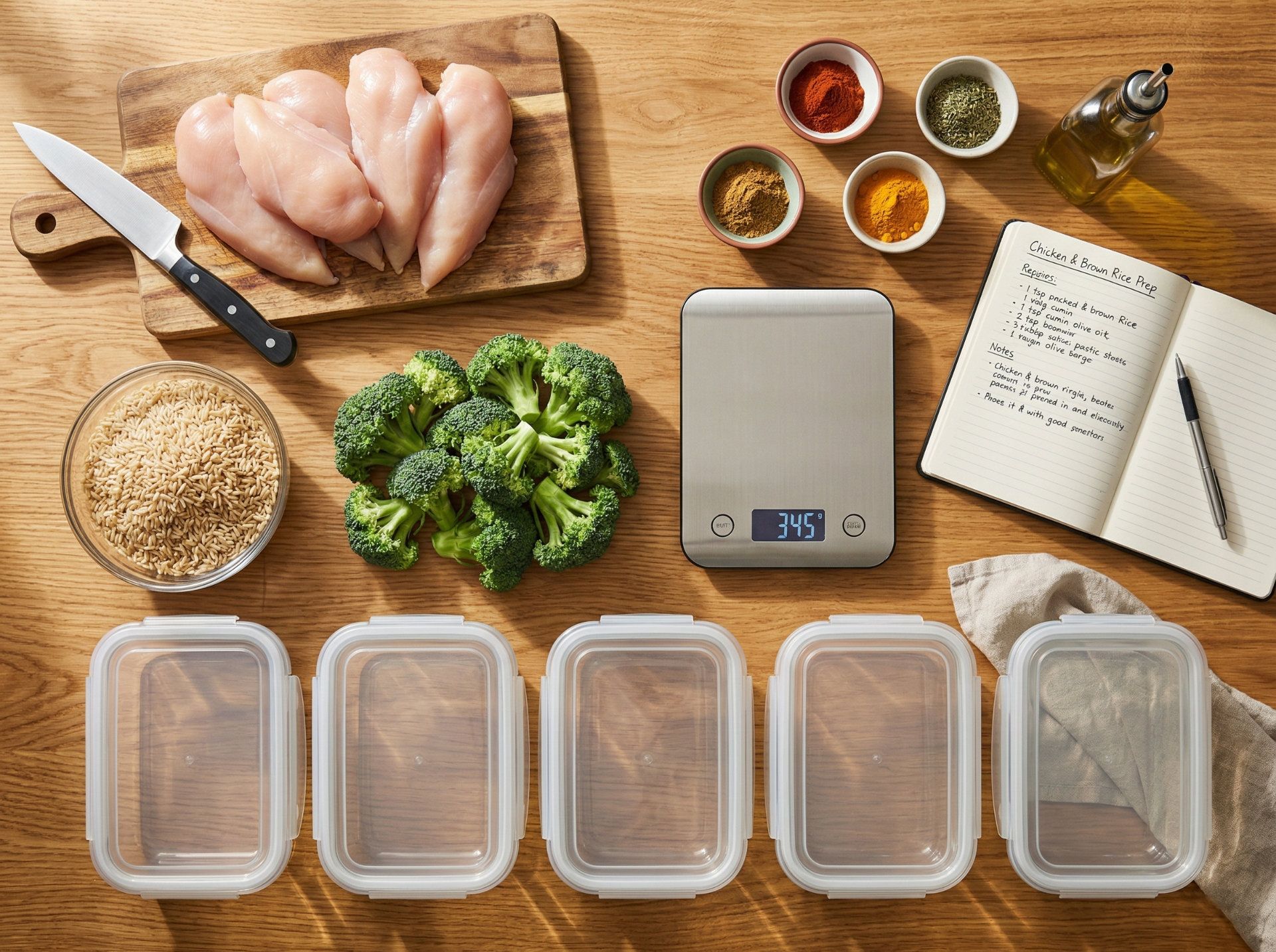
In practice, meal prep involves several steps:
Planning: Deciding what to cook, calculating macros, making a shopping list
Shopping: Buying ingredients at Makro, Tops, Villa Market, or a local fresh market
Cooking: Preparing proteins, carbs, vegetables, and sauces in bulk
Portioning: Dividing food into individual containers with controlled portions
Storing: Refrigerating meals for the week (most meal prep lasts 3 to 5 days safely)
Reheating: Microwaving or reheating each meal before eating
Meal prep became massively popular through fitness culture on YouTube and Instagram. The appeal is clear: you control every single ingredient, you save money compared to eating out every day, and you always have a healthy meal ready. In theory, it's the perfect system.
In practice? The story gets more complicated.
What Is Clean Food Delivery?
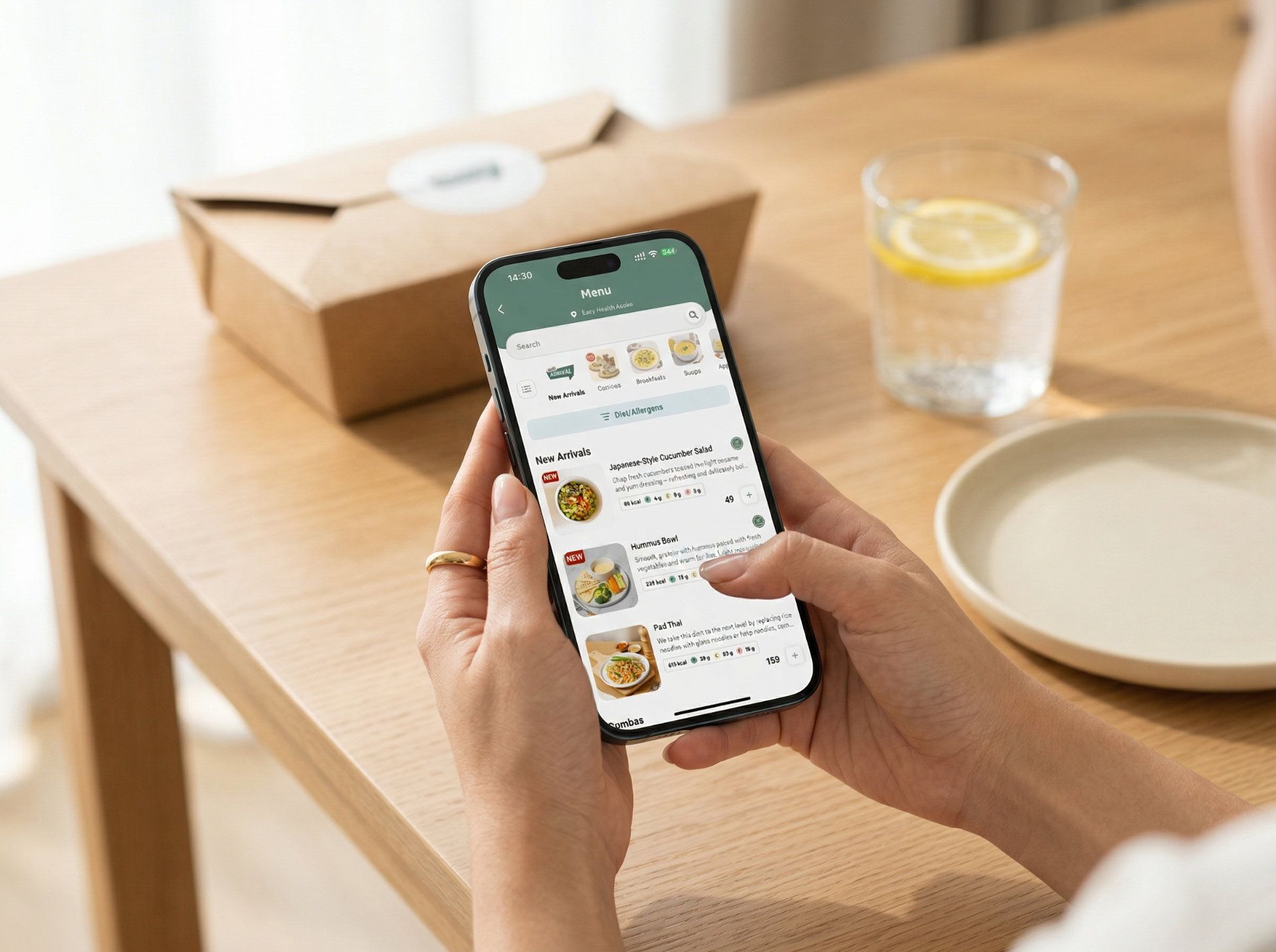
Clean food delivery means ordering meals from a service that prepares nutritious, macro-counted food and delivers it to your home or office. The meals are typically fresh (not frozen), calorie-controlled, and free from additives like excess sugar and MSG.
Unlike regular food delivery through apps like GrabFood or LINE MAN, clean food delivery services focus specifically on nutrition. Each meal shows exact macros (calories, protein, carbs, fat), uses whole ingredients, and is designed for people with specific health or fitness goals.
In Bangkok, the clean food delivery market has grown rapidly over the past few years. Services range from basic calorie-controlled boxes to premium brands that offer full macro transparency, zero added sugar, and diverse menus with 100+ dishes.
The Real Comparison: 7 Factors That Actually Matter
Let's compare meal prep and clean food delivery across the factors that determine whether a system actually works for your life.
Factor 1: Time Investment
Meal Prep
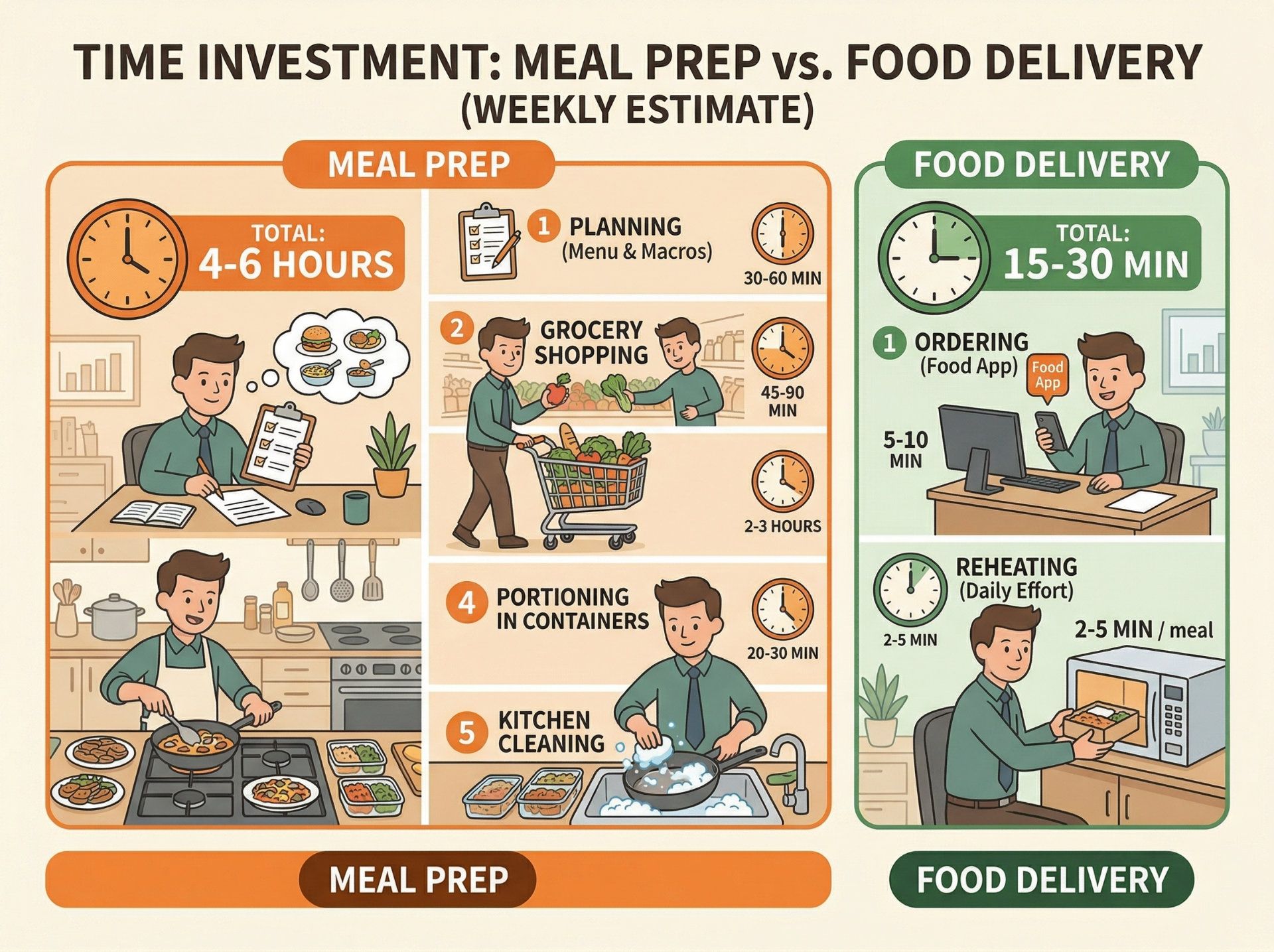
The time cost of meal prep is consistently underestimated. Here's what a realistic week looks like:
Menu planning and macro calculation: 30 to 60 minutes
Grocery shopping (including travel to the store): 45 to 90 minutes
Cooking and preparing: 2 to 3 hours
Portioning into containers: 20 to 30 minutes
Cleaning the kitchen afterward: 20 to 30 minutes
Daily reheating: 5 to 10 minutes per meal
Total weekly time investment: approximately 4 to 6 hours
That's nearly half a working day, every single week. For someone commuting 1 to 2 hours each way on the BTS in Bangkok, losing another 4 to 6 hours of their weekend to meal prep is a significant lifestyle cost.
Clean Food Delivery
Ordering meals through an app: 5 to 10 minutes
Receiving delivery: 0 minutes of active effort (it arrives at your door)
No cooking, no cleaning, no portioning
Daily reheating (if needed): 2 to 5 minutes per meal
Total weekly time investment: approximately 15 to 30 minutes
The time difference is dramatic. Clean food delivery gives you back roughly 4 to 5 hours per week. Over a month, that's 16 to 20 hours. Over a year, it's more than 200 hours of your life that you're not spending in a kitchen or a supermarket.
Winner: Clean food delivery, by a large margin.
Factor 2: Cost
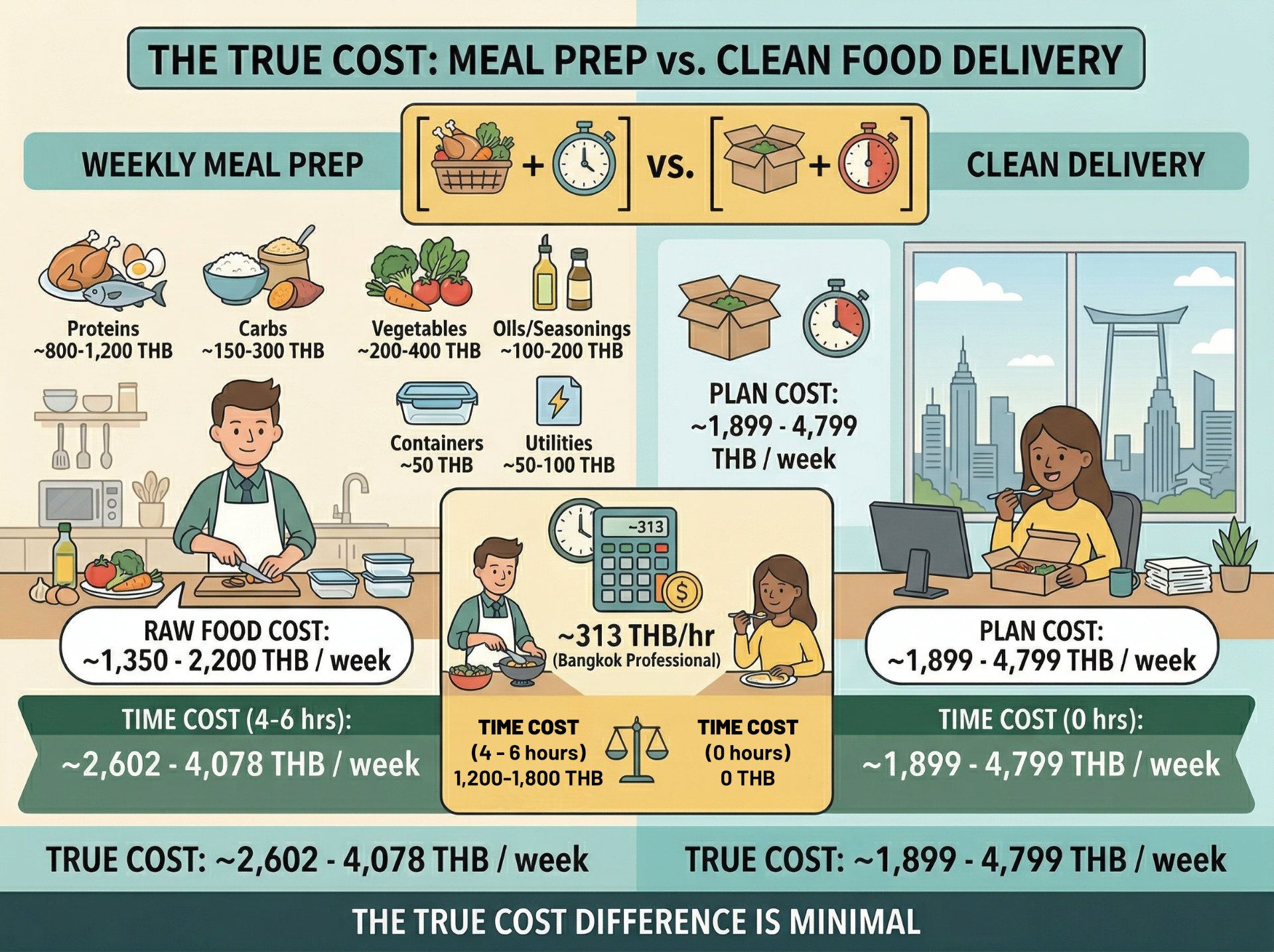
This is where most people assume meal prep wins. Let's check with real numbers from Bangkok.
Meal Prep Cost (per person, 5 days, 3 meals per day)
Protein sources (chicken breast, eggs, fish): approximately 800 to 1,200 THB per week
Carb sources (rice, oats, sweet potato): approximately 150 to 300 THB per week
Vegetables and fruits: approximately 200 to 400 THB per week
Cooking oils, sauces, seasonings: approximately 100 to 200 THB per week
Containers (one-time cost, amortized): approximately 50 THB per week
Gas/electricity for cooking: approximately 50 to 100 THB per week
Total weekly cost: approximately 1,350 to 2,200 THB for 15 meals Per meal cost: approximately 90 to 147 THB
Clean Food Delivery Cost (Easy Health, 5-day plans)
Lean Plan (800 to 1,000 kcal/day): 1,899 THB / 5 days
Balance Plan (1,400 to 1,600 kcal/day): 3,399 THB / 5 days
Active Plan (1,800 to 2,000 kcal/day): 3,499 THB / 5 days
Athlete Plan (2,400 to 2,600 kcal/day): 4,799 THB / 5 days
Keto Plan (Low-Carb / High-Fat): 3,499 THB / 5 days
Vegetarian Plan (1,400 to 1,600 kcal/day): 2,799 THB / 5 days
Individual à la carte meals: 75 to 289 THB per dish
For the most popular plan (Balance at 3,399 THB for 5 days of meals), the per-meal cost depends on how many meals per day are included. For à la carte ordering, many dishes fall in the 135 to 229 THB range.
The Real Calculation
Meal prep is cheaper in pure food cost. There's no getting around that. But the comparison isn't complete without factoring in the value of your time.
If you earn 50,000 THB per month (a reasonable salary for a Bangkok professional), your hourly rate is approximately 313 THB. Meal prep takes 4 to 6 extra hours per week. At 313 THB per hour, that's 1,252 to 1,878 THB worth of your time.
Add that to the food cost (1,350 to 2,200 THB), and the true cost of meal prep becomes 2,602 to 4,078 THB per week. Suddenly the gap between meal prep and clean food delivery is much smaller than it appears.
For higher earners, the math tips even further in favor of delivery.
Winner: Meal prep for raw food cost. But when you factor in time value, clean food delivery is competitive or even cheaper for many Bangkok professionals.
Factor 3: Nutritional Accuracy
Meal Prep
When you meal prep, you control every ingredient. That sounds like an advantage, and it can be, if you're disciplined about measuring and tracking.
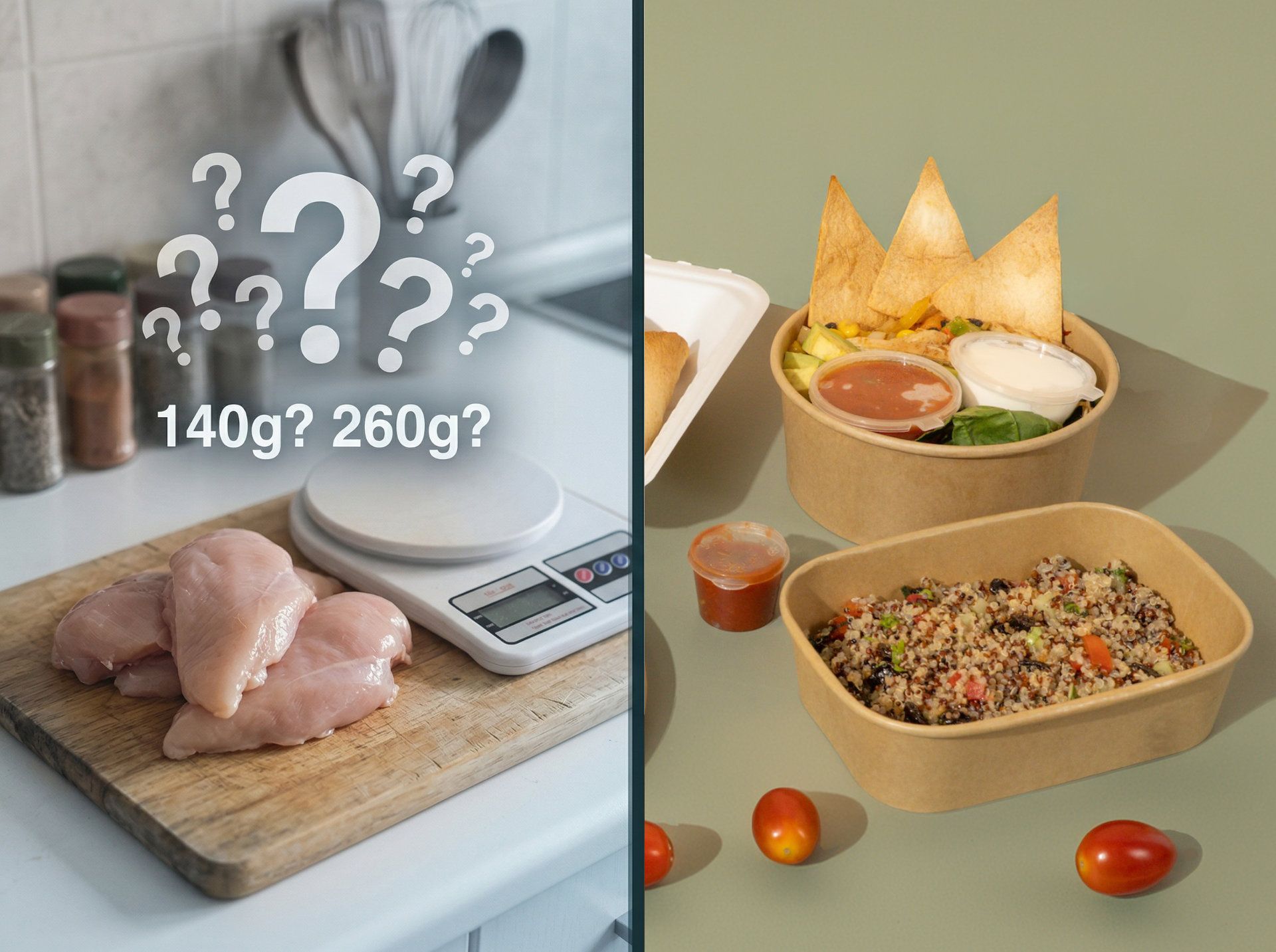
The reality is that most people who meal prep do not weigh their food with a kitchen scale. They eyeball portions. And the research on this is clear: humans are terrible at estimating food quantities. A study published in the International Journal of Obesity found that people routinely underestimate their calorie intake by 30 to 50%. That "200 grams of chicken" you put in each container might actually be 140 grams in one and 260 grams in another.
Additionally, calculating macros for home-cooked meals is complicated. Cooking methods change calorie content (fried versus grilled), sauces add hidden calories, and different cuts of meat have different fat content. Unless you're weighing everything on a digital scale and logging it in an app, your "macro-counted meal prep" is really more of a rough estimate.
Clean Food Delivery
A dedicated clean food delivery service calculates macros at the production level. Ingredients are weighed before cooking, recipes are standardized, and nutritional information is calculated based on actual weights and preparation methods.
When a meal from a service like Easy Health says "385 kcal, 33g protein, 13g carbs, 23g fat," that's based on measured ingredients, not estimates. Every meal you order gives you the same nutritional profile because the preparation is standardized.
For people who need accurate macro tracking (athletes, bodybuilders, people on medical diets, or anyone in a precise calorie deficit for weight loss), this level of consistency is hard to replicate at home without significant effort.
Winner: Clean food delivery for accuracy and consistency. Meal prep can be equally accurate, but only if you weigh everything and track meticulously, which most people don't.
Factor 4: Food Variety
Meal Prep
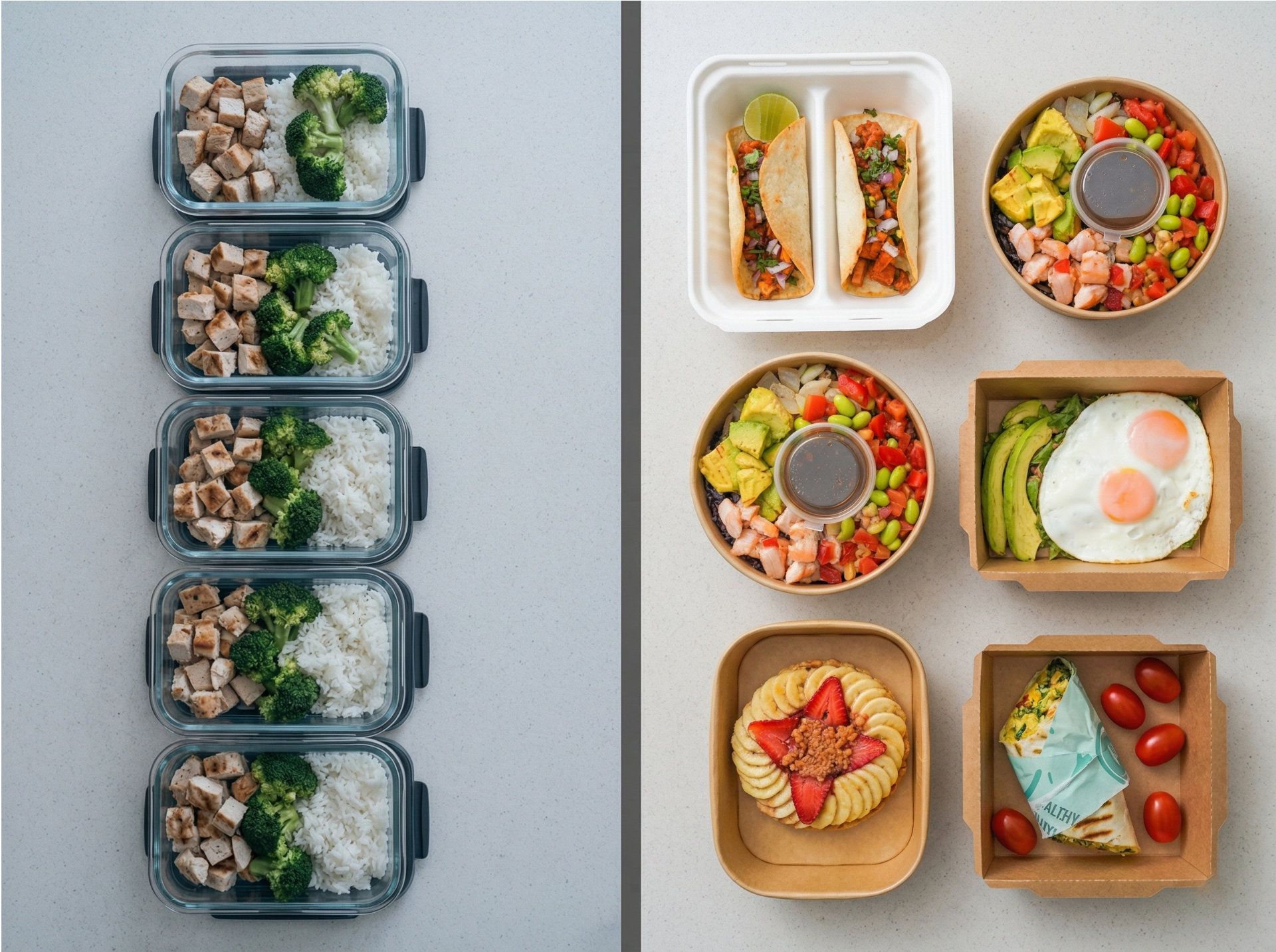
This is meal prep's Achilles heel. When you cook in bulk, you're usually making 2 to 3 proteins, 1 to 2 carb sources, and 2 to 3 vegetable options. That means you're eating essentially the same 3 to 4 meals for 5 straight days.
By day 3, the grilled chicken and brown rice that tasted great on Sunday tastes like punishment. By day 5, many people abandon their prep entirely and order delivery.
You can improve variety by prepping more dishes, but that increases your time investment proportionally. Want 7 different meals? You're now spending 6 to 8 hours prepping instead of 3 to 4.
Some meal preppers freeze portions to extend variety across weeks, but frozen meals lose texture and flavor. That reheated frozen chicken breast is not the same as fresh-cooked food, no matter what anyone tells you.
Clean Food Delivery
A service like Easy Health offers over 160 menu items across 24 categories. In a single week, you could eat Pad Thai for lunch on Monday, a Burrito Bowl on Tuesday, a Ranchero Skillet on Wednesday, Pumpkin Soup with a Breakfast Wrap on Thursday, and an Acai Berry Bowl on Friday. Every day is different.
This variety isn't just about enjoyment (though that matters for long-term adherence). Different foods provide different micronutrients. Eating the same chicken, rice, and broccoli every day means you're getting the same limited set of vitamins and minerals. A diverse diet naturally covers more of your micronutrient needs.
Winner: Clean food delivery, decisively. Variety is the one thing that's almost impossible to achieve with bulk meal prep.
Factor 5: Food Safety and Freshness
Meal Prep
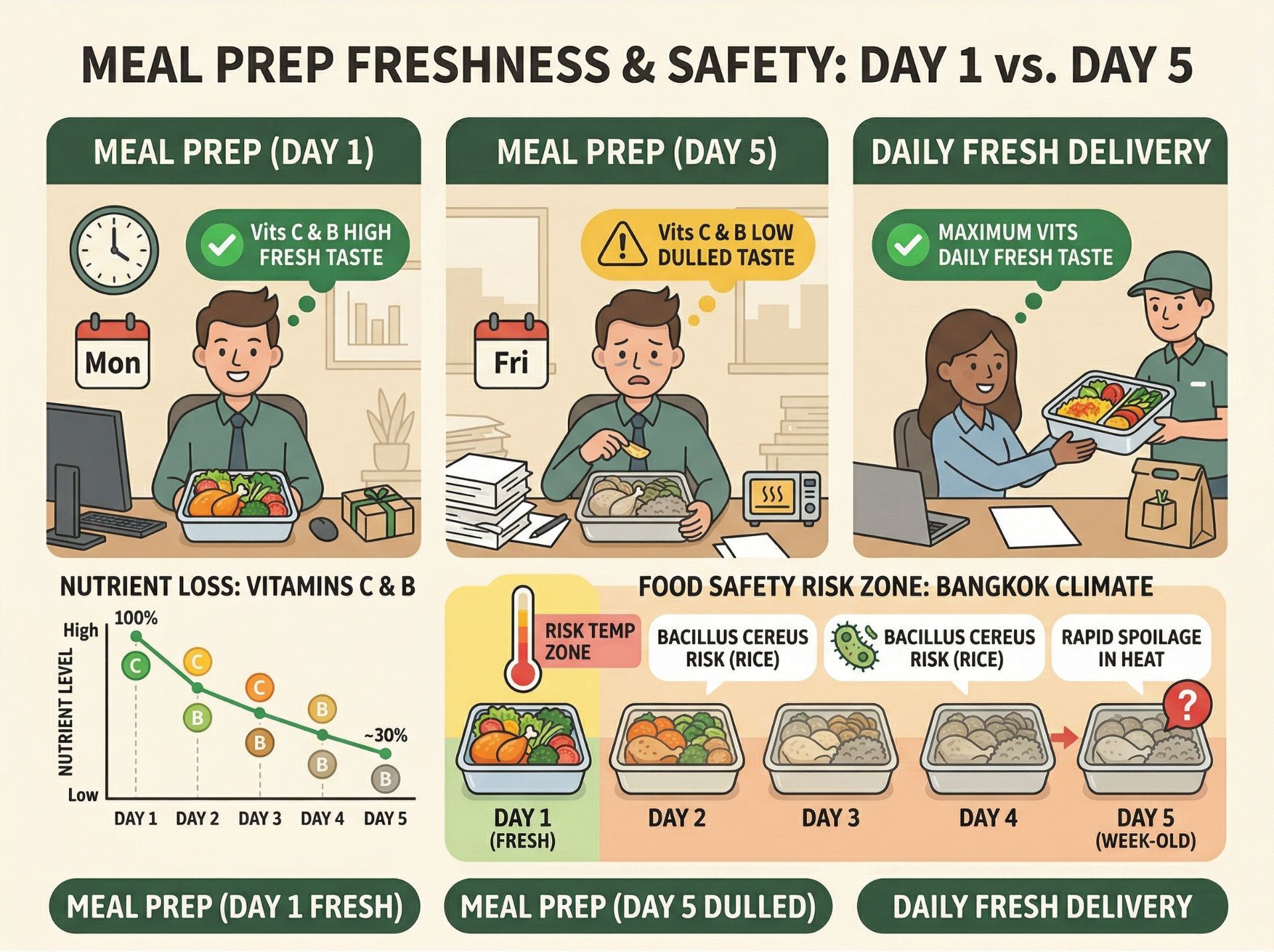
Home meal prep typically lasts 3 to 5 days in the refrigerator. After that, bacterial growth becomes a concern, especially in Bangkok's climate where power outages or even a slightly warm fridge can accelerate spoilage.
The food you eat on Monday is fresh. The food you eat on Friday has been sitting in the fridge for 5 days. The taste difference is noticeable, and so is the potential food safety risk if storage conditions aren't perfect.
Rice is a particular concern. Cooked rice can develop Bacillus cereus bacteria if not stored at the correct temperature. In a tropical climate, this risk is higher than in cooler countries.
Clean Food Delivery
Fresh meals are prepared and delivered daily (or based on the delivery schedule). You're eating food that was made that morning, not food that's been sitting in a container since Sunday.
This matters for both taste and nutrition. Certain vitamins (particularly Vitamin C and B vitamins) degrade over time and with repeated reheating. A meal eaten within hours of preparation retains more of these nutrients than one that's been refrigerated for 5 days and microwaved.
Winner: Clean food delivery for freshness and food safety. Meal prep is safe when done correctly, but the quality decline over 5 days is real.
Factor 6: Flexibility and Adaptability
Meal Prep
Once you've prepped your meals, you're committed. If your plans change midweek (a client dinner, a social event, a day when you just don't feel like eating the same grilled chicken again), those prepped meals either go to waste or sit in the fridge longer than they should.
Meal prep also doesn't adapt well to changing goals. If you decide to switch from a calorie deficit to maintenance, or from standard eating to keto, you'd need to redo your entire prep with different recipes and different macro targets.
Clean Food Delivery
Most delivery services allow you to change your order daily or choose different meals each time. Want keto on Monday, standard balanced meals on Tuesday, and a lighter option on Wednesday? No problem.
À la carte ordering gives you complete flexibility. If your schedule changes, you simply don't order for that day. No food waste, no guilt about abandoned containers in the fridge.
Winner: Clean food delivery for flexibility. Meal prep requires commitment and doesn't adapt well to changing plans.
Factor 7: Long-Term Sustainability
This is the most important factor. A perfect system that you quit after 3 weeks is worse than an imperfect system you maintain for a year.
Meal Prep
The dropout rate for meal prep is extremely high. There's no formal research tracking this, but fitness coaches and nutritionists widely report that most clients who start meal prepping abandon it within 4 to 8 weeks. The reasons are consistent: boredom from repetitive meals, time fatigue from weekly prep sessions, and the accumulated frustration of spending weekends cooking instead of living.
Some people genuinely enjoy cooking and find meal prep meditative. For them, it works long-term. But they're the minority. For most busy professionals in Bangkok, meal prep is a sprint, not a marathon.
Clean Food Delivery
The barrier to continuation is much lower. Ordering food takes minutes. The meals are varied. There's no cleanup. The primary barrier is cost, and even that becomes manageable when you compare it to the combined cost of groceries plus your time.
Services that offer subscription plans or meal plans (like 5-day packages) also create a structure that's easy to maintain. You commit at the beginning of the week, and your meals are handled. No decision fatigue every day about what to eat.
Winner: Clean food delivery for most people. Meal prep wins for the small percentage who genuinely enjoy cooking and have the time to sustain it.
The Hybrid Approach: The Best of Both Worlds
Here's something most articles on this topic don't mention: you don't have to choose one or the other. Many people in Bangkok find that a hybrid approach works best.
How it works:
Use clean food delivery for weekday lunches and dinners when you're busy, tired, and most likely to make poor food choices
Do simple meal prep for breakfasts (overnight oats, boiled eggs, Greek yogurt bowls take 20 minutes to prep for a whole week)
Cook fresh on weekends when you actually have time and energy to enjoy the process
Keep à la carte delivery as your backup for days when plans change
This hybrid model gives you the consistency and convenience of delivery during the week, the cost savings of simple breakfast prep, and the enjoyment of cooking on your own terms during weekends.
For example, a typical hybrid week might look like this:
Monday to Friday breakfast: Homemade overnight oats with protein powder (prepped Sunday evening in 15 minutes)
Monday to Friday lunch: Easy Health à la carte (choose different dishes daily)
Monday to Friday dinner: Easy Health Balance Plan meals
Saturday and Sunday: Cook at home, try new recipes, enjoy the process
This approach costs less than full delivery for every meal, takes far less time than full meal prep, and gives you variety, accuracy, and the satisfaction of cooking when you choose to, not when you have to.
Common Meal Prep Mistakes That Derail Your Progress
If you do choose to meal prep (whether fully or as part of a hybrid approach), avoid these mistakes that trip up most people in Bangkok.
Mistake 1: Cooking too much of one thing. Five days of the same grilled chicken and rice is a recipe for quitting. Even if you enjoy it on day 1, by day 4 you'll start dreading meal time. Prep at least 3 different protein options and 2 different carb sources to maintain some variety.
Mistake 2: Not seasoning properly. One reason meal prep gets a bad reputation is that people under-season their food for fear of "unhealthy" additions. Salt, pepper, garlic, herbs, and spices add minimal calories but dramatically improve taste. The best-tasting meal prep is the one you'll actually eat.
Mistake 3: Ignoring food safety in Bangkok's heat. If you're transporting meals to work on the BTS in 35-degree heat without an insulated bag, your food is sitting in the danger zone (4 to 60 degrees Celsius) for potentially hours. Invest in a proper insulated lunch bag with an ice pack. This is not optional in a tropical climate.
Mistake 4: Not accounting for the "taste decline" factor. Food that was delicious on Sunday will not taste the same on Thursday. Plan your best meals for later in the week (like putting the more flavorful curry on Thursday and the simpler grilled chicken on Monday when it's still fresh).
Mistake 5: Spending more on ingredients than you realize. Quality protein in Bangkok isn't cheap. Chicken breast at Makro is affordable, but if you're buying salmon, grass-fed beef, or specialty items from Villa Market or Gourmet Market, your grocery bill adds up quickly. Track your actual spending before claiming meal prep is "so much cheaper."
How Easy Health Fits Into Your Lifestyle
Whether you go full delivery, full meal prep, or hybrid, Easy Health is designed to make the clean eating part effortless.
Every meal from Easy Health is prepared fresh daily with zero added sugar and no MSG. Every dish shows exact calories, protein, carbs, and fat. The menu features over 160 items, so you're never stuck eating the same thing twice.
Here are some of the most popular options for people making the switch from meal prep:
Farmer Omelette · Hearty omelette with mushrooms, peppers, and onions. 385 kcal, 33g protein, 13g carbs, 23g fat. 229 THB. A protein-dense breakfast that beats any reheated meal prep. Tagged: High Protein.
Pad Thai · The clean version of a Thai classic. 615 kcal, 39g protein. 135 THB. Try making Pad Thai this good at home with accurate macros. It's harder than it sounds.
Ranchero Skillet · Bold, savory, and loaded with protein. 589 kcal, 56g protein, 27g carbs, 29g fat. 289 THB. One dish covers nearly half your daily protein target. Tagged: High Protein.
Power Fit Combo · Soup + main dish + smoothie. 1,043 kcal, 83g protein. 319 THB. A complete meal-prep replacement in a single order.
Peanut Butter Berry Jam Bowl · Protein-rich oats with fresh berries. 431 kcal, 21g protein. 175 THB. Better than any overnight oats you'll make at home, and someone else does the cleanup.
Tom Jued Soup · Light Thai clear soup with tofu and fresh vegetables. 93 kcal, 14g protein, 6g carbs, 1g fat. 75 THB. A perfect low-calorie side to any main.
For structured meal planning, the Easy Health Meal Plans eliminate decision fatigue entirely:
Lean Plan (800 to 1,000 kcal/day) at 1,899 THB / 5 days. Aggressive fat loss with balanced macros.
Balance Plan (1,400 to 1,600 kcal/day) at 3,399 THB / 5 days. The most popular plan for Bangkok professionals.
Active Plan (1,800 to 2,000 kcal/day) at 3,499 THB / 5 days. For people who train 3 to 5 times per week.
Athlete Plan (2,400 to 2,600 kcal/day) at 4,799 THB / 5 days. High-energy meals for intense training.
Keto Plan (Low-Carb / High-Fat) at 3,499 THB / 5 days. Clean keto without hidden sugars in sauces.
Vegetarian Plan (1,400 to 1,600 kcal/day) at 2,799 THB / 5 days. Plant-based meals with adequate protein.
The bottom line is simple. The best healthy eating system is the one you actually stick with. For some people, that's meal prep. For others, it's delivery. For most people living busy lives in Bangkok, it's some combination of both, and Easy Health is designed to be the reliable, consistent part of that equation.
The Final Verdict: Which One Should You Choose?
Choose meal prep if:
You genuinely enjoy cooking and find it relaxing
You have 4 to 6 free hours per week dedicated to food preparation
You're on a tight budget and every 50 THB per meal matters
You want maximum control over every single ingredient
You have a kitchen with adequate space and equipment
You're disciplined about food scale use and macro tracking
Choose clean food delivery if:
Your time is worth more than the cost difference
You're busy with work, commuting, family, or social life
You need accurate, consistent macros without the effort of tracking
Variety is important to you and eating the same meal for 5 days isn't sustainable
You live in a condo with a small kitchen or limited cooking equipment
You've tried meal prep before and couldn't maintain it beyond a few weeks
Choose a hybrid approach if:
You want the best balance of cost, convenience, and enjoyment
You like cooking on weekends but need a hands-off solution for weekdays
You want flexibility to adapt week by week based on your schedule
You're looking for a system that works long-term, not just for a few weeks
There's no wrong answer. The wrong answer is the one that sounds good in theory but falls apart in practice. Be honest about your schedule, your budget, your cooking skills, and your history with healthy eating. Then choose the approach that you'll actually maintain.
FAQ
Is meal prep really cheaper than food delivery in Bangkok?
In terms of pure food cost, yes. Meal prepping with ingredients from Makro or local markets costs roughly 90 to 150 THB per meal, while clean food delivery ranges from 75 to 289 THB per dish. However, this comparison ignores the 4 to 6 hours per week you spend shopping, cooking, portioning, and cleaning. When you factor in the value of your time, the real cost difference narrows significantly, especially for professionals earning above-average salaries.
How long does meal prep food last in the fridge?
Most meal-prepped food is safe to eat for 3 to 5 days when stored properly at or below 4 degrees Celsius. In Bangkok's climate, ensure your fridge is maintaining the correct temperature, as power fluctuations and frequent door opening can warm the interior. Rice and chicken are particularly sensitive to bacterial growth. If food looks, smells, or tastes off, don't eat it. When in doubt, throw it out.
Can I build muscle with food delivery instead of meal prep?
Absolutely. Building muscle depends on total daily protein intake, calorie surplus, and progressive resistance training. It doesn't matter whether your 150 grams of protein per day comes from home-cooked chicken or a delivery meal. What matters is hitting your macro targets consistently. A meal service that shows exact protein per dish makes this tracking easier, not harder.
What's the biggest reason people quit meal prep?
Boredom. Eating the same 3 to 4 meals for an entire week, week after week, is mentally exhausting. Research on dietary adherence consistently shows that food variety is a major predictor of long-term compliance. People don't quit because the food is unhealthy. They quit because they can't face another container of cold chicken and rice.
Is frozen meal prep as nutritious as fresh food delivery?
Freezing preserves most macronutrients (protein, carbs, fat) well, but it degrades certain micronutrients, particularly water-soluble vitamins like Vitamin C and B vitamins. Texture and taste also suffer, especially for vegetables, rice, and foods with high water content. Fresh meals delivered the same day they're prepared retain better nutritional value, better taste, and better texture than frozen meals that are thawed and reheated.
Can I do meal prep for some meals and use delivery for others?
Yes, and this hybrid approach is what many nutritionists recommend for long-term sustainability. A common strategy is to prep simple breakfasts at home (overnight oats, boiled eggs, yogurt bowls), use clean food delivery for weekday lunches and dinners, and cook fresh on weekends. This balances cost savings with convenience and keeps your eating plan enjoyable rather than exhausting.
Ready to Make Clean Eating the Easiest Part of Your Day? Download the Easy Health App
Whether you're replacing meal prep entirely or filling in the gaps, the Easy Health App makes it simple. Every meal is fresh, macro-counted, and made with zero added sugar. No more Sunday cooking marathons. No more sad Tupperware lunches. Just real food that supports your goals.
Here's what you get:
Easy Ordering · Browse 160+ menu items, pick your meals for the week, and order in seconds
Track Your Nutrition (Calories & Macros) · See exact calories, protein, carbs, and fat for every dish, so your nutrition stays on target without a food scale
Personalized Meal Planning · Choose from 6 curated plans (Lean, Balance, Active, Athlete, Keto, Vegetarian) or mix and match à la carte
Exclusive Rewards · Earn points with every order and unlock special deals available only in the app
Download now and start eating smarter today:
Android: Download on Google Play
iOS: Download on the App Store
References & Links
References:
Lichtman, S.W. et al. (1992). "Discrepancy between self-reported and actual caloric intake and exercise in obese subjects." New England Journal of Medicine, 327(27), 1893-1898. · https://www.nejm.org/doi/full/10.1056/NEJM199212313272701
Raynor, H.A. & Epstein, L.H. (2001). "Dietary variety, energy regulation, and obesity." Psychological Bulletin, 127(3), 325-341. · https://pubmed.ncbi.nlm.nih.gov/11393299/
Food Standards Agency, "Use-by dates and food safety guidance" · https://www.food.gov.uk/safety-hygiene/best-before-and-use-by-dates