
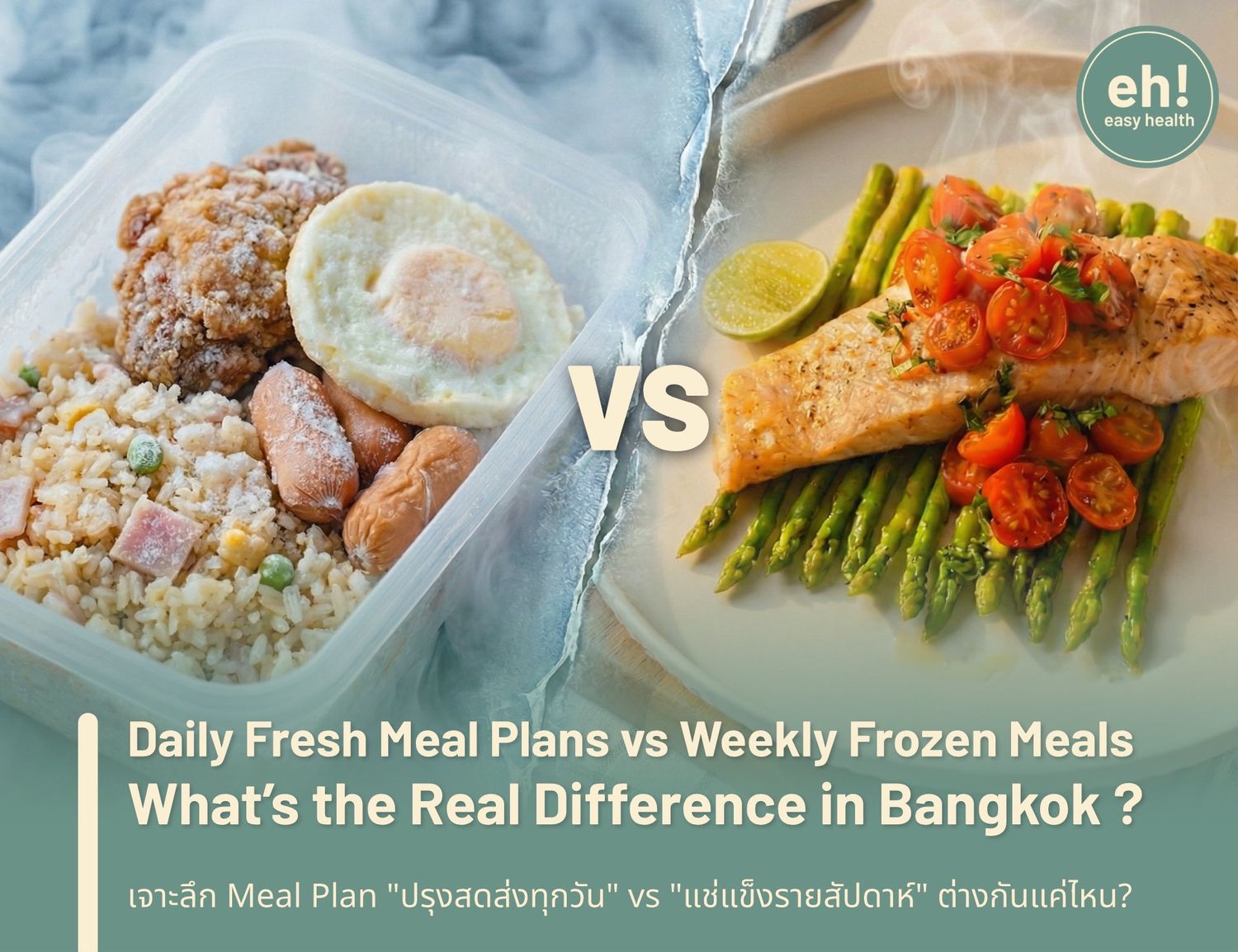
Daily Fresh Meal Plans vs Weekly Frozen Meals: What’s the Real Difference in Bangkok?
In Bangkok’s crowded food delivery market, healthy meal services typically follow one of two approaches:
Weekly Frozen Meals, delivered in bulk and stored for reheating across the week
Daily Fresh Meal Plans, cooked and delivered the same day for immediate consumption
The question is not whether frozen food works, but whether it fits your lifestyle, goals, and consistency. Easy Health explains how fresh and frozen meal plans compare in real terms, helping you decide which type of healthy food delivery in Bangkok is actually worth committing to.
Weekly Frozen Meal Plans: How They Work in Practice
This approach is widely used by meal prep companies because it reduces delivery frequency and keeps logistics costs lower.
How it works: Meals are prepared in large batches once or twice per week, rapidly chilled or frozen, and delivered together in a single shipment. Customers store meals in the fridge or freezer and reheat them as needed.
Day-to-day experience: By the fourth or fifth day, meals are typically consumed several days after cooking, which can influence texture and overall freshness once reheated.
Pros: Fewer deliveries help keep costs lower, and frozen storage allows meals to be eaten flexibly over a longer period without strict timing.
The Cons:
Texture changes: Freezing disrupts the cellular structure of many vegetables. Once reheated, items like broccoli can lose firmness, while fresh components such as leafy greens cannot be included at all.
Moisture loss: Extended freezing can lead to dehydration, which often results in proteins like chicken becoming dry or rubbery after reheating.
Nutrient degradation: Although freezing helps preserve food short term, repeated reheating at higher temperatures may reduce levels of heat-sensitive vitamins, including vitamin C and certain B vitamins.
Daily Fresh Meal Plans: Cooked and Delivered the Same Day
This is the model used by Easy Health, built around the idea that healthy food should be eaten fresh, not reheated days later.
How it works: Cooking begins early each morning, with meals prepared, packed, and dispatched the same day for delivery across Bangkok and Pattaya.
Day-to-day experience: Meals arrive fresh, with vegetables retaining their texture, proteins remaining tender, and sauces tasting balanced rather than muted by reheating.
The Pros:
Better taste and texture: Same-day preparation allows vegetables to stay crisp and proteins to retain moisture, without the softness that often comes from freezing and reheating.
Minimal processing: Because meals are intended to be eaten the day they are delivered, there is no need for preservatives, stabilisers, or excess sodium to extend shelf life.
Greater menu flexibility: Fresh delivery makes it possible to include ingredients such as leafy greens, avocado, and fish that do not hold up well to freezing.
The Cons: Daily delivery required: Meals are delivered each day, which means being available to receive them. Delivery timing can be managed through the Easy Health App, but it does require a bit more coordination than weekly drop-offs.
Daily Fresh vs Weekly Frozen: Key Differences at a Glance
Why Easy Health Uses Daily Fresh Delivery
Logistically, daily delivery is more demanding and costly than weekly drop-offs. It requires tighter scheduling, more coordination, and less margin for error. So the question is fair: why choose this model?
The answer comes down to consistency. People do not fail because they lack discipline. They stop because the food stops being enjoyable. When meals feel dry, repetitive, or overly processed, motivation drops quickly and old habits take over.
Freshly prepared meals change that experience. When food arrives with proper texture, balanced flavours, and real variety, eating well feels normal rather than restrictive. That is what allows people to stay consistent long enough to see results.
At Easy Health, the goal is not just to deliver meals with a calorie number attached. It is to support a way of eating that people can realistically maintain as part of everyday life.
FAQ: Daily Fresh vs Weekly Frozen Meals
Q1: Can Easy Health meals be frozen if I cannot eat them the same day?
Yes. While meals are designed to be eaten fresh, cooked dishes such as curries or stews can be frozen if needed. For best quality, items like salads, wraps, and dishes with fresh greens are recommended within 24 hours, as freezing affects texture.
Q2: Does daily delivery mean I have to be home every day?
No. Delivery timing can be managed through the Easy Health App, and meals can be dropped at condo reception desks or office lobbies where permitted. Most customers do not need to be present at the time of delivery.
Q3: Are daily fresh meals more expensive than frozen plans?
Not necessarily. Pricing remains competitive because operations are managed in-house rather than outsourced. In practice, daily fresh meals often provide better value in terms of ingredient quality, freshness, and overall eating experience rather than storage life alone.
Taste the Difference. Download the Easy Health App.
Fresh meals make eating well easier to maintain. Choose food that arrives ready to enjoy each day, without relying on freezer storage or heavy reheating.
Subscribe to a Daily Fresh Plan:
Android: Download via Google Play Store
References
Healthline. (2024). Fresh vs. Frozen Fruit and Vegetables — Which Are Healthier? Retrieved from https://www.healthline.com/nutrition/fresh-vs-frozen-fruit-and-vegetables
Harvard Health Publishing. (2024). Microwaving food: Nutrient loss. Retrieved from https://www.health.harvard.edu/staying-healthy/microwave-cooking-and-nutrition
FDA. (2024). Food Safety and Delivery Services. Retrieved from https://www.fda.gov/food/buy-store-serve-safe-food/food-safety-food-delivery-services