

What Is TDEE? How to Calculate Calories & Choose the Right Meal Plan
You want to lose weight, build muscle, or just feel healthier. You know you need to "watch what you eat," but how much is too much? And how little is too little?
Most people guess. They skip dinner, eat a tiny salad for lunch, and then binge on the weekend because they are starving. This cycle happens because they don't know their "Magic Number."
That number is your TDEE (Total Daily Energy Expenditure).
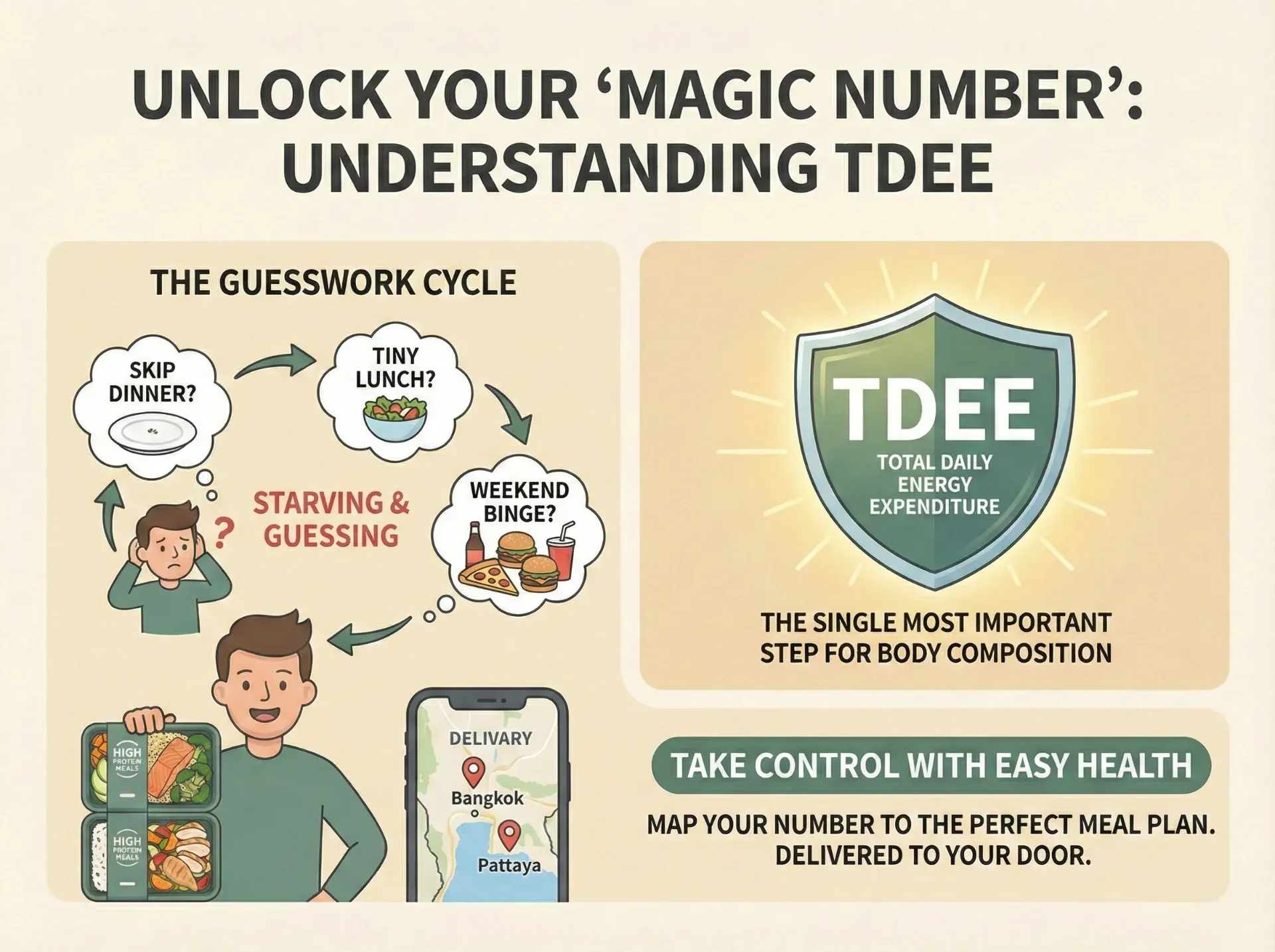
Understanding your TDEE is the single most important step in taking control of your body composition. Today, Easy Health explains the science simply and helps you map your number to the perfect Meal Plan delivered right to your door in Bangkok or Pattaya.
Part 1: What is TDEE? (The Science Made Simple)
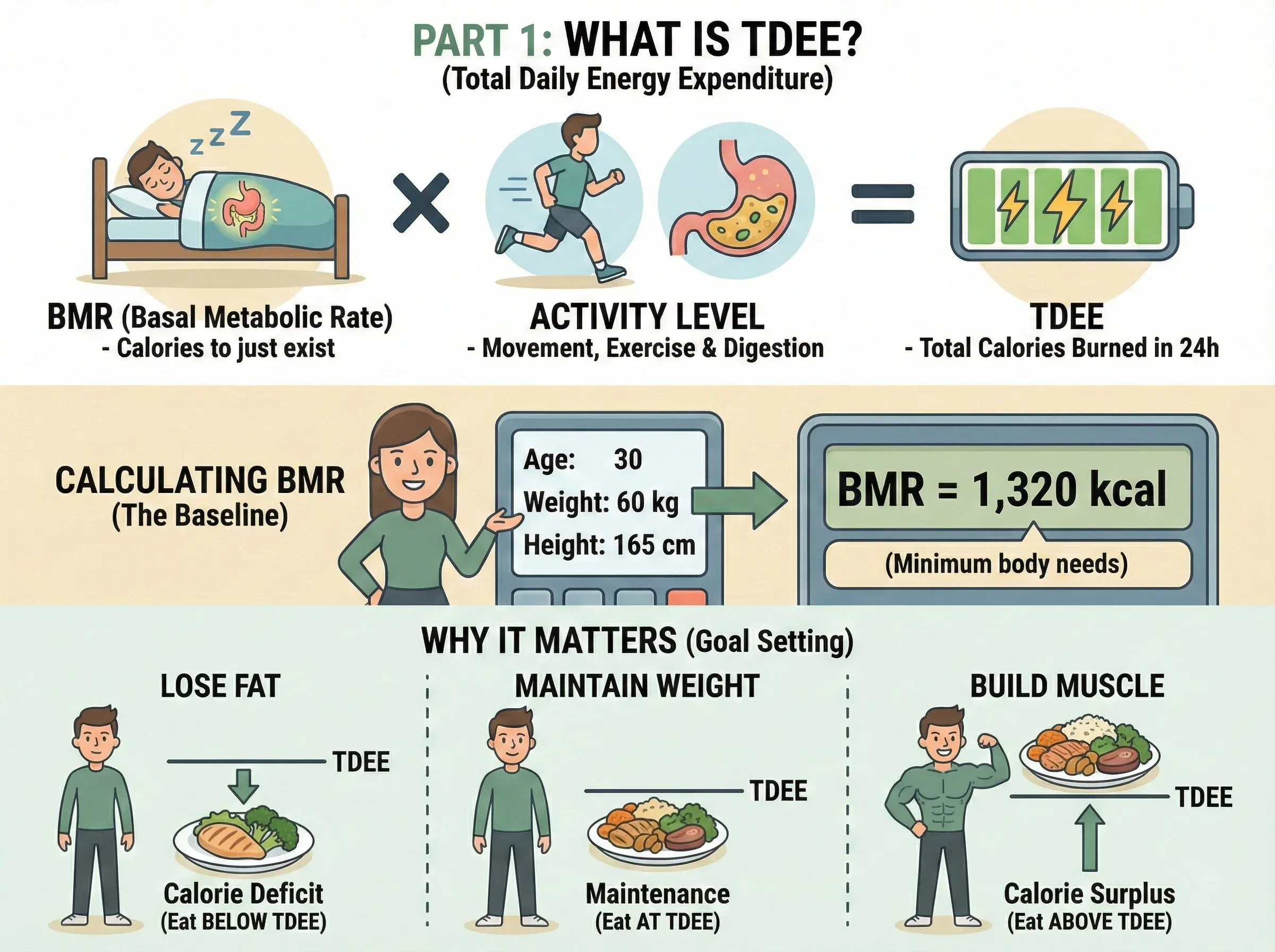
TDEE stands for Total Daily Energy Expenditure. It represents the total number of calories your body burns in a 24-hour period.
It is calculated by combining two factors:
BMR (Basal Metabolic Rate): The calories you burn just by existing (breathing, circulating blood, organ function) if you stayed in bed all day.
Activity Level: The calories burned through movement, exercise, and digestion (Thermic Effect of Food).
Formula: TDEE = BMR x Activity Multiplier
But How Do I Find My BMR? (Calculating BMR)
Before multiplying by activity, you need your baseline BMR. The most accurate formula to do this yourself is the Mifflin-St Jeor Equation:
Men: (10 x weight in kg) + (6.25 x height in cm) - (5 x age in years) + 5
Women: (10 x weight in kg) + (6.25 x height in cm) - (5 x age in years) - 161
Example: A 30-year-old woman, 60 kg, 165 cm tall.
BMR = (10x60) + (6.25x165) - (5x30) - 161 = 1,320 kcal (This is the minimum your body needs).
Why does this matter?
To Lose Fat: You must eat below your TDEE (Calorie Deficit).
To Maintain Weight: You must eat at your TDEE (Maintenance).
To Build Muscle: You must eat above your TDEE (Calorie Surplus).
Part 2: How to Calculate Your TDEE?
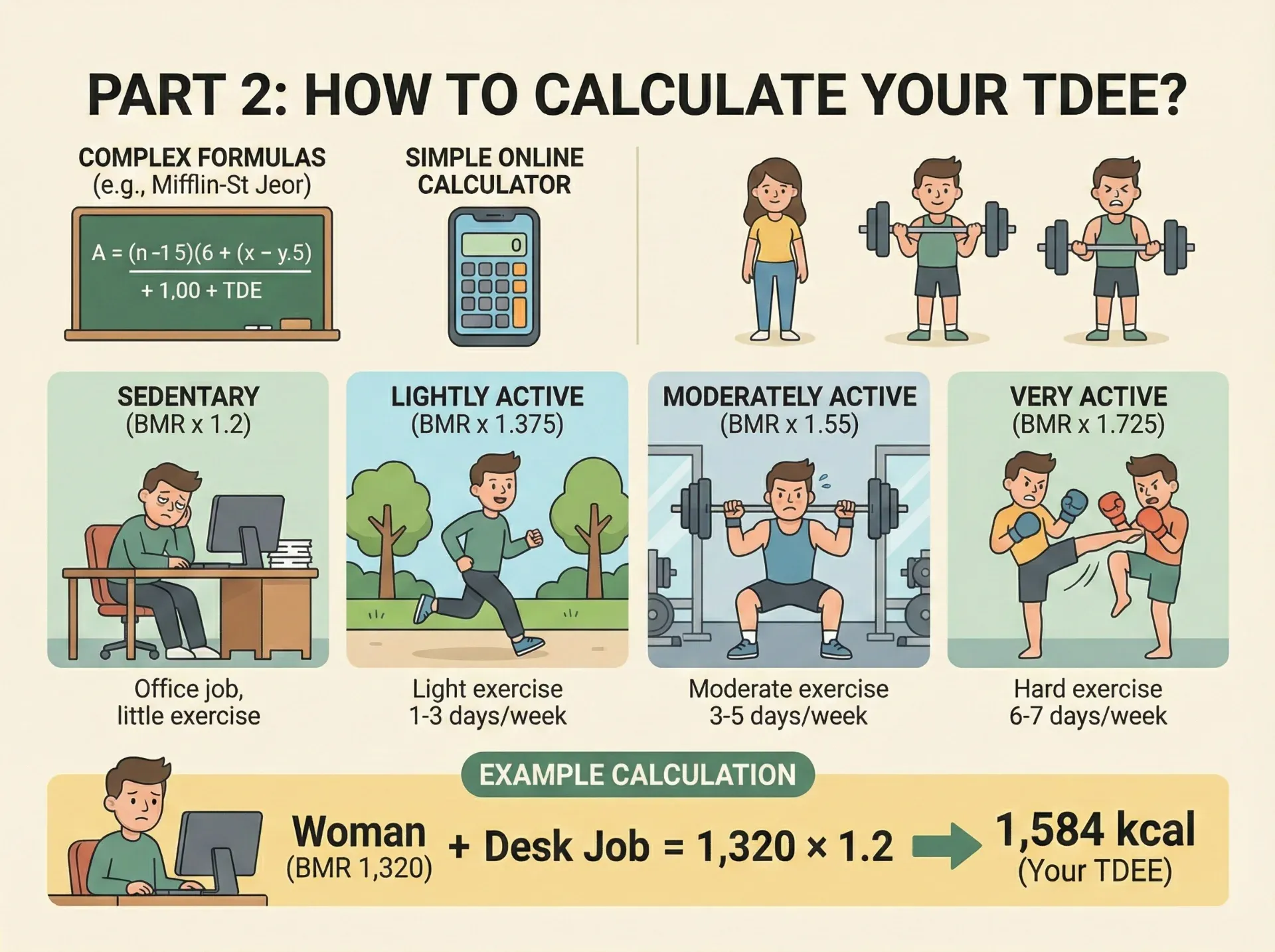
You can use complex formulas like Mifflin-St Jeor, or use a simple online TDEE Calculator. But to estimate it quickly right now, use these general multipliers based on your lifestyle in Bangkok:
Sedentary (Office job, little exercise):
BMR x 1.2
Lightly Active (Light exercise 1-3 days/week):
BMR x 1.375
Moderately Active (Moderate exercise 3-5 days/week):
BMR x 1.55
Very Active (Hard exercise 6-7 days/week):
BMR x 1.725
Example Cont.: The same woman (BMR 1,320) works a desk job (Sedentary).
Her TDEE = 1,320 x 1.2 = 1,584 kcal.
Part 3: Matching Your TDEE to the Right "Easy Health Plan"
Once you know your number, stop worrying about cooking and weighing food. We have designed our Meal Plans to fit specific TDEE ranges perfectly.
Scenario A: "I Want to Lose Weight Fast" (The Deficit)
Your Goal: Eat 300-500 kcal below your TDEE.
If your TDEE is ~1,500 - 1,800 kcal: You need to eat around 1,000 - 1,200 kcal.
Choose: The Lean Plan (800-1,000 kcal/day).
Why: It creates a safe, effective deficit while ensuring high protein intake to protect your muscle mass.
Scenario B: "I Want to Stay Healthy & Maintain" (The Balance)
Your Goal: Eat at or slightly below your TDEE.
If your TDEE is ~1,600 - 2,000 kcal: You need a plan that keeps you full without excess energy.
hoose: The Balance Plan (1,400-1,600 kcal/day).
Why: Perfect for the average active urbanite. It provides enough fuel for work and light play without causing weight gain.
Scenario C: "I Want to Build Muscle / Tone Up" (The Fuel)
Your Goal: Eat at your TDEE or a slight surplus, with high protein.
If your TDEE is ~2,000 - 2,400 kcal: You need serious fuel to recover from workouts.
Choose: The Active Plan (1,800-2,000 kcal/day).
Why: Packed with extra protein and complex carbs to refill glycogen stores after the gym.
Scenario D: "I Am an Athlete / Bulking" (The Surplus)
Your Goal: Eat above your TDEE significantly.
If your TDEE is > 2,500 kcal:
Choose: The Athlete-Bulk Plan (2,400-2,600 kcal/day).
Why: Clean, high-volume food to support intense training and mass gain without the "dirty bulk" belly fat.
Why "Guessing" Doesn't Work in Bangkok
You might think, "I'll just buy street food and eat half."
The problem is Hidden Calories.
A plate of Pad Thai can range from 500 to 1,200 kcal depending on the oil and sugar used.
A standard Iced Latte has ~300 kcal.
With Easy Health Meal Plans, there is no guessing.
Precision: We cook to exact recipes. 1,000 kcal means 1,000 kcal.
Nutrient Density: We prioritize nutrients, not just calories. You get more vitamins and minerals per calorie than street food.
Calculate, Choose, and Conquer with the App
Don't let the math stress you out.
Use a free online calculator to find your TDEE.
Open the Easy Health App.
Select the Meal Plan that matches your number.
Sit back and let us deliver your results daily.
Start your science-based nutrition journey today:
Android: Download via Google Play Store
References
Mayo Clinic. (2024). Calorie Calculator: How many calories do you need? Retrieved from https://www.mayoclinic.org/healthy-lifestyle/weight-loss/in-depth/calorie-calculator/itt-20402304
Harvard Health Publishing. (2024). Calorie counting made easy. Retrieved from https://www.health.harvard.edu/staying-healthy/calorie-counting-made-easy
National Academy of Sports Medicine (NASM). (2024). Resting Metabolic Rate: How to Calculate and Improve Yours. Retrieved from https://blog.nasm.org/nutrition/resting-metabolic-rate-how-to-calculate-and-improve-yours