
How to Count Calories Without Quitting: The No-App, No-Scale Guide
"Just count your calories." You have probably heard it a thousand times. It sounds simple until you actually try it. You spend 20 minutes searching for "Pad Kra Pao" in a tracking app, find five wildly different results, guess the portion size, forget to log your iced coffee, and quit by day three. You conclude that calorie counting simply does not work for your lifestyle.
Here is the truth: Calorie counting works. It is the most scientifically validated approach to weight management. The problem is that traditional guides overcomplicate it. They assume you have the time to weigh every single gram of chicken breast on a kitchen scale.
This guide is different. It is designed for busy professionals living in Bangkok. We will teach you how to estimate portions with your hands, do simple mental math, and use strategic shortcuts so you can hit your fitness goals without downloading a single app.
The 60-Second Crash Course on Calories
Before you track anything, you need to know what you are tracking. A calorie is simply a unit of energy. Your body needs this energy to function—from walking to thinking and breathing. Every food you eat provides energy based on its macronutrient (macro) breakdown:
Understanding Macronutrients
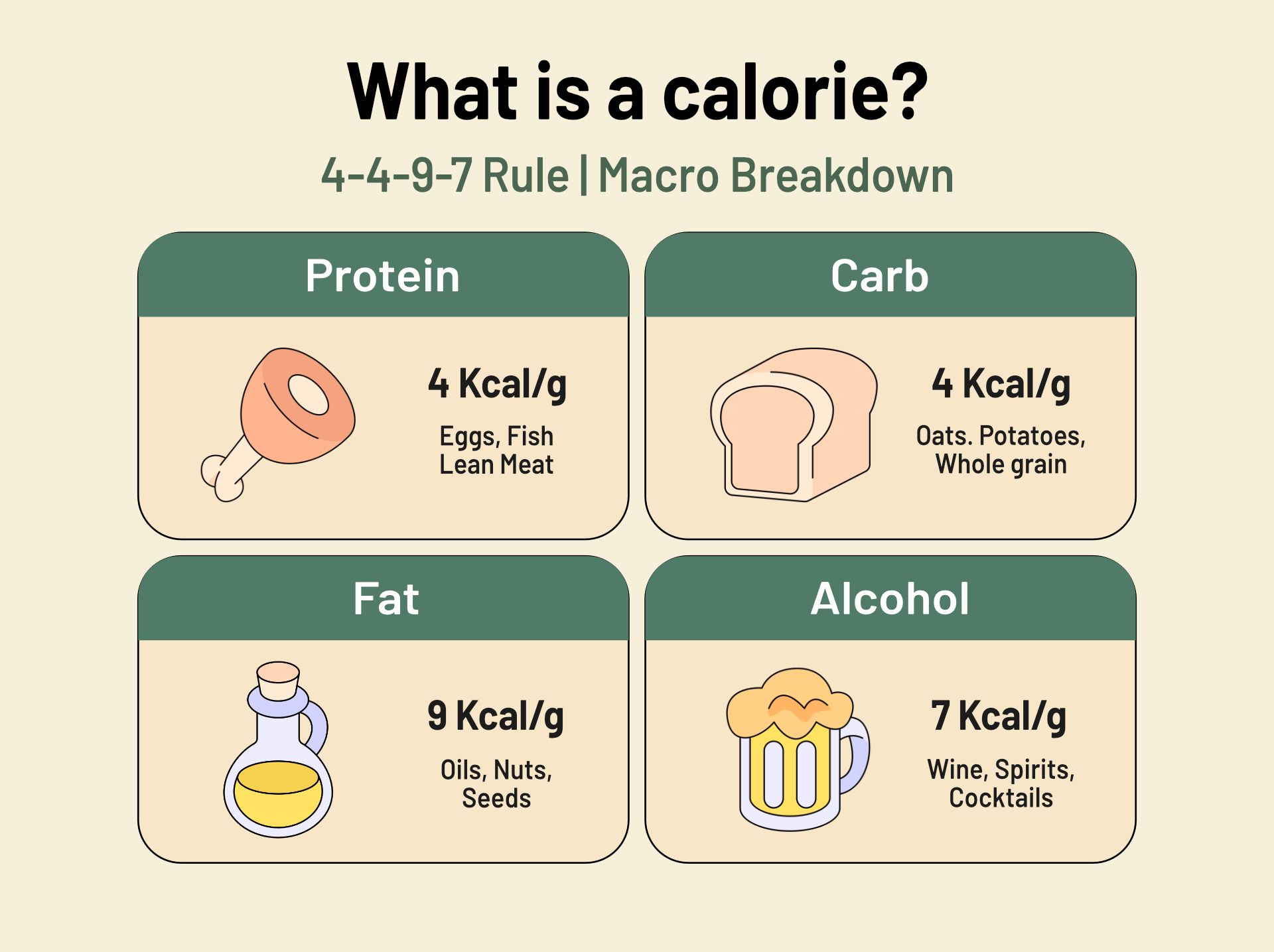
Protein: 4 calories per gram
Carbohydrates: 4 calories per gram
Fats: 9 calories per gram
Notice that fats contain more than double the calories of protein or carbs. This is why a single tablespoon of cooking oil adds roughly 120 calories to your meal, even though it takes up zero space on your plate.
3 Steps to Effortless Calorie Control
Forget the food scale. Here is how you can manage your intake, even if you are eating at a street food stall or a busy food court:
Step 1: Find Your Daily Energy Quota (TDEE)
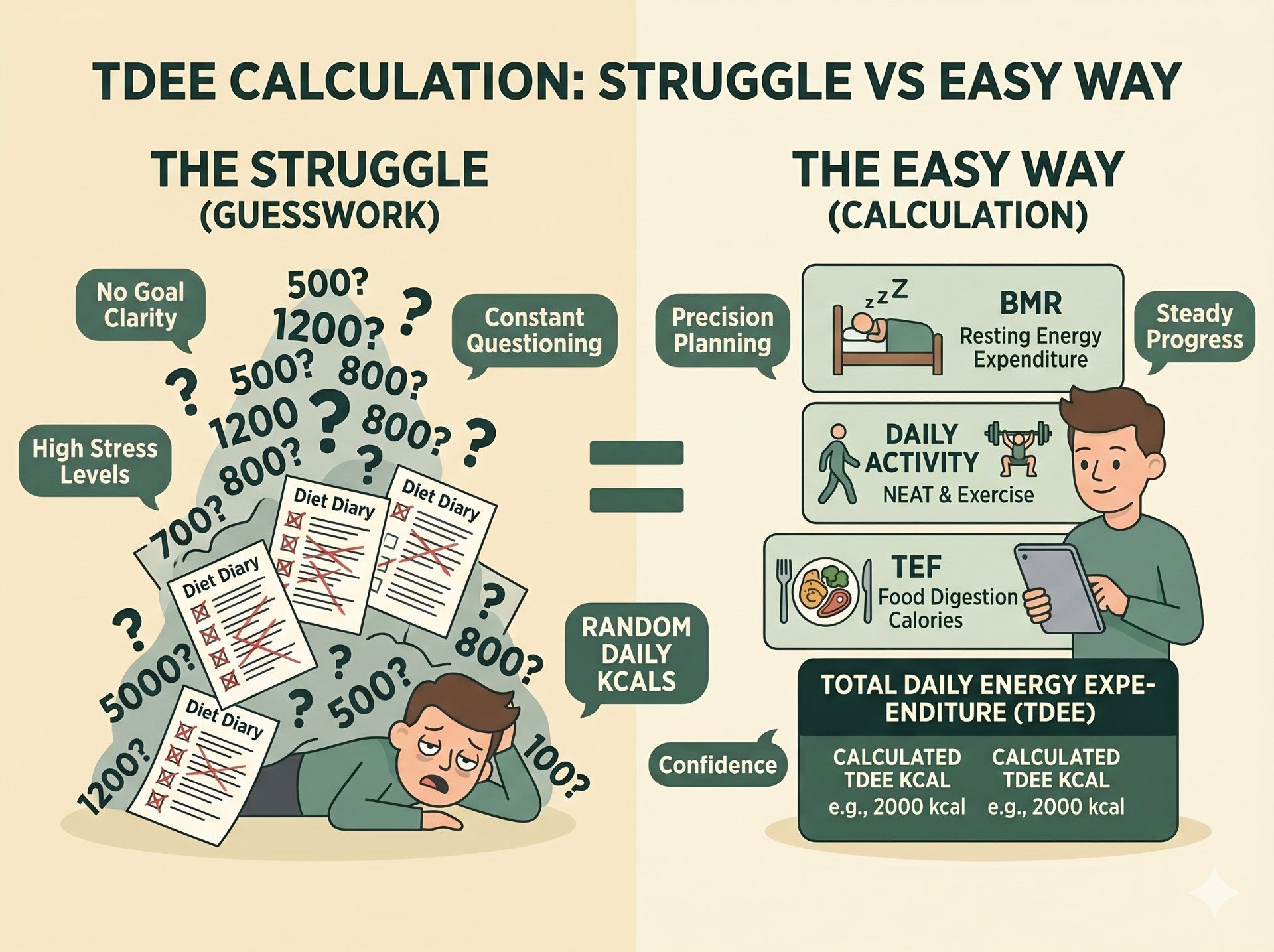
Your body burns a specific number of calories every day just by existing and moving. This is your Total Daily Energy Expenditure (TDEE).
The Weight Loss Sweet Spot: To lose weight sustainably (about 0.5 kg per week), you need to eat 500 calories less than your TDEE.
Crucial Warning: Never drop below 1,200 calories (for women) or 1,500 calories (for men) without medical supervision. Extreme deficits trigger stress hormones, slow down your metabolism, and force your body to burn muscle instead of fat.
Step 2: The Hand-Portion Method
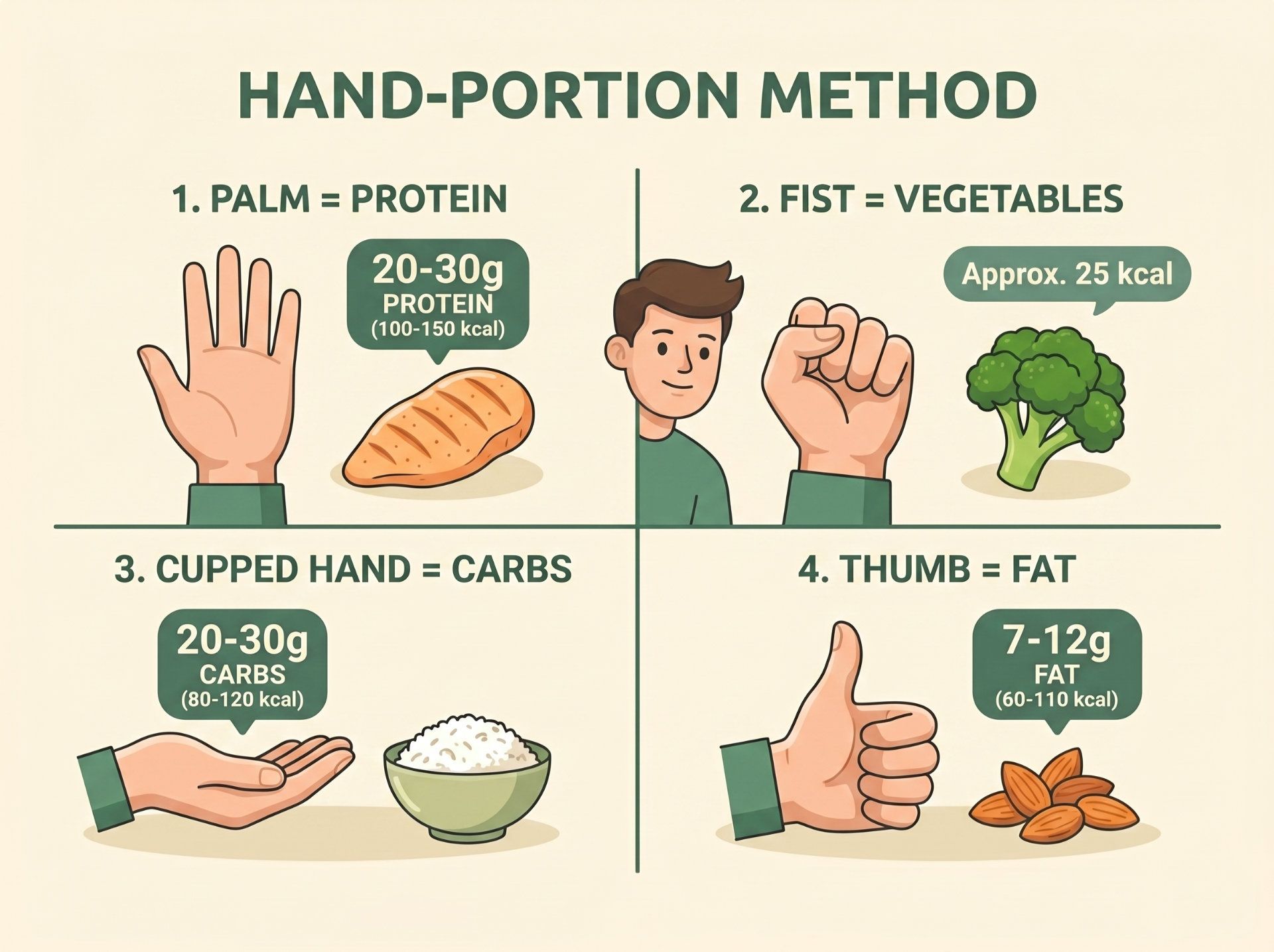
Your hand is proportional to your body, making it the ultimate portable measuring tool. Use this guide to build your plate:
1 Palm of Protein (thickness and size of your palm): Roughly 20-30g of protein (100-150 calories). Examples: Chicken breast, fish, or 3 eggs.
1 Fist of Vegetables: Very low calorie (around 25 calories) but high in volume and fiber to keep you full.
1 Cupped Hand of Carbs: Roughly 20-30g of carbs (80-120 calories). Examples: Rice, noodles, or sweet potatoes.
1 Thumb of Fat: Roughly 7-12g of fat (60-110 calories). Examples: Cooking oil, butter, or nuts.
Quick Start: Women should start with one of each per meal. Men should start with two of each.
Step 3: Prioritize Protein (The 80/20 Rule)
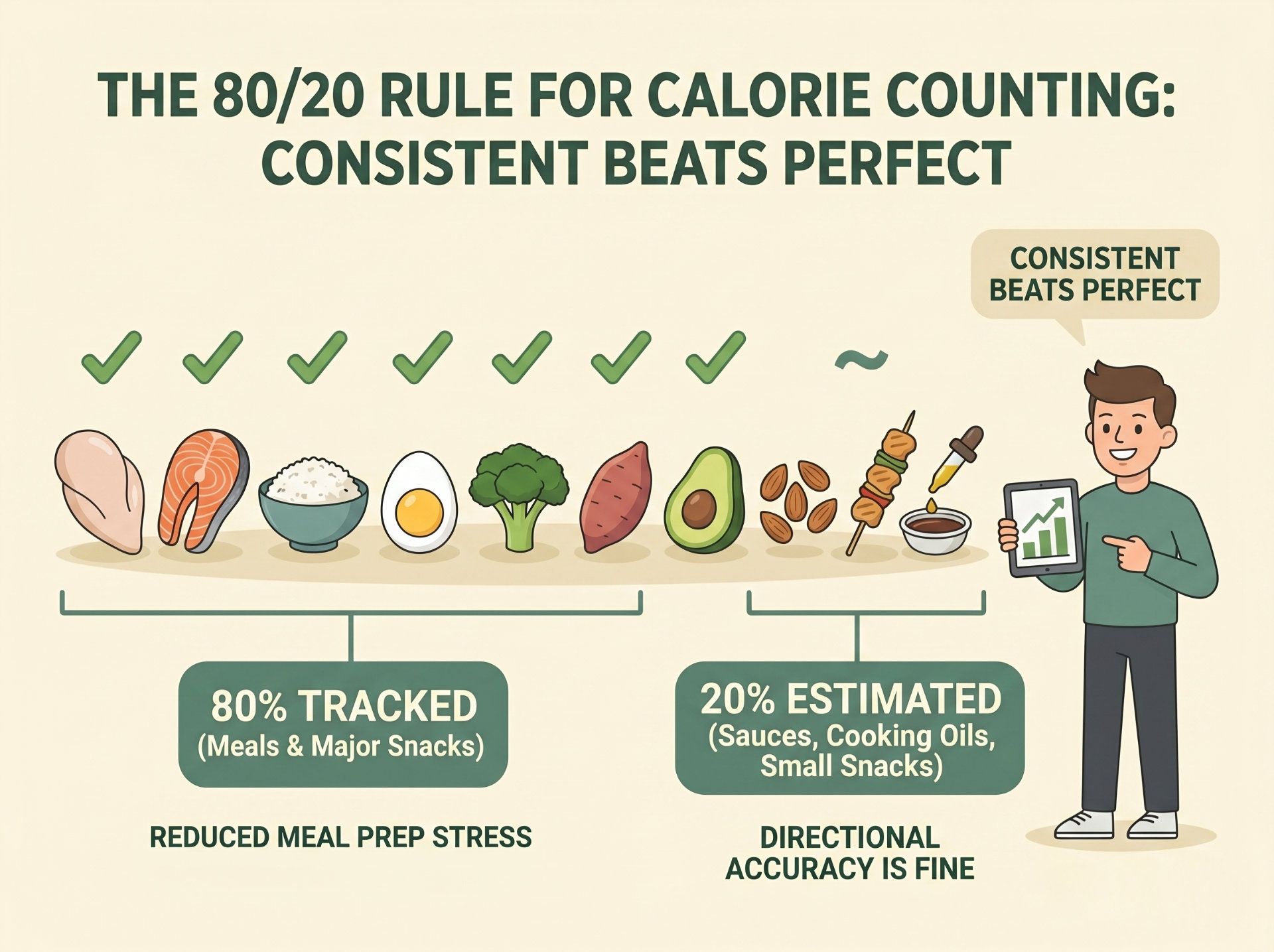
You do not need to be 100% precise. Studies show that tracking with 80% accuracy still yields massive results. The absolute most important rule is to hit your protein target first (aim for 1.2 - 1.6g per kg of body weight). Protein protects your muscle mass during weight loss and keeps you full, making it much easier to stick to your calorie limit.
Navigating the Bangkok Food Scene: Mistakes to Avoid
Bangkok's incredible food culture comes with hidden challenges. Avoid these common traps to ensure your progress does not stall:
1. Drinking Your Calories
A standard Thai Iced Tea can pack up to 400 calories. A bubble tea easily hits 700 calories. If you meticulously track your food but ignore your drinks, you will not see results. Rule of thumb: Count every beverage that is not water, black coffee, or plain tea.
2. The Invisible Cooking Oil Trap
Standard Thai street food uses 3-5 tablespoons of oil per dish. That is 360-600 hidden calories. When eating out, you cannot control this. Always mentally add a 100-200 calorie buffer when logging restaurant meals to account for hidden oils and sugary sauces.
3. The "All or Nothing" Mindset
You had three beers and a late-night pizza. You went 1,500 calories over your limit. Do not panic and quit. One bad day will not make you gain fat permanently, but quitting entirely will. Log it, accept it, and return to your plan the next day. Consistency beats perfection.
The Ultimate Shortcut: Put Your Nutrition on Autopilot
If doing mental math and avoiding hidden street food oils sounds like too much work for your busy schedule, there is a completely frictionless solution.
At Easy Health, we do the exact calorie counting for you. Every single meal we deliver has its precise calories, protein, carbohydrates, and fats printed clearly on the packaging.
Zero Guesswork: The numbers on the box are the exact numbers in your food.
No Hidden Traps: We use zero MSG, zero added sugar, and strictly control our cooking oils.
Fits Every Goal: From light 400-calorie lunches to high-protein muscle-building combos.
You can order individual meals or opt for our 5-Day Meal Plans. We will calculate your macros and deliver perfectly portioned, delicious food straight to your desk or condo.
7 Common Calorie Counting Mistakes (And How to Avoid Them)
Mistake 1: Not Counting Drinks
A Thai iced tea (cha yen) contains 200-400 calories. A bubble tea can reach 500-700 calories. A "healthy" fruit smoothie from a commercial shop often has 300-500 calories. Many people carefully track their food and completely ignore their drinks, then wonder why the scale is not moving.
Fix: Treat every drink that is not water, plain tea, or black coffee as a food item. Count it.
Mistake 2: Ignoring Cooking Oil
One tablespoon of oil is approximately 120 calories. Thai cooking can easily use 3-5 tablespoons per dish, adding 360-600 invisible calories. When eating out, you have no control over this. When cooking at home, measure your oil.
Fix: Add 100-200 calories to any restaurant Thai dish as a buffer for cooking oil and hidden sugar in sauces.
Mistake 3: Being Too Aggressive
Cutting calories too drastically (below 1,200 for women, 1,500 for men) triggers metabolic adaptation. Your body reduces energy expenditure, increases hunger hormones (ghrelin), and decreases satiety hormones (leptin). Research by Rosenbaum and Leibel (2010) in the International Journal of Obesity (DOI: 10.1038/ijo.2010.184) demonstrated that this metabolic compensation makes extreme deficits counterproductive for long-term fat loss.
Fix: Start with a modest 300-500 calorie deficit. Sustainable progress beats dramatic crash-and-rebound cycles every time.
Mistake 4: Counting Calories but Ignoring Protein
A 1,500-calorie day of white rice, bread, and fruit juice is very different from a 1,500-calorie day with adequate protein. The first will leave you hungry, lose muscle, and slow your metabolism. The second will preserve muscle, maintain metabolism, and keep you full.
Fix: Set your protein target first (minimum 1.2g per kg of body weight), then allocate remaining calories to carbs and fat.
Mistake 5: Weekend Amnesia
Many people track meticulously Monday through Friday and then "take weekends off." Two untracked days of overeating can easily erase a week's deficit. If you cut 500 calories per day for 5 days (2,500 total deficit), one Saturday brunch plus drinks can add 2,000-3,000 surplus calories back.
Fix: Track weekends too, even if roughly. Or budget a higher calorie allowance on weekends and reduce slightly on weekdays.
Mistake 6: Trusting "Health Food" Labels
Many products marketed as "healthy," "low fat," "organic," or "sugar free" are not low calorie. A gluten-free muffin has roughly the same calories as a regular muffin. An organic cookie is still a cookie. "Low fat" products often compensate by adding sugar, making the calorie content identical or even higher.
Fix: Read the nutrition label, not the marketing claim. Look at total calories, protein, and sugar per serving.
Mistake 7: Giving Up After One Bad Day
You ate a whole pizza. You had three beers and late-night som tum. You exceeded your calorie target by 1,500. So you quit. This is the most common and most destructive mistake. One day of overeating adds perhaps 200g of actual fat. One week of quitting adds far more.
Fix: Log the bad day honestly and move on. Consistency over weeks and months matters infinitely more than perfection on any single day.
FAQ
How do I start counting calories as a beginner?
Start by calculating your TDEE (Total Daily Energy Expenditure) using the formula in this guide. Then set a calorie target based on your goal: subtract 300-500 calories for weight loss, eat at maintenance to hold steady, or add 200-300 for muscle gain. For the first two weeks, simply estimate your meals using the hand-portion method. One palm of protein is 100-150 calories, one cupped hand of carbs is 80-120 calories, one thumb of fat is 60-110 calories. You do not need an app or a food scale to start. Awareness alone changes behaviour.
How many calories should I eat per day to lose weight?
The specific number depends on your TDEE. For most women, a weight loss target falls between 1,200-1,600 calories per day. For most men, between 1,500-2,000 calories per day. A safe rate of loss is 0.5 kg (1 pound) per week, which requires a daily deficit of approximately 500 calories below your TDEE. Never go below 1,200 (women) or 1,500 (men) without medical supervision, as very low calorie diets increase stress hormones and promote muscle loss.
Can I count calories without using an app?
Yes. The hand-portion method is a research-validated approach that requires no technology. Your palm measures protein, your fist measures vegetables, your cupped hand measures carbs, and your thumb measures fat. Alternatively, eating pre-portioned meals with printed nutritional information (like Easy Health meals) eliminates the need for any counting at all. The key is building awareness of portion sizes and calorie density, not achieving laboratory-grade precision.
What is more important, calories or macros?
For weight management, total calories are the primary factor. You cannot out-macro a calorie surplus. However, macronutrient composition significantly affects how you feel, how much muscle you retain, and how sustainable your diet is. A calorie-controlled diet with adequate protein (1.2-1.6g per kg body weight) will produce far better results than the same calories from mostly carbs and fat. For beginners, focus on total calories and protein first. Add carb and fat targets later once you are comfortable.
Why am I not losing weight even though I am counting calories?
The most common reasons are underestimating calorie intake (forgetting drinks, cooking oil, sauces, and small snacks), overestimating calories burned during exercise, inconsistent tracking (skipping weekends or social meals), and metabolic adaptation from too-aggressive calorie cuts. A 2014 study in the New England Journal of Medicine found that people routinely underestimate calorie intake by 30-50%. The fix: track everything for one full week, including all drinks, cooking oils, and sauces. The hidden calories usually reveal themselves quickly.
Is calorie counting safe for everyone?
Calorie counting is generally safe for healthy adults. However, it is not recommended for people with a history of eating disorders, as the focus on numbers can trigger restrictive or obsessive behaviours. If tracking calories creates anxiety, guilt, or disordered eating patterns, stop immediately and consult a healthcare professional. For most people, calorie counting is a temporary educational tool. Once you develop an intuitive understanding of portions and food choices, you can transition to mindful eating without tracking every number.
Ready to Make Calorie Counting Simple?
Every meal on the Easy Health menu shows exact calories, protein, carbs, and fat. No guessing. No estimating. No searching through databases for approximate numbers. Just real food with real data, cooked fresh daily in Bangkok.
Over 160 menu items with full macro transparency
Zero MSG, zero added sugar, zero preservatives
Cooked fresh daily and delivered across Bangkok
Exact nutritional information printed on every package
Download the Easy Health app:
References
Mifflin, M. D., et al. (1990). A new predictive equation for resting energy expenditure in healthy individuals. The American Journal of Clinical Nutrition, 51(2), 241-247. https://doi.org/10.1093/ajcn/51.2.241
Leidy, H. J., et al. (2015). The role of protein in weight loss and maintenance. The American Journal of Clinical Nutrition, 101(6), 1320S-1329S. https://doi.org/10.3945/ajcn.114.084038
Tomiyama, A. J., et al. (2010). Low calorie dieting increases cortisol. Psychosomatic Medicine, 72(4), 357-364. https://doi.org/10.1097/PSY.0b013e3181d9523c
Rosenbaum, M., & Leibel, R. L. (2010). Adaptive thermogenesis in humans. International Journal of Obesity, 34(S1), S47-S55. https://doi.org/10.1038/ijo.2010.184
Hall, K. D., et al. (2011). Quantification of the effect of energy imbalance on bodyweight. The Lancet, 378(9793), 826-837. https://doi.org/10.1016/S0140-6736(11)60812-X
Westerterp-Plantenga, M. S., et al. (2012). Dietary protein, its role in satiety, energetics, weight loss and health. British Journal of Nutrition, 108(S2), S52-S63. https://doi.org/10.1017/S0007114512002589
Harvard T.H. Chan School of Public Health. The Nutrition Source: Calories. https://nutritionsource.hsph.harvard.edu/healthy-weight/
World Health Organization. (2020). Healthy Diet. Fact Sheet. https://www.who.int/news-room/fact-sheets/detail/healthy-diet
Thai Ministry of Public Health, Department of Health. Nutrition Guidelines for Thai Adults. https://nutrition2.anamai.moph.go.th