

Office Weight Loss: Mastering a Calorie Deficit with a Meal Plan (No Starvation Required)
“Sit all day, move only to the restroom.” This reflects the routine of many office workers in Bangkok. The result is gradual weight gain and the familiar development of an “office belly” over time. Many people attempt to address this through restrictive eating, such as skipping dinner or relying only on fruit, which often leads to overeating later and a repeated cycle of weight fluctuation.
Office weight loss does not require extreme restriction or intensive gym routines when time is limited. The core principle is establishing a calorie deficit through consistent, structured eating choices.
Easy Health explains how this principle can be applied in a practical way for office-based lifestyles, along with simple dietary strategies that can be implemented during the workday.
What Is a Calorie Deficit? (Explained in One Minute)
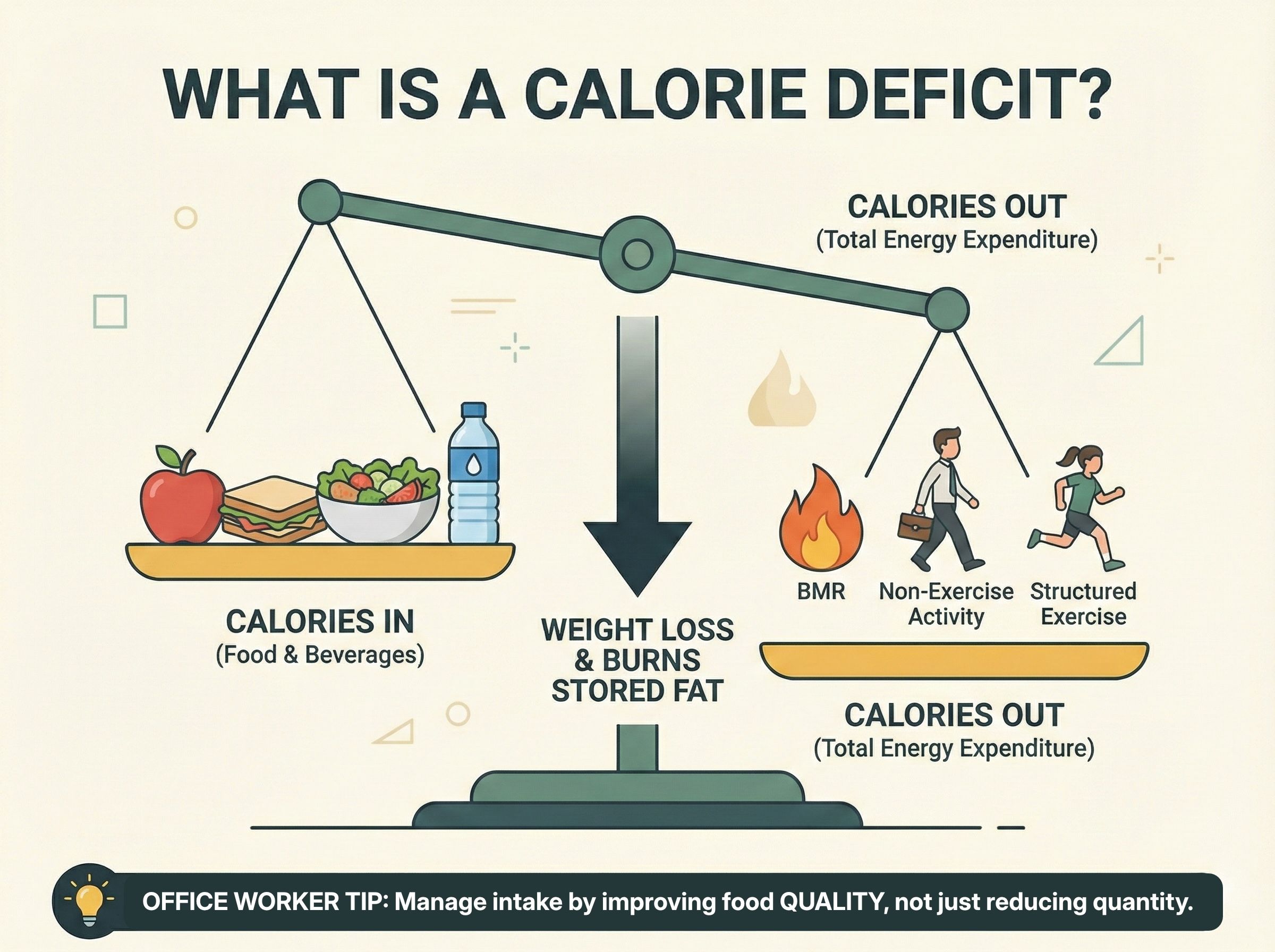
A calorie deficit occurs when the body consumes fewer calories than it expends over the same period. When this occurs, the body draws on stored fat for energy, which supports weight loss, as defined by the following balance:
Calories In: Total energy intake from all food and beverages consumed.
Calories Out: Total energy expenditure, including basal metabolic rate, daily non-exercise activity, and structured physical activity.
For office workers with lower daily energy expenditure due to prolonged sitting, the focus is on managing calorie intake strategically, not by reducing food quantity, but by improving food quality.
3 Traps That Undermine a Calorie Deficit for Office Workers
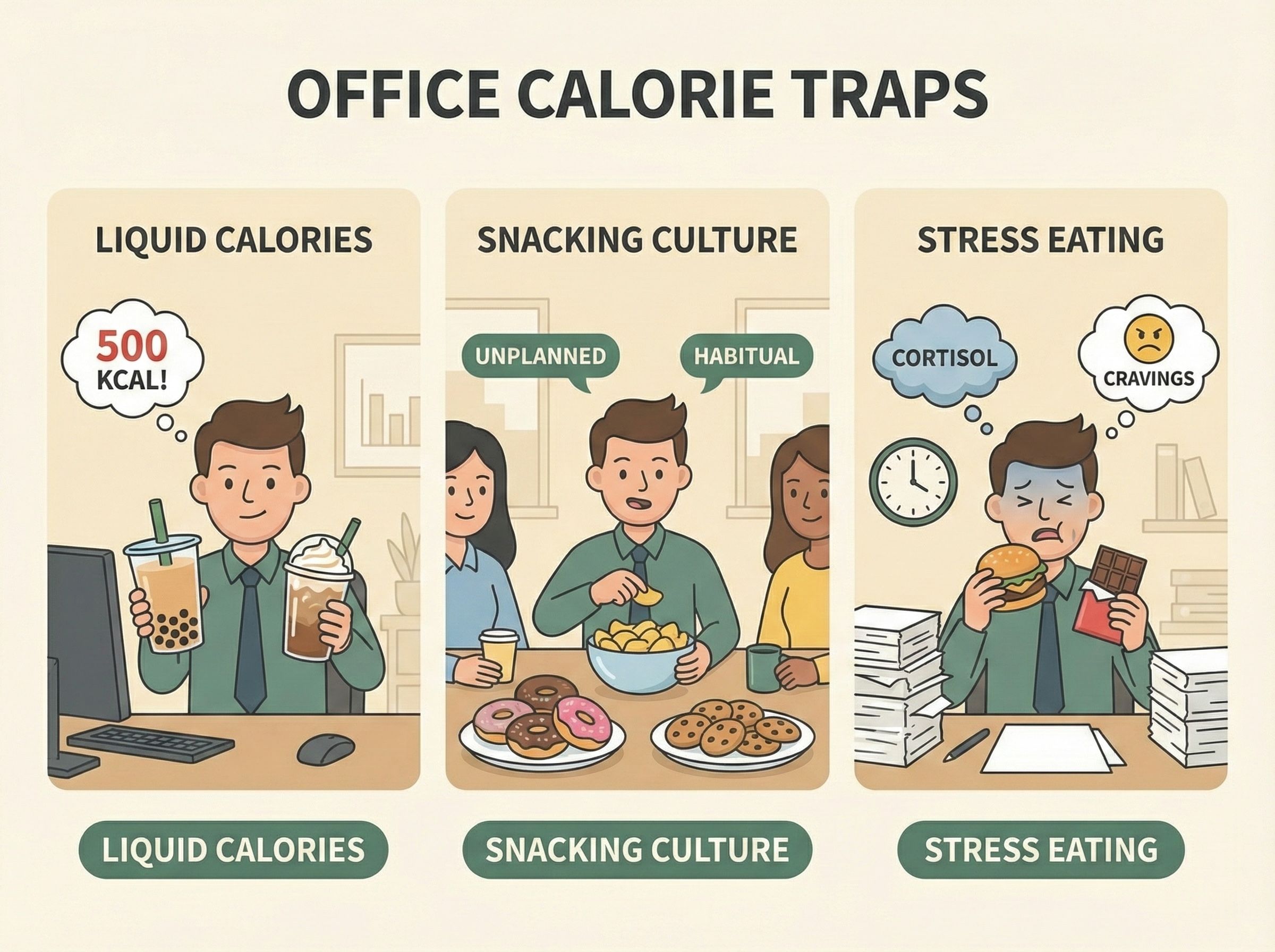
Liquid Calories: Beverages such as bubble tea, sweetened iced coffee, and soda can contain 300 to 500 calories per serving, comparable to a full meal.
Snacking Culture: Shared office snacks and treats brought by colleagues often lead to unplanned, habitual eating that quickly accumulates calories.
Stress Eating: Work-related stress increases cortisol levels, which can heighten cravings for sugary and high-fat comfort foods.
How to Maintain a Calorie Deficit at Your Desk Without Hunger
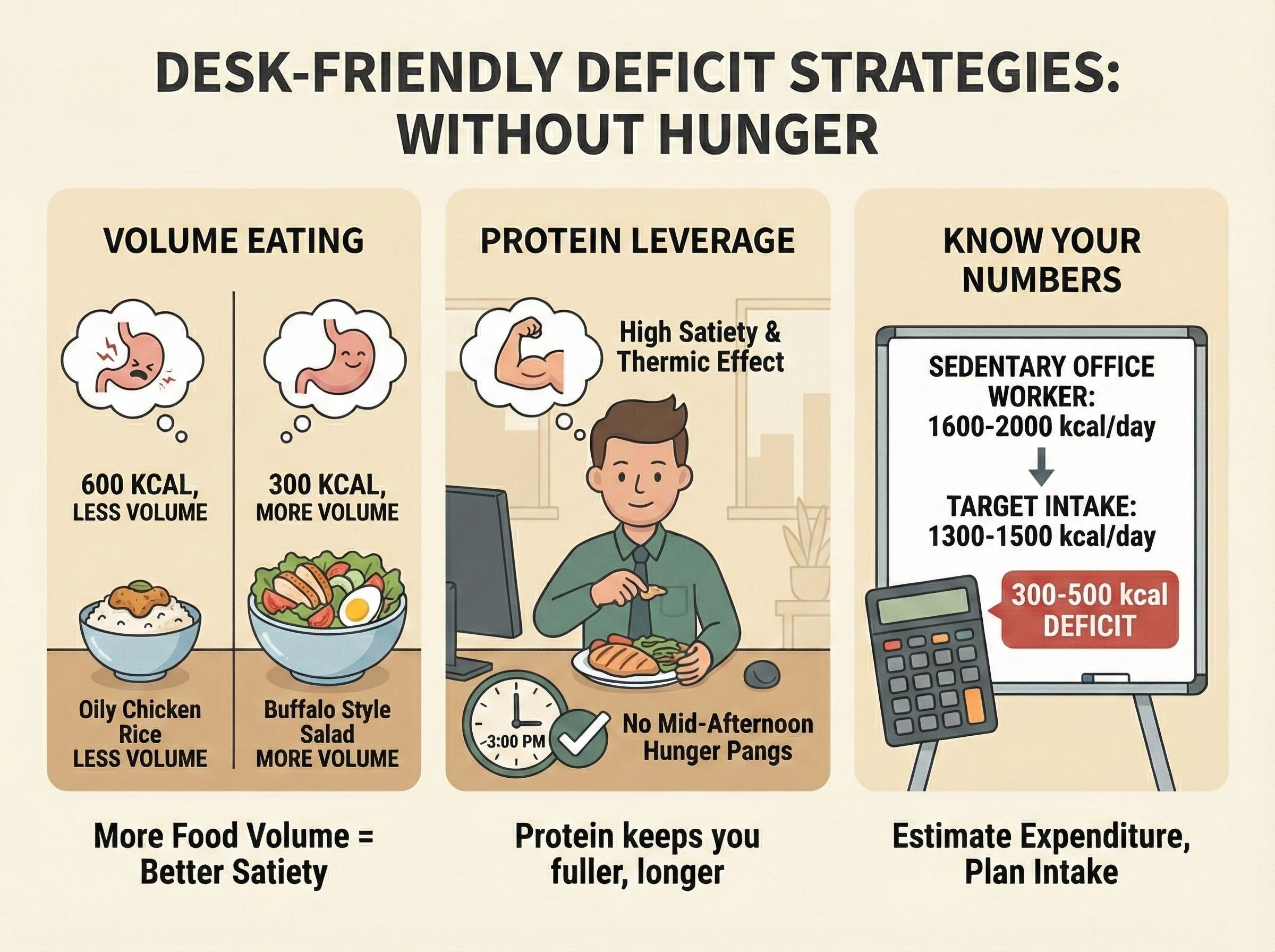
1. Volume Eating (Eat More, Fewer Calories)
Rather than choosing a small portion of oily chicken rice at approximately 600 calories that still leaves you hungry, opt for a larger salad or soup. This provides greater food volume for satiety at roughly half the calorie intake.
Easy Health Recommend: Buffalo Style Salad, a generous portion of fresh greens combined with chicken and boiled egg that promotes fullness while remaining calorie conscious.
2. Protein Leverage
Protein supports satiety more effectively than carbohydrates or fats and has a higher thermic effect, which contributes to increased energy expenditure during digestion. Meeting protein targets at lunch can help reduce mid-afternoon hunger.
Easy Health Recommend: Free-range chicken fitness meal with lean grilled chicken, high in protein and low in fat, suitable for weight management.
3. Know Your Numbers
Estimate your total daily energy expenditure. For a sedentary office worker, this is often in the range of 1,600 to 2,000 calories per day. The goal is to maintain an intake approximately 300 to 500 calories below this level, such as targeting 1,300 to 1,500 calories per day.
Sample One-Day Meal Plan: Satisfying and Calorie Controlled (Approximately 1,400 kcal)
Breakfast (300 kcal): Black coffee or Americano paired with plain Greek yogurt from Easy Health, offering a high-protein and filling start to the day.
Lunch (450 kcal): Warm Yum Wrap with tom yum chicken, where spiced flavors help manage cravings and the format remains convenient for office consumption.
Afternoon Snack (150 kcal): One green apple or approximately ten almonds.
Dinner (500 kcal): Sombrero Bowl in a Mexican style, combining protein from beef with healthy fats from avocado, with riceberry substituted for white rice.
FAQ: Top Office Weight Loss Questions
Q1: Do I count calories per bite?
A: Precise tracking is not required long term. Using an app initially can help build awareness of portion sizes, after which most people can estimate intake with reasonable accuracy.
Q2: Will eating less lead to brain fog at work?
A: Cognitive fatigue is more often related to inadequate nutrient intake than calorie reduction itself. Maintaining a calorie deficit with nutrient-dense whole foods can support more stable blood sugar levels and consistent mental performance.
Q3: Can I maintain a calorie deficit without time to cook?
A: Yes. Easy Health’s meal delivery service provides pre-planned, nutritionally calculated dishes that support a calorie-controlled approach, allowing you to follow the plan through simple ordering and scheduled meals.
Download the Easy Health App for accurate calorie tracking and simple meal planning!
The Easy Health App removes the need to estimate calories from street food by providing structured, calorie-controlled meal options.
Key Features That Support a Calorie Deficit:
Real-Time Nutrition: Each menu item displays clear calorie, protein, carbohydrate, and fat information based on the actual recipe.
Goal Setting: Select the “Weight Loss” goal to filter menus that fit within your calorie targets.
Plan Ahead: Schedule meals for the week in advance to reduce daily decision-making that often leads to less healthy choices.
Download the app for free and begin managing your body composition through a science-based approach:
Android: Download via Google Play Store
References
Mayo Clinic. (2024). Counting calories: Get back to weight-loss basics. Retrieved from https://www.mayoclinic.org/healthy-lifestyle/weight-loss/in-depth/calories/art-20048065
Harvard Health Publishing. (2024). Calories burned in 30 minutes for people of three different weights. Retrieved from https://www.health.harvard.edu/diet-and-weight-loss/calories-burned-in-30-minutes-for-people-of-three-different-weights
Department of Health, Ministry of Public Health Thailand. (2024). Fighting Belly Fat Guidelines for Working Adults. Retrieved from https://nutrition2.anamai.moph.go.th