

Carbs Are Not the Enemy: The Smart Carb Guide
Every few years a new diet makes carbs the villain. Low-carb, keto, no-rice, no-noodles. And yet the countries with the leanest, longest-living populations tend to eat plenty of them. The problem was never carbs. It was always which carbs, how much, and when. Understanding smart carbs changes how you eat without turning every meal into a negotiation with yourself.
Why Carbs Got Such a Bad Reputation

The backlash against carbs is not entirely without logic. Refined carbohydrates, think white bread, sugary drinks, instant noodles, and most packaged snacks, cause a rapid spike in blood sugar. Your body responds by releasing insulin to bring that sugar back down, often overshooting and leaving you hungrier than before you ate. This cycle of spike and crash is what drives overeating.
The mistake was generalizing this pattern to all carbohydrates. Blaming carbs for weight gain because of white sugar is like blaming fat for heart disease because of trans fats. The category contains both the problem food and its opposite.
Research published in Cell Metabolism found that the quality and source of carbohydrates matters far more than the quantity for metabolic health outcomes. Populations eating high-carb diets based on whole grains, legumes, and vegetables consistently show better insulin sensitivity and lower rates of obesity than populations eating the same total carbs from refined sources.
Smart Carbs vs Empty Carbs: The Difference That Actually Matters
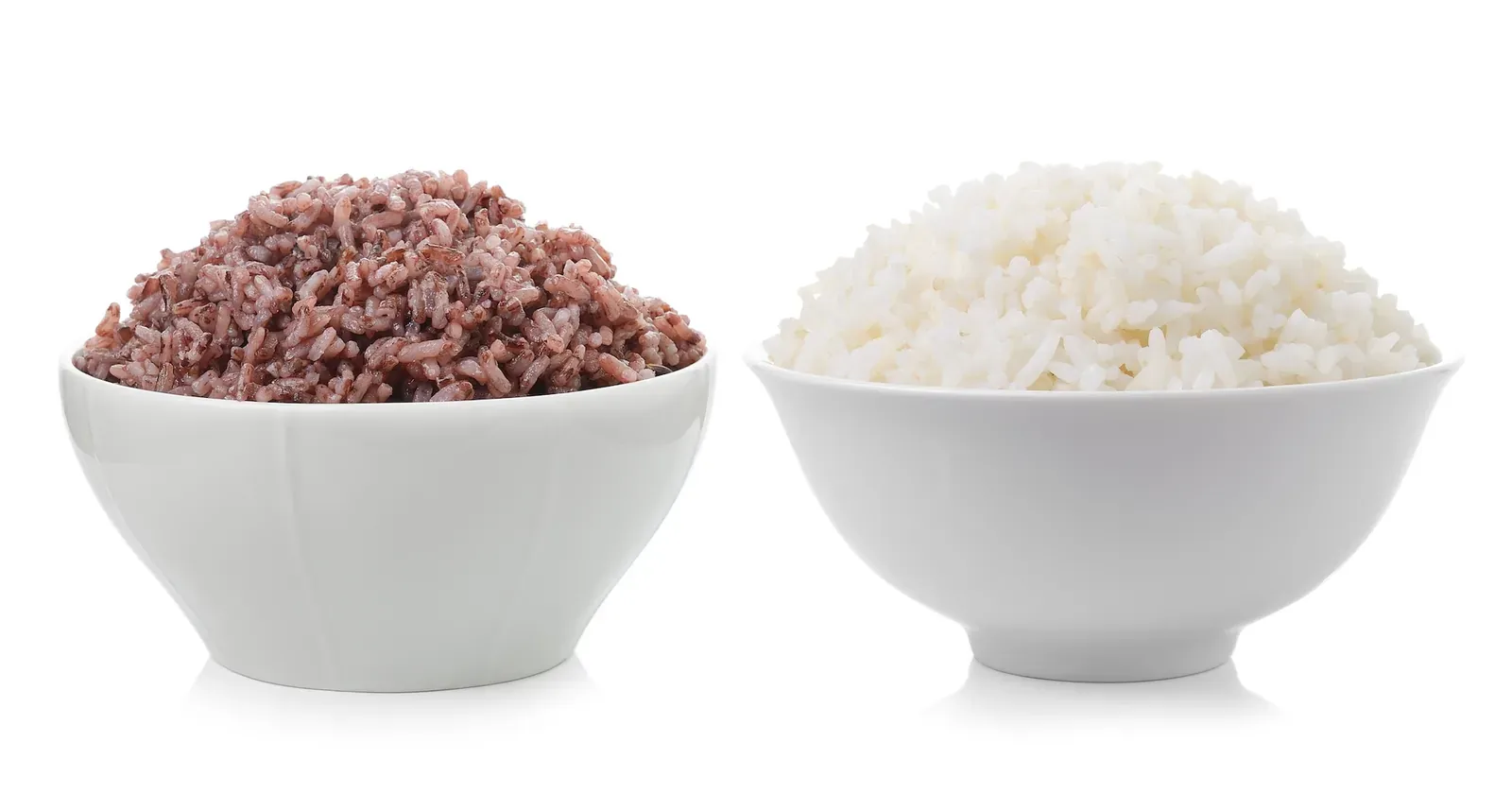
Smart carbs are carbohydrate sources that come packaged with fiber, vitamins, minerals, and sometimes protein. They digest slowly, keep blood sugar stable, and keep you full longer. Empty carbs are stripped of these nutrients during processing, leaving fast-digesting starch or sugar with little else.
The practical distinction:
Smart carbs: brown rice, oats, sweet potato, quinoa, legumes, fruit, whole grain bread
Empty carbs: white sugar, white bread, instant noodles, most packaged snacks, sugary drinks, white rice eaten in large portions
The fiber content is the key variable. Fiber slows digestion and blunts the blood sugar spike. A sweet potato and a bag of chips have roughly similar carb counts per 100 grams, but the sweet potato's fiber and micronutrient content makes it metabolically very different.
One note on white rice: it sits in a gray area. Plain white rice is low in fiber but it is also a staple of Thai food culture and not inherently harmful in moderate portions, especially when eaten as part of a meal with protein, vegetables, and fat that naturally slow its digestion. The problem is portion size and what surrounds it.
How Many Carbs Do You Actually Need Per Day

Carbohydrate needs vary by activity level, body size, and goals. The general ranges supported by current research:
Sedentary adults: 100 to 150 grams per day is a reasonable baseline
Active people training 3 to 5 days per week: 150 to 250 grams per day supports performance and recovery
Athletes or those doing daily high-intensity training: 250 to 400 grams or more per day, spread around training windows
To put those numbers in context: a standard plate of khao man gai contains roughly 60 to 70 grams of carbs. A bowl of pad thai is around 55 to 65 grams. Most Thai meals eaten without tracking put active adults in the right range naturally, but with a carb quality problem since the dominant sources are refined white rice and starchy noodles.
The goal is not to cut carbs. It is to upgrade them: more fiber-rich sources, smaller portions of white rice, and timing them around when your body actually needs them.
Carbs and Thai Food: What to Keep, What to Adjust
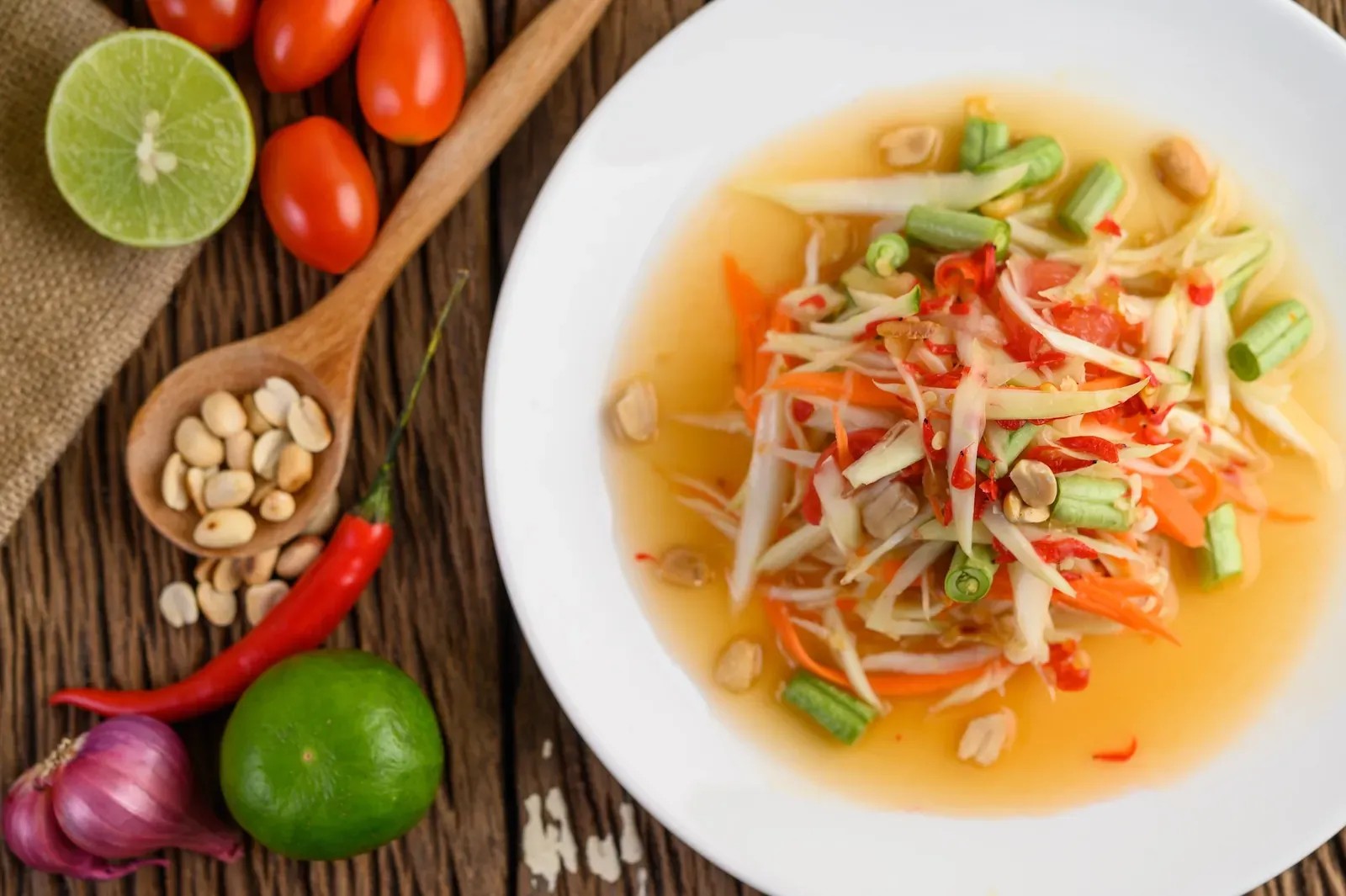
Thai food is genuinely one of the better cuisines in the world for balanced eating, but carb quality is its main weakness. Here is a realistic view:
Keep as-is:
Papaya salad (som tum): low carb, high fiber, high micronutrients
Tom yum and tom kha soups: minimal starch, rich in vegetables and protein
Stir-fried vegetables with protein: the carbs are negligible
Fresh spring rolls with vegetables: lower refined starch than fried versions
Adjust portion or frequency:
White rice: no need to eliminate, but a palm-sized portion (around 100 to 150g cooked) is plenty for a meal
Pad thai and rice noodle dishes: high in refined starch, choose less frequently or pair with extra protein to slow digestion
Khao man gai and khao moo daeng: the rice portion is is large by default, consider halving it and adding a side
Mango sticky rice: best treated as an occasional dessert, not a daily lunch add-on
The easy upgrade that works in Bangkok: swap one white rice meal per day for a higher-protein option with vegetables, or order from a menu that shows you the exact carb breakdown so you are not guessing.
Looking at the Easy Health menu, the Sweet Potato Falafel and the Quinoa Maki are both examples of smart-carb meals where the carbohydrate source is high-fiber and comes with a strong protein component. The full macro breakdown is visible before you order, which removes the guesswork entirely.
When to Eat Carbs for the Best Results

Carb timing is genuinely useful, though it is secondary to total carb quality. The body uses carbs most efficiently at two points in the day:
Before training: Eating 30 to 60 grams of carbs 1 to 2 hours before a workout gives your muscles glycogen (stored energy) to perform. Good options are oats, a banana, or brown rice. This is not the time to eat refined sugar, which gives a spike followed by an energy crash mid-session.
After training: The 30 to 90 minute window after exercise is when muscles are most receptive to replenishing glycogen. A combination of carbs and protein here speeds recovery. The ratio that research supports is roughly 3 to 1 or 4 to 1 carbs to protein for endurance training, closer to 1 to 1 for strength training.
For people who are not training, the most practical advice is to eat the majority of your carbs earlier in the day when you are most active and your body is most insulin-sensitive. Eating a large bowl of rice at 9pm while sitting on the couch is a different metabolic situation than eating the same bowl at noon before a full afternoon of activity.
The Easy Health Active Plan is structured around this principle: meals are timed and proportioned to support activity, with carb-heavier options available for lunch and post-workout windows.
Frequently Asked Questions
Do I need to cut carbs to lose weight?
No. Weight loss requires a calorie deficit, not carb elimination. Reducing refined carbs can help create that deficit naturally because high-fiber carbs are more filling per calorie, but you can lose weight eating carbs as long as total calories are appropriate. Many people find low-carb diets effective not because carbs are uniquely fattening, but because cutting them reduces overall calorie intake. The approach works, but it is not the only approach, and it is not necessary to go low-carb to get results.
Is it true that eating carbs at night makes you fat?
Not exactly. What matters more is total daily calorie intake than timing. That said, most people are least active in the evening, and insulin sensitivity is slightly lower later in the day, meaning the same carb portion is handled slightly less efficiently at night than at noon. Eating carbs at night is not a fat-gain guarantee, but if you are trying to optimise fat loss, shifting more of your carb intake toward midday and post-workout is a useful practical adjustment.
Is white rice bad for you?
White rice is low in fiber and has a higher glycemic index than brown rice, meaning it raises blood sugar faster. But it is not toxic, and it has been a dietary staple across Southeast and East Asia for centuries. The key variables are portion size and what you eat alongside it. A moderate portion of white rice with plenty of protein, fiber-rich vegetables, and healthy fat digests more slowly than a large portion eaten alone. If white rice is a cultural and practical staple for you, the smarter move is to control the portion rather than eliminate it.
What are the best carbs to eat before a workout in Bangkok's heat?
In Bangkok's climate, pre-workout digestion can be uncomfortable if you eat too much or too close to your session. Good options that are light enough to digest quickly but substantial enough to fuel performance include a banana (around 27 grams of carbs), oats with a small amount of fruit (around 40 grams), or a small portion of sweet potato. Avoid heavy rice-based meals within an hour of training. If training early morning before eating is more comfortable for you, that is also a valid approach for moderate-intensity sessions.
Is fruit a smart carb or should I limit it for fat loss?
Fruit is a smart carb. The fiber in whole fruit slows the digestion of its natural sugars, which is why eating an orange has a very different effect on blood sugar than drinking orange juice (where the fiber has been removed). Fruit also provides vitamins, antioxidants, and water content that support overall health. For most people, 2 to 3 servings of whole fruit per day is well within a fat-loss-friendly diet. The exception is if you are doing a strict low-carb approach, in which case lower-sugar fruits like berries are the smarter choice.
How is the glycemic index useful in practice?
The glycemic index (GI) ranks foods by how quickly they raise blood sugar on a scale from 0 to 100. High-GI foods (above 70) spike blood sugar fast; low-GI foods (below 55) raise it gradually. In practice, the most useful takeaway is to choose lower-GI carb sources most of the time and to combine any higher-GI foods with protein, fat, or fiber to blunt the spike. White rice (GI around 72) eaten with chicken, vegetables, and a source of fat behaves metabolically much more like a moderate-GI food than when eaten alone in a large portion.
Eat Smarter Carbs Without the Guesswork
Upgrading your carbs does not mean a complete overhaul of the way you eat. It means knowing which sources give you more nutritional value for the same calories, and having access to meals where that math has already been done for you.
The Easy Health menu labels the carbohydrate content of every item, including whether the carb source is high-fiber or refined. When you can see that the Oriental Quinoa has 37 grams of carbs from whole-food sources versus a standard food court lunch with 70 grams mostly from white rice, you can make a smarter call without giving anything up.
160+ menu items with full macro transparency including carbohydrate breakdown
Zero added sugar, zero MSG, zero artificial preservatives across all meals
High-fiber carb options across every meal category from breakfast through dinner
Fresh daily preparation, delivered across Bangkok, with branches in Bangkok and Pattaya
Browse the full menu at easyhealth.asia/menu.
Download the Easy Health app:
Easy Health on Google Play (Android)
Easy Health on App Store (iOS)
References
Ludwig DS, Hu FB, Tappy L, Brand-Miller J. (2018). Dietary carbohydrates: role of quality and quantity in chronic disease. BMJ, 361, k2340. https://doi.org/10.1136/bmj.k2340
Ebbeling CB, Feldman HA, Klein GL, et al. (2018). Effects of a low carbohydrate diet on energy expenditure during weight loss maintenance. BMJ, 363, k4583. https://doi.org/10.1136/bmj.k4583
Slavin JL. (2013). Fiber and prebiotics: mechanisms and health benefits. Nutrients, 5(4), 1417-1435. https://doi.org/10.3390/nu5041417
Jenkins DJ, Kendall CW, Augustin LS, et al. (2002). Glycemic index: overview of implications in health and disease. American Journal of Clinical Nutrition, 76(1), 266S-273S. https://doi.org/10.1093/ajcn/76.1.266S
Hawley JA, Burke LM. (1997). Effect of meal frequency and timing on physical performance. British Journal of Nutrition, 77(S1), S91-S103. https://doi.org/10.1079/BJN19970107
Reynolds A, Mann J, Cummings J, et al. (2019). Carbohydrate quality and human health: a series of systematic reviews and meta-analyses. The Lancet, 393(10170), 434-445. https://doi.org/10.1016/S0140-6736(18)31809-931809-9)