

Hyrox Recovery: How to Eat Protein So Your Muscles Repair Faster and You Are Ready for the Next Session
Hyrox is one of the fastest-growing fitness competitions in the world, and Bangkok's fitness scene has caught on fast. Between the 8 km of running and 8 functional workout stations (Sled Push, Sled Pull, Burpee Broad Jumps, Rowing, Farmers Carry, Sandbag Lunges, Wall Balls, and SkiErg), a single Hyrox race or training session pushes your muscles through extreme mechanical stress, metabolic fatigue, and micro-damage that takes days to fully repair.
But here is the part most athletes overlook: the session itself does not make you stronger. Recovery does. And the most critical factor in recovery is not foam rolling, ice baths, or sleep (though all help). It is protein. Specifically, how much you eat, when you eat it, and whether the quality is high enough to actually fuel the repair process.
This guide breaks down the science of muscle recovery after Hyrox training, explains exactly how much protein you need, when the timing window actually matters, and shows you real meals that deliver the numbers. No supplements required. Just real food with real macros.
What Hyrox Does to Your Muscles (And Why Recovery Nutrition Matters)

Hyrox is uniquely brutal because it combines endurance and functional strength in a way that damages muscle fibres on two fronts simultaneously.
The Endurance Component
The 8 km of running between stations creates repetitive impact stress. Each foot strike generates 2-3 times your body weight in force through your legs. Over 8,000 metres, that is tens of thousands of micro-impacts on your quads, calves, hamstrings, and hip flexors. This repetitive loading causes micro-tears in Type I (slow-twitch) muscle fibres.
The Strength Stations
The functional stations hit different:
Sled Push/Pull loads your quads, glutes, hamstrings, and posterior chain with extreme concentric and eccentric force. The sled does not have a deceleration phase like free weights, so your muscles absorb the full load continuously. This creates significant mechanical damage to Type II (fast-twitch) muscle fibres.
Wall Balls combine a deep squat with an overhead press in rapid succession. Your quads, glutes, shoulders, and triceps work under both stretch (eccentric) and contraction (concentric) stress, repeatedly, often to the point of failure. The eccentric phase of the squat is where the most muscle damage occurs.
Farmers Carry loads your grip, forearms, traps, and core with sustained isometric tension. This does not create the same fibre tearing as sled work, but it depletes local energy stores (glycogen and ATP) rapidly.
Burpee Broad Jumps push your entire body through explosive hip extension, chest-to-floor contact, and plyometric landing. The landing phase generates extreme eccentric stress on your quads and calves.
The Combined Effect
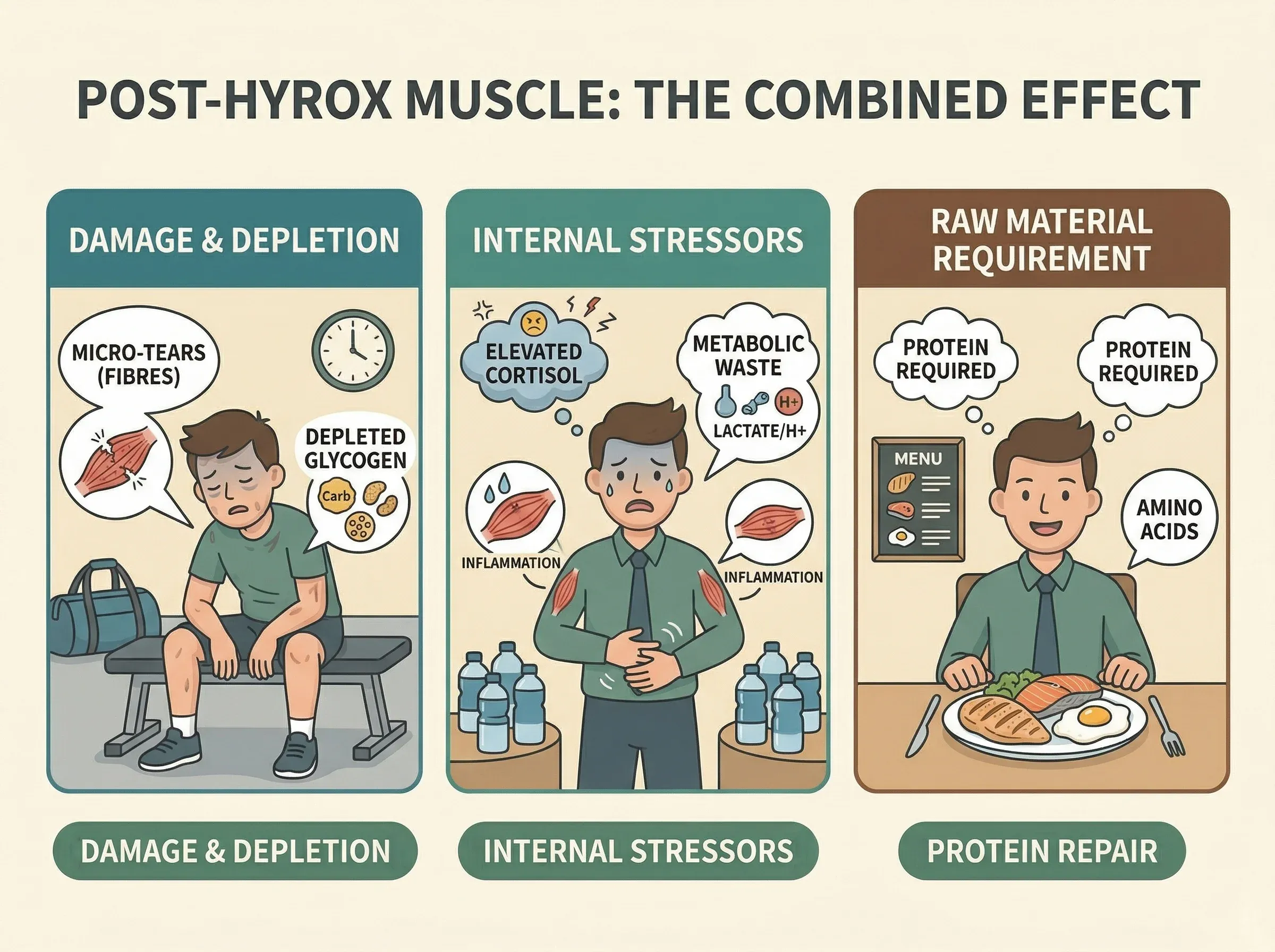
After a full Hyrox session, your muscles are dealing with:
Micro-tears across both slow-twitch and fast-twitch fibres
Depleted glycogen stores (the carbohydrate fuel stored in muscles)
Elevated cortisol (stress hormone that promotes muscle breakdown)
Inflammation markers that trigger the repair process
Accumulated metabolic waste (lactate, hydrogen ions)
Your body needs raw materials to fix all of this. The primary raw material is protein, specifically the amino acids that protein breaks down into during digestion.
How Much Protein Do You Need After Hyrox Training?
The science here is more nuanced than the "30g within 30 minutes" rule that most gyms still repeat.
The Immediate Post-Workout Window
A 2013 meta-analysis in the Journal of the International Society of Sports Nutrition (Schoenfeld et al.) found that total daily protein intake matters more than exact timing. However, there is still a benefit to consuming protein within 2 hours after intense exercise, because muscle protein synthesis (MPS) rates are elevated during this period.
The optimal post-workout dose: 0.3-0.5g of protein per kg of body weight. For a 70 kg athlete, that is 21-35g of protein. For an 80 kg athlete, 24-40g.
Total Daily Requirements for Hyrox Athletes
The demands of Hyrox are higher than standard gym training because of the combined endurance and strength components. Research from the International Society of Sports Nutrition (Jager et al., 2017) recommends:
General fitness: 1.4-1.6g protein per kg body weight per day
Strength and power athletes: 1.6-2.2g per kg per day
Hybrid athletes (endurance + strength): 1.6-2.4g per kg per day
Hyrox athletes fall into the hybrid category. For a 70 kg person, that means 112-168g of protein daily. For an 80 kg person, 128-192g.
Most people do not eat anywhere near this amount without intentional planning. The average Thai diet provides roughly 60-80g of protein per day, less than half of what a serious Hyrox athlete needs.
Protein Quality Matters
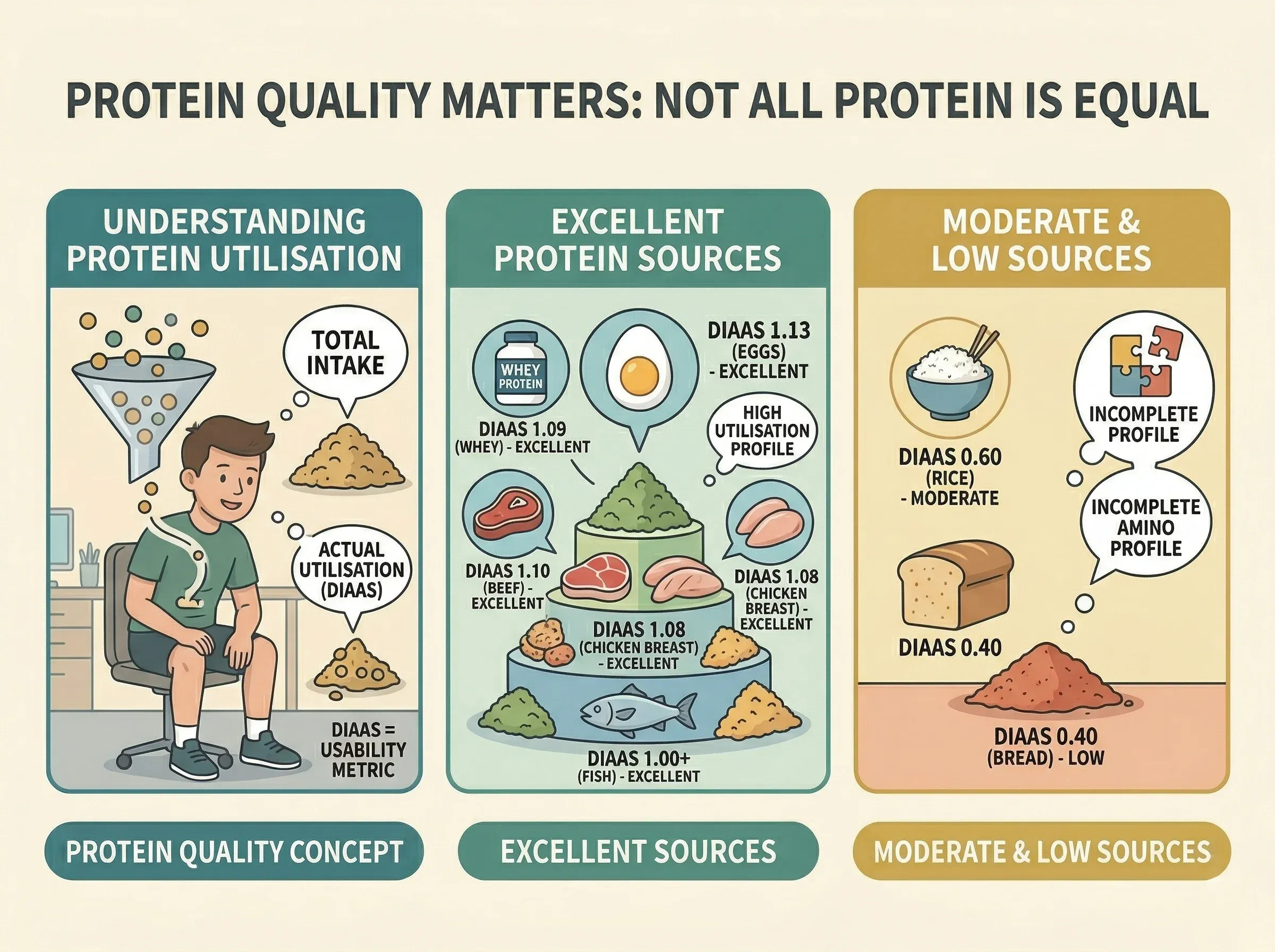
Not all protein is equal. The Digestible Indispensable Amino Acid Score (DIAAS) measures how well your body can actually use the protein from different sources:
Eggs: DIAAS 1.13 (excellent, over 100% utilisation)
Chicken breast: DIAAS 1.08 (excellent)
Beef: DIAAS 1.10 (excellent)
Fish: DIAAS 1.00+ (excellent)
Whey protein: DIAAS 1.09 (excellent)
Rice: DIAAS 0.60 (moderate, incomplete amino acid profile)
Bread: DIAAS 0.40 (low)
Animal proteins consistently score highest because they contain all essential amino acids in the proportions your muscles need. This does not mean plant protein is useless, but you need to eat more of it and combine sources to match the same recovery effect.
For Hyrox recovery specifically, the amino acid leucine is critical. Leucine triggers the mTOR pathway, the molecular signal that activates muscle protein synthesis. You need approximately 2.5-3g of leucine per meal to fully activate this pathway. A 170g chicken breast provides roughly 3.5g of leucine. A single egg provides roughly 0.5g.
Post-Hyrox Meal Timing: What the Science Actually Says
The "anabolic window" has been exaggerated by supplement marketing, but there is real science underneath the hype.
0-2 Hours Post-Session
This is the highest-priority window. Muscle protein synthesis is elevated 50-100% above baseline after resistance exercise (Burd et al., 2011). Consuming protein during this window takes advantage of this elevated sensitivity.
What to eat: A meal with 30-50g of high-quality protein, moderate carbs (to replenish glycogen), and moderate fat. This is not the time for a protein shake alone. Your body needs real food to provide the full spectrum of amino acids, vitamins, and minerals that support recovery.
2-4 Hours Post-Session
The second meal matters almost as much as the first. Muscle protein synthesis stays elevated for up to 24-48 hours after intense exercise. Spacing protein intake across meals (every 3-4 hours) keeps the repair process running continuously.
The Next 24-48 Hours
Full recovery from a hard Hyrox session takes 48-72 hours. During this entire period, protein synthesis is elevated. This means every meal in the 2-3 days after training contributes to recovery. A single post-workout meal is not enough. Consistent daily protein intake is what determines how fast you bounce back.
Real Recovery Meals: What to Eat After Hyrox
Here is where theory meets practice. These are real meals from the Easy Health Fit Meals range that deliver the protein numbers Hyrox athletes actually need. Every meal is cooked fresh daily in Bangkok, with zero MSG, zero added sugar, and full macro transparency.
Primary Recovery Meals (Post-Workout)
Free-Range Chicken Fitness Meal
63g protein
Zero MSG, zero added sugar
Free-range chicken for higher nutrient density and better amino acid profile than factory-farmed poultry
Served with vegetables (broccoli, carrots, cauliflower) for micronutrients and fibre
Why it works for Hyrox recovery: 63g protein exceeds the 30-40g minimum threshold for maximising muscle protein synthesis in a single meal. The leucine content from chicken is enough to fully activate the mTOR pathway. Clean preparation means no inflammatory additives competing with your recovery process.
Grass-Fed Minced Beef Fitness Meal
48g protein
Premium grass-fed beef with higher CLA (Conjugated Linoleic Acid) and Omega-3 content than grain-fed beef
Served with vegetables for recovery-supporting micronutrients
Why it works for Hyrox recovery: Beef is one of the richest natural sources of creatine (which supports ATP regeneration for your next session), iron (critical for oxygen transport during those 8 km runs), and zinc (supports immune function, which is suppressed after intense exercise). 48g protein provides substantial recovery fuel.
Supporting Recovery Meals (Throughout the Day)
Morning Omelette
366 kcal · 28g protein · 3g carbs · 27g fat
225 THB
Eggs provide the highest DIAAS score of any whole food. The fat content supports hormone production (testosterone, growth hormone) that drives recovery.
Ranchero Skillet
589 kcal · 56g protein · 27g carbs · 29g fat
289 THB
56g protein in a single meal. The highest protein option on the menu. For larger athletes who need 160-190g daily, this covers over a third in one sitting.
Farmer Omelette
385 kcal · 33g protein · 13g carbs · 23g fat
229 THB
33g protein with moderate carbs to help replenish glycogen. Good for a second or third meal on recovery days.
Pad Thai (Clean Version)
615 kcal · 39g protein
135 THB
Higher carb option that helps refill muscle glycogen stores. The 39g protein still hits the threshold for maximal MPS stimulation. Ideal for athletes who need both recovery protein and energy replacement.
Sample Hyrox Recovery Day (~2,000 kcal, ~170g protein)
Post-Workout (within 2 hrs): Free-Range Chicken Fitness Meal (47g protein)
Lunch (3-4 hrs later): Ranchero Skillet (589 kcal, 56g protein) - 289 THB
Afternoon Snack: Tom Jued Soup (93 kcal, 14g protein) - 75 THB
Dinner: Farmer Omelette (385 kcal, 33g protein) - 229 THB
Daily total: ~170g protein across 4 protein-rich meals
Why this works: Protein is distributed across 4 meals spaced 3-4 hours apart, keeping muscle protein synthesis elevated throughout the entire recovery day. Total protein exceeds the 1.6-2.4g/kg threshold for a 70-80 kg hybrid athlete.
Recovery Beyond Protein: The Complete Picture
Protein is the foundation, but complete Hyrox recovery requires attention to the full picture.
Carbohydrates for Glycogen
A full Hyrox session can deplete 60-80% of your muscle glycogen stores. Replenishing this takes 24-48 hours of adequate carb intake. Aim for 5-8g of carbohydrates per kg of body weight on heavy training days. Complex carbs (brown rice, quinoa, sweet potatoes) provide sustained energy without blood sugar spikes.
Hydration and Electrolytes
Bangkok's tropical heat means you lose more water and electrolytes during training than athletes in temperate climates. A 90-minute Hyrox session in Bangkok can produce 1.5-3 litres of sweat loss. Replace with water plus sodium, potassium, and magnesium. Do not rely on plain water alone.
Sleep
Growth hormone (the primary driver of muscle repair) is released in pulses during deep sleep. The largest pulse occurs in the first 90 minutes of sleep. Aim for 7-9 hours, with consistent bed and wake times. Sleep deprivation reduces muscle protein synthesis by up to 18% even when protein intake is adequate (Dattilo et al., 2011).
Active Recovery
Light movement on rest days (walking, swimming, easy cycling) increases blood flow to damaged muscles, delivering amino acids and removing metabolic waste faster than complete rest. Do not train hard on recovery days. Move gently.
Hyrox Training Schedule: When to Eat What
Training Day (Pre-Session)
Eat 2-3 hours before training. Focus on moderate carbs, moderate protein, low fat (fat slows digestion).
Example: Hearty Breakfast Wrap (375 kcal, 27g protein) - 179 THB
Training Day (Post-Session)
Within 2 hours: High-protein meal. Free-Range Chicken Fitness Meal (47g protein) or Grass-Fed Minced Beef Fitness Meal (39g protein).
Continue with protein-rich meals every 3-4 hours for the rest of the day.
Recovery Day (Day After Hard Session)
Maintain high protein intake (1.6-2.4g/kg). Do not drop calories dramatically.
Include higher carbs to continue glycogen replenishment.
Example day: Morning Omelette (28g protein) + Pad Thai (39g protein) + Grass-Fed Minced Beef Fitness Meal (39g protein) + Tom Jued Soup (14g protein) = ~120g protein minimum
Easy Health Meal Plans for Hyrox Athletes:
Active Plan: 1,800-2,000 kcal/day, 3,499 THB/5 days. Designed for regular exercisers.
Athlete Plan: 2,400-2,600 kcal/day, 4,799 THB/5 days. Maximum fuel for serious Hyrox training. The highest protein delivery of any plan.
Browse the full Fit Meals menu or check out all meal plans to find the right fit for your training schedule.
Bangkok Hyrox Community: Recovery Challenges Specific to Thailand

Training for Hyrox in Bangkok presents recovery challenges that athletes in cooler climates do not face.
Heat stress amplifies muscle damage. Training in 30-35 degree heat with high humidity increases core temperature faster, which elevates cortisol and inflammatory markers beyond what the same workout would produce in 20 degree weather. This means Bangkok-based Hyrox athletes may need slightly more protein (toward the upper end of the 1.6-2.4g/kg range) and more recovery time than international training guidelines suggest.
Sweat losses are extreme. A 90-minute Hyrox training session in Bangkok can produce 2-3 litres of sweat, compared to 1-1.5 litres in temperate climates. Each litre of sweat contains roughly 1g of sodium, 0.2g of potassium, and trace magnesium. These electrolyte losses impair muscle contraction, nerve signaling, and protein synthesis. If you feel crampy, weak, or unusually sore after Bangkok training sessions, electrolyte depletion is likely a contributing factor.
Food safety matters more in heat. Meal prep that sits at room temperature in Bangkok's heat becomes a bacterial risk faster than in cooler countries. This is one reason why freshly cooked delivery meals are particularly valuable for athletes here. Every Easy Health meal is cooked fresh daily and delivered in temperature-controlled packaging, eliminating the food safety guesswork that comes with preparing 4-5 high-protein meals at home in tropical conditions.
The expat training schedule creates nutritional gaps. Many Hyrox athletes in Bangkok train early morning (5-7 AM) or late evening (7-9 PM) to avoid peak heat. Early morning training means the post-workout meal often gets rushed or skipped as athletes hurry to work. Late evening training means the post-workout meal happens close to bedtime, which can disrupt sleep quality. Planning your recovery meals in advance, whether through meal prep or a delivery service, eliminates the friction that causes athletes to under-eat protein during these critical windows.
Street food is not recovery food. After a punishing Hyrox session, the temptation to grab cheap street food is real. But a 50-baht plate of khao pad (fried rice) delivers maybe 12-15g of protein, excessive sodium, low-quality oil, and a blood sugar spike from refined white rice. Compare that to a Free-Range Chicken Fitness Meal with 47g protein, zero MSG, and clean preparation. The price difference is real, but so is the recovery difference. Your muscles do not care about saving 150 baht. They care about getting 40+ grams of complete protein with all essential amino acids in the right proportions.
5 Recovery Mistakes Hyrox Athletes Make
Mistake 1: Relying on Protein Shakes Alone
Shakes are convenient but incomplete. They lack the micronutrients (iron, zinc, B-vitamins), fibre, and food matrix effects that whole food provides. A shake after training is fine as a supplement, but should not replace a real meal. Your Free-Range Chicken Fitness Meal with 63g protein delivers recovery nutrients that no powder can match.
Mistake 2: Skipping Meals on Rest Days
Your muscles do the majority of their repair on rest days, not training days. Cutting calories or skipping meals on recovery days sabotages the repair process exactly when your body needs resources most.
Mistake 3: Not Eating Enough Total Protein
Hitting 30g post-workout means nothing if the rest of your day has 40g total. Distribute 25-50g of protein across 4-5 meals throughout the day. Every meal is a recovery opportunity.
Mistake 4: Ignoring Carbs
The anti-carb trend has convinced many athletes to cut carbs for body composition. But Hyrox demands carbohydrate. Your sled pushes, wall balls, and running stations all rely on glycogen. Without adequate carbs, your next session will feel significantly harder regardless of how much protein you eat.
Mistake 5: Training Through Soreness
DOMS (Delayed Onset Muscle Soreness) peaks 24-72 hours after a hard session. Training through significant DOMS increases injury risk and extends recovery time. If you are still sore, do active recovery (walking, mobility work) instead of another Hyrox session. Proper nutrition shortens DOMS duration, but it does not eliminate the need for rest.
FAQ
How much protein should I eat after a Hyrox session?
Aim for 0.3-0.5g per kg of body weight within 2 hours post-session. For a 70 kg athlete, that is 21-35g minimum. A meal like the Free-Range Chicken Fitness Meal (63g protein) exceeds this threshold and provides complete recovery nutrition including micronutrients that protein shakes lack.
Is the post-workout "anabolic window" real?
It exists, but it is wider than most people think. Muscle protein synthesis stays elevated for 24-48 hours after intense exercise. Eating protein within 2 hours is beneficial, but what matters most is your total daily protein intake spread across multiple meals. Do not stress if you cannot eat immediately after training.
Can I recover from Hyrox on a vegetarian diet?
Yes, but it requires more planning. Plant proteins have lower DIAAS scores and less leucine per gram. You need to eat larger portions and combine sources (legumes + grains) to match the amino acid profile of animal proteins. Easy Health offers a Vegetarian Plan (1,400-1,600 kcal, 2,799 THB/5 days) that provides balanced plant-based nutrition.
How many days should I rest between Hyrox sessions?
Most athletes need 48-72 hours between full Hyrox simulations. You can train individual components (running, strength work) on alternating days, but full race simulations should be spaced at least 3 days apart. Proper protein intake can reduce recovery time, but biology has limits.
Should I eat differently on training days vs rest days?
Training days: more carbs (for energy) and protein timed around your session. Rest days: maintain the same protein intake but you can reduce carbs slightly since glycogen demand is lower. Never drop protein on rest days because that is when the majority of muscle repair happens.
What is the best meal to eat the night before a Hyrox race?
Focus on moderate carbs, moderate protein, and lower fat. You want glycogen stores full without digestive discomfort. A clean Pad Thai (615 kcal, 39g protein) provides the carb load plus protein, without the heavy fats that slow digestion overnight. Avoid spicy food and high-fibre meals that might cause GI distress on race morning.
Ready to Fuel Your Hyrox Training?
Every meal on the Easy Health menu shows exact macros so you can plan your recovery nutrition with precision. No guessing. No hidden MSG or sugar competing with your recovery.
Over 160 menu items, all cooked fresh daily
Full macro info (calories, protein, carbs, fat) for every meal
Dedicated Fit Meals range with 39-56g protein per meal
Zero MSG, zero added sugar, zero preservatives
Download the Easy Health app:
Or explore online:
References
Schoenfeld, B. J., Aragon, A. A., & Krieger, J. W. (2013). The effect of protein timing on muscle strength and hypertrophy: a meta-analysis. Journal of the International Society of Sports Nutrition, 10(1), 53. https://doi.org/10.1186/1550-2783-10-53
Jager, R., et al. (2017). International Society of Sports Nutrition Position Stand: Protein and Exercise. Journal of the International Society of Sports Nutrition, 14, 20. https://doi.org/10.1186/s12970-017-0177-8
Burd, N. A., et al. (2011). Enhanced amino acid sensitivity of myofibrillar protein synthesis persists for up to 24 h after resistance exercise in young men. The Journal of Nutrition, 141(4), 568-573. https://doi.org/10.3945/jn.110.135038
Dattilo, M., et al. (2011). Sleep and muscle recovery: endocrinological and molecular basis for a new and promising hypothesis. Medical Hypotheses, 77(2), 220-222. https://doi.org/10.1016/j.mehy.2011.04.017
Morton, R. W., et al. (2018). A systematic review, meta-analysis and meta-regression of the effect of protein supplementation on resistance training-induced gains in muscle mass and strength in healthy adults. British Journal of Sports Medicine, 52(6), 376-384. https://doi.org/10.1136/bjsports-2017-097608
Phillips, S. M., & Van Loon, L. J. (2011). Dietary protein for athletes: from requirements to optimum adaptation. Journal of Sports Sciences, 29(sup1), S29-S38. https://doi.org/10.1080/02640414.2011.619204
Thomas, D. T., Erdman, K. A., & Burke, L. M. (2016). Position of the Academy of Nutrition and Dietetics: Nutrition and Athletic Performance. Journal of the Academy of Nutrition and Dietetics, 116(3), 501-528. https://doi.org/10.1016/j.jand.2015.12.006
World Health Organization. (2007). Protein and Amino Acid Requirements in Human Nutrition. WHO Technical Report Series 935. https://www.who.int/publications/i/item/9241209356