
Clean Eating vs. Calorie Counting: Which One Actually Works?
Ask two different people who have successfully lost weight how they did it, and one will say they just started eating cleaner, while the other tracked every calorie. Both are telling the truth. The question is not which approach is correct but which one is right for your situation, and whether the debate itself is even the most useful frame.
What Each Approach Is Actually Doing
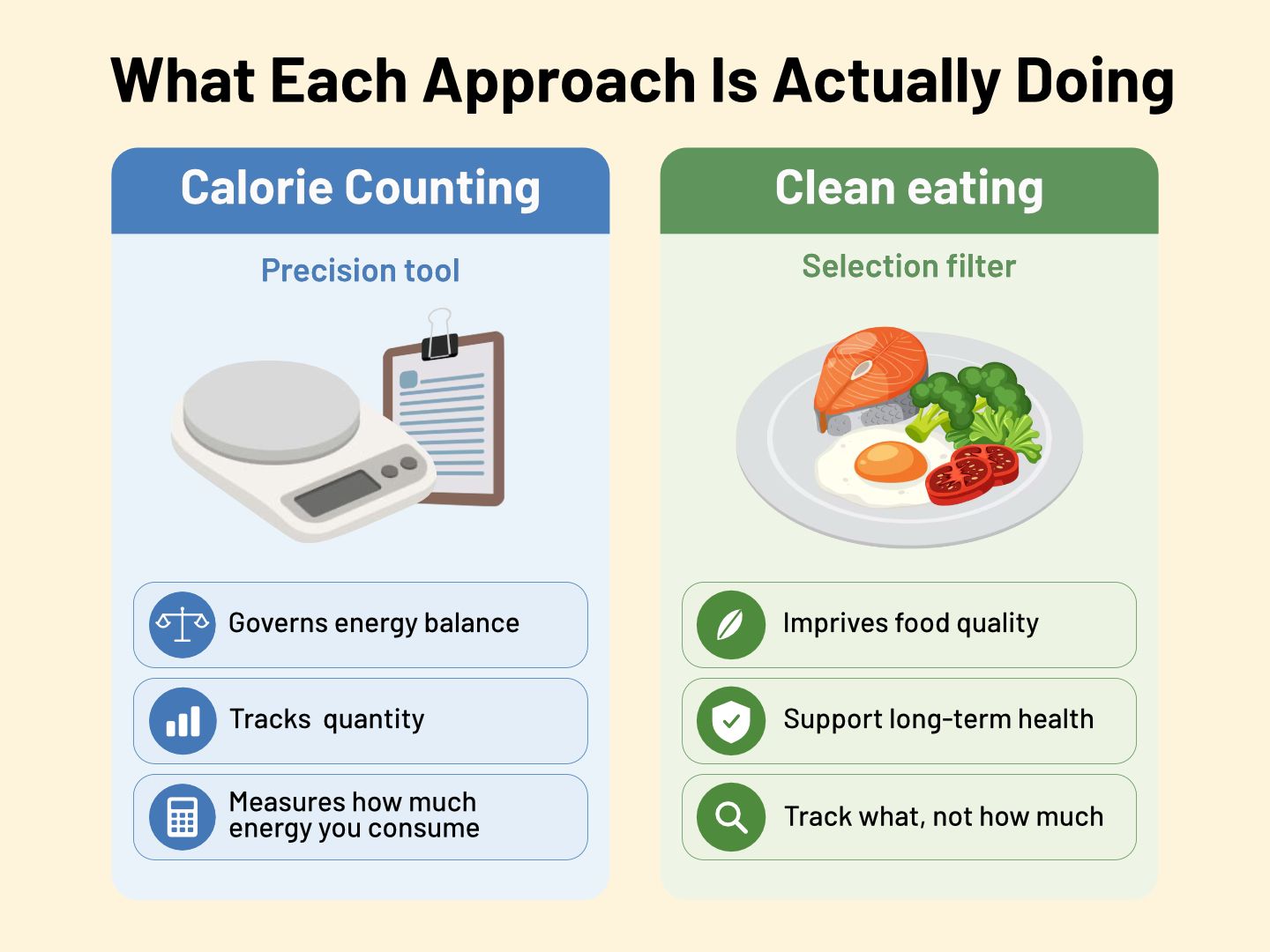
Understanding why each method works clarifies when to use which one.
Calorie counting is a precision tool. It works on the principle that body weight is ultimately governed by energy balance. Eat fewer calories than you burn and you lose weight, regardless of whether those calories come from brown rice or white rice, salmon or fried chicken. Research consistently supports this. A 2009 study published in the New England Journal of Medicine found that participants lost similar amounts of weight across diets with very different macronutrient compositions, as long as caloric restriction was the same. The feedback loop is direct: you know your numbers, you adjust them.
Clean eating works differently. It does not require counting anything. Instead, it operates on a simple filter: prioritize whole, minimally processed foods and eliminate or reduce the ultra-processed ones. The reason it often produces weight loss is that whole foods are naturally lower in caloric density, higher in fiber and protein, and far less engineered to override your satiety signals. You tend to eat less without trying to. The benefit extends beyond weight as well. Food quality has independent effects on inflammation, gut health, energy, and long-term metabolic health that calorie counting does not address.
Where Calorie Counting Falls Apart in Bangkok
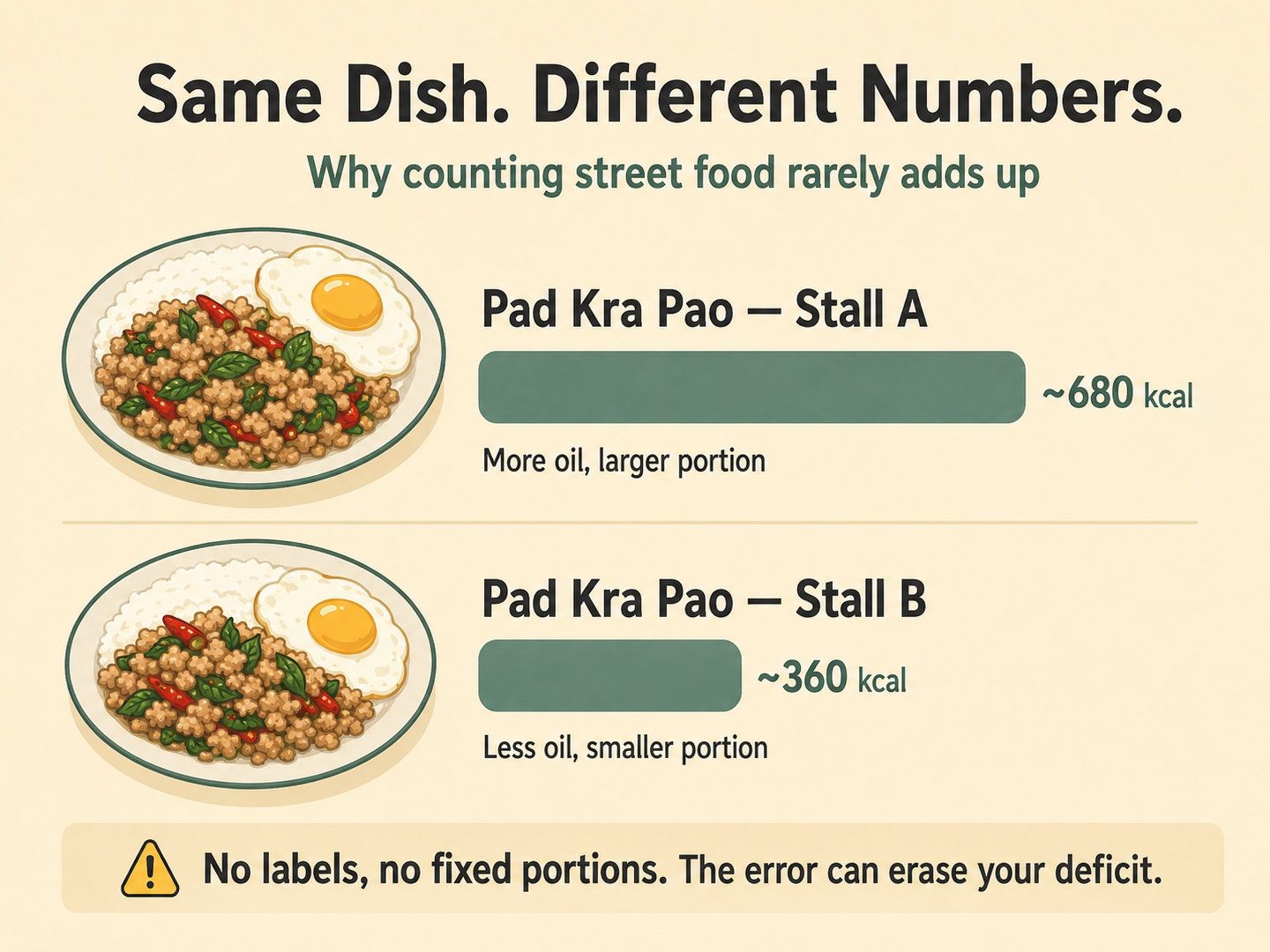
Calorie counting works well in theory. In practice, it requires two things that Bangkok makes genuinely difficult: accurate food labels and consistent portion sizes.
Thai street food has neither. The pad kra pao at one stall will have twice the oil of the same dish at another. The khao man gai portions range from modest to enormous depending on who is serving. The sauce that comes with your laab has no nutritional information on it. Even if you are diligent about logging meals, the margin of error is significant enough to erase a modest calorie deficit entirely.
There is also the cognitive load. Weighing food, logging every ingredient, and calculating totals for every meal is sustainable for some people and completely unsustainable for others. Research on dietary adherence consistently shows that the stricter and more time-consuming an approach, the higher the dropout rate over time. A method that you follow for two weeks before burning out will always underperform a method that you stick to for six months, even if the second one is theoretically less precise.
Where Clean Eating Falls Short

Clean eating has its own blind spot, and it is a significant one: "clean" does not automatically mean low-calorie.
Avocado is clean. Almond butter is clean. Salmon is clean. Quinoa is clean. All of them are also calorie-dense, and eating them without any awareness of quantity can easily result in eating 600 calories more per day than you realize. This is one of the most common reasons people who genuinely eat well still cannot lose weight. They have fixed the quality problem but have no feedback mechanism on quantity.
The other issue is that clean eating as a concept has no agreed definition. For some people it means no processed food. For others it means organic, or gluten-free, or specific dietary philosophies. Without a clear framework, it is easy to create rules that are arbitrary or overly restrictive without actually addressing what matters.
The Approach That Combines Both and Actually Works

The most practical framework, especially in Bangkok, is not clean eating or calorie counting but a combination of both used at different levels of attention.
Use clean eating as your default selection filter. When you are choosing what to eat, prioritize whole protein sources, vegetables, and whole grains. Eliminate ultra-processed food, sugary drinks, and food with heavy sauces as your baseline. This handles food quality automatically without requiring you to calculate anything.
Use macro awareness as your calibration check, not obsessive daily logging. Know roughly what your protein, calorie, and fat targets are. Check in on them periodically, maybe once or twice a week, to see if you are in the right range. This gives you the feedback loop of calorie counting without the cognitive overhead of tracking every meal every day.
This is exactly the problem that Easy Health's meal delivery is built to solve. Every item on the menu is made with whole ingredients, zero added sugar, and full macro transparency on every dish. You get clean eating by default because the food quality is already handled, and you get the calorie and protein information when you want it without having to calculate anything yourself. The Balance Plan at 1,400 to 1,600 calories per day, for example, is both macro-calibrated and clean by construction.
How to Apply This When You Are Busy in Bangkok
A few things that make the hybrid approach work in practice:
Set a weekly protein target rather than a daily calorie target. Protein is harder to overconsume and getting enough of it naturally regulates total intake. Hitting 100 to 130g of protein per day in Bangkok requires intentional choices, and making those choices will crowd out most of the problematic foods naturally.
Browse Easy Health's full menu to build a mental reference for what good macro distribution looks like. The Fajita Bowl at 47g protein and 602 calories, or the Free-Range Chicken Fitness Meal at 47g protein and 538 calories, give you a concrete anchor for what a well-structured meal actually looks like in numbers.
If you eat out at Thai restaurants, apply the clean eating filter first: choose dishes with a clear protein source, ask for less oil, skip the sugary sauces. Do not try to calculate exact calories for street food. The estimate will be inaccurate enough to be misleading.
Frequently Asked Questions
I eat clean but I am not losing weight. What is actually going wrong?
Almost always, the issue is caloric quantity. Whole foods are healthier but not calorie-free. If you are eating generous portions of nuts, nut butters, avocado, whole grain rice, and fatty fish without any awareness of total intake, it is entirely possible to eat 500 to 700 more calories per day than your body needs while eating nothing that most people would call unhealthy. Adding some macro awareness to your clean eating habits, even loosely, usually solves this.
Can I lose weight eating Thai street food if I just count calories?
Yes, technically. The challenge is accuracy. Street food calories are difficult to estimate and the margin of error is high. A reasonable approach is to count calories for meals where you have clear information, apply clean eating principles for street food by choosing dishes with visible lean protein and fewer heavy sauces, and use your weight over 2 to 3 weeks as your feedback signal rather than trusting daily calculations.
How precise does calorie counting actually need to be to work?
Research suggests that being within 10 to 15 percent of your target is sufficient for consistent fat loss. You do not need to be exact to the calorie. What matters more than precision is consistency. A rough daily target that you hit reliably six days out of seven will produce better results than a precise target you manage three days a week.
Is clean eating just a restrictive diet with a better marketing name?
It can be, depending on how strictly it is applied. At its core, clean eating is simply a preference for whole, minimally processed food, which has strong evidence behind it and is not inherently restrictive. The version that creates rules around specific "allowed" and "banned" foods, demands organic only, or eliminates entire food groups without medical reason is where it starts to create the same psychological burden as restrictive dieting.
What matters more: hitting my calorie target or eating whole foods?
For weight loss specifically, the calorie target is what determines the outcome. You can lose weight eating poor-quality food in a calorie deficit. But food quality independently affects energy levels, inflammation, skin health, gut health, and long-term metabolic function. The reason this feels like an either/or question is that most people treat it that way. In practice, eating whole foods makes hitting a reasonable calorie target easier because whole foods are more filling per calorie.
Can I do both approaches without it becoming obsessive?
Yes, and the key is using each tool for what it is good at. Clean eating handles the daily default: what do I choose when I am at a food court, ordering delivery, or cooking at home? Macro awareness handles the calibration check: am I roughly in the right range over this week? When you treat calorie awareness as occasional feedback rather than a daily obligation, it stops feeling like a surveillance task and becomes useful information.
Easy Health Was Built for Exactly This
The clean eating versus calorie counting debate largely dissolves when your meals come with clean ingredients and full macro transparency already included.
160+ menu items with zero added sugar, zero MSG, and zero artificial preservatives
Full calorie and macro breakdown on every single item, so you always have the numbers if you want them
The Balance Plan (1,400 to 1,600 kcal/day) handles the structure for you, no tracking required
Fresh daily preparation, never frozen, delivered across Bangkok with branches in Bangkok and Pattaya
Browse the full menu at easyhealth.asia/menu and find the plan that fits your goal.
Download the Easy Health app:
Easy Health on Google Play (Android)
Easy Health on App Store (iOS)
References
Sacks FM, Bray GA, Carey VJ, et al. (2009). Comparison of Weight-Loss Diets with Different Compositions of Fat, Protein, and Carbohydrates. New England Journal of Medicine, 360(9), 859-873. https://doi.org/10.1056/NEJMoa0804748
Hall KD, Ayuketah A, Brychta R, et al. (2019). Ultra-Processed Diets Cause Excess Calorie Intake and Weight Gain. Cell Metabolism, 30(1), 67-77. https://doi.org/10.1016/j.cmet.2019.05.008
Dansinger ML, Gleason JA, Griffith JL, et al. (2005). Comparison of the Atkins, Ornish, Weight Watchers, and Zone Diets for Weight Loss and Heart Disease Risk Reduction. JAMA, 293(1), 43-53. https://doi.org/10.1001/jama.293.1.43
Monteiro CA, Cannon G, Levy RB, et al. (2019). Ultra-processed foods: what they are and how to identify them. Public Health Nutrition, 22(5), 936-941. https://doi.org/10.1017/S1368980018003762
Tapsell LC, Neale EP, Satija A, Hu FB. (2016). Foods, Nutrients, and Dietary Patterns: Interconnections and Implications for Dietary Guidelines. Advances in Nutrition, 7(3), 445-454. https://doi.org/10.3945/an.115.011718
Stubbs RJ, Mazlan N, Whybrow S. (2001). Carbohydrates, appetite and feeding behavior in humans. Journal of Nutrition, 131(10), 2775S-2781S. https://doi.org/10.1093/jn/131.10.2775S
Internal links: Easy Health menu | Easy Health meal plans