
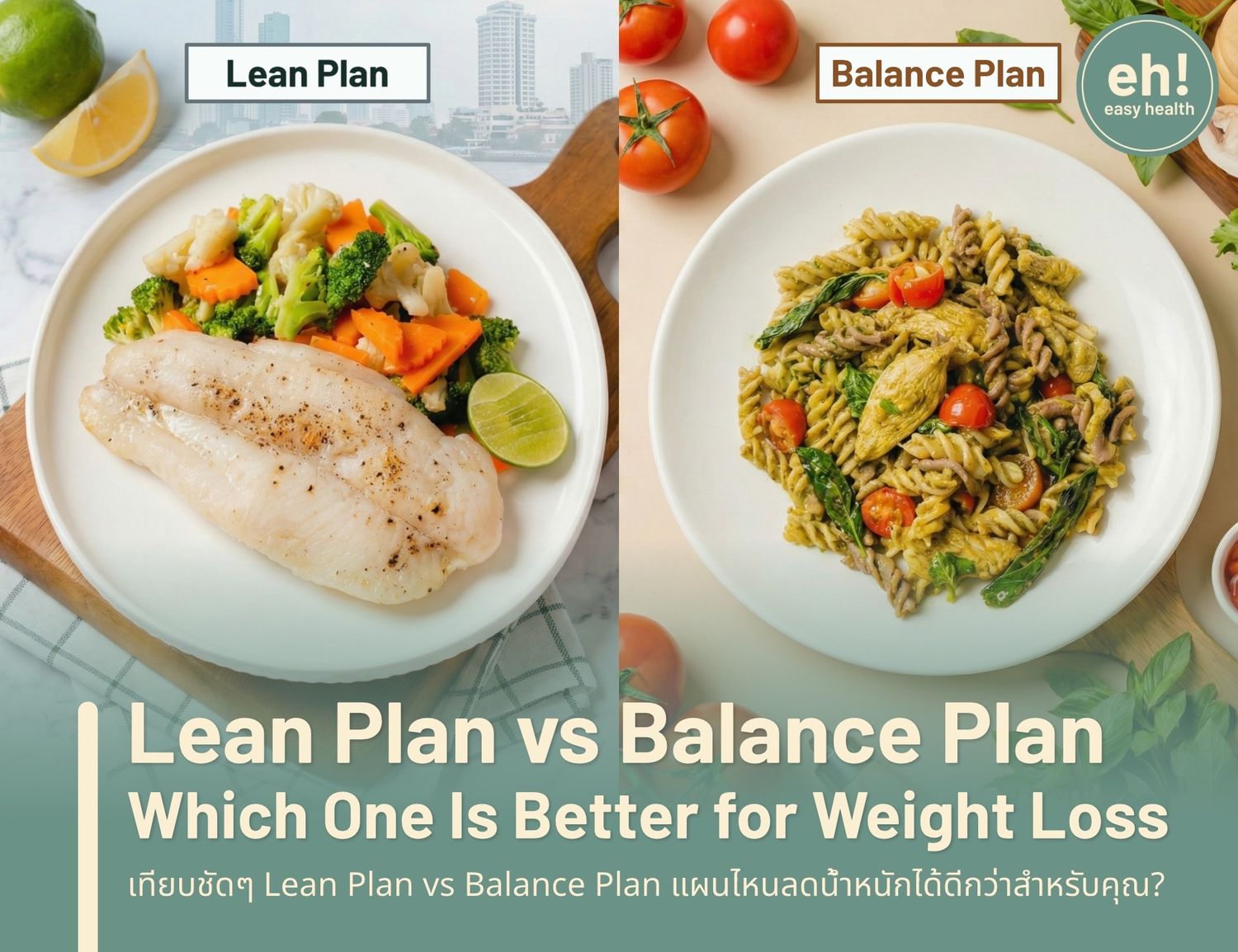
Lean Plan vs Balance Plan: Which Is Better for Weight Loss?
When it comes to weight loss, there is no "One Size Fits All" solution.
At Easy Health, our two most popular subscriptions—the Lean Plan and the Balance Plan—are often the subject of debate. Both are designed to help you lose fat and eat clean, but they approach the goal from different angles.
Do you need aggressive calorie cutting for quick results?
Or do you need a sustainable lifestyle change that keeps you fueled?
If you are an expat or busy professional in Bangkok trying to decide, this guide is for you. We break down the calories, the macros, and the "real-life feel" of both plans to answer the ultimate question: Which one is better for YOUR weight loss journey?
Contender #1: The Lean Plan (The "Rapid Results" Specialist)
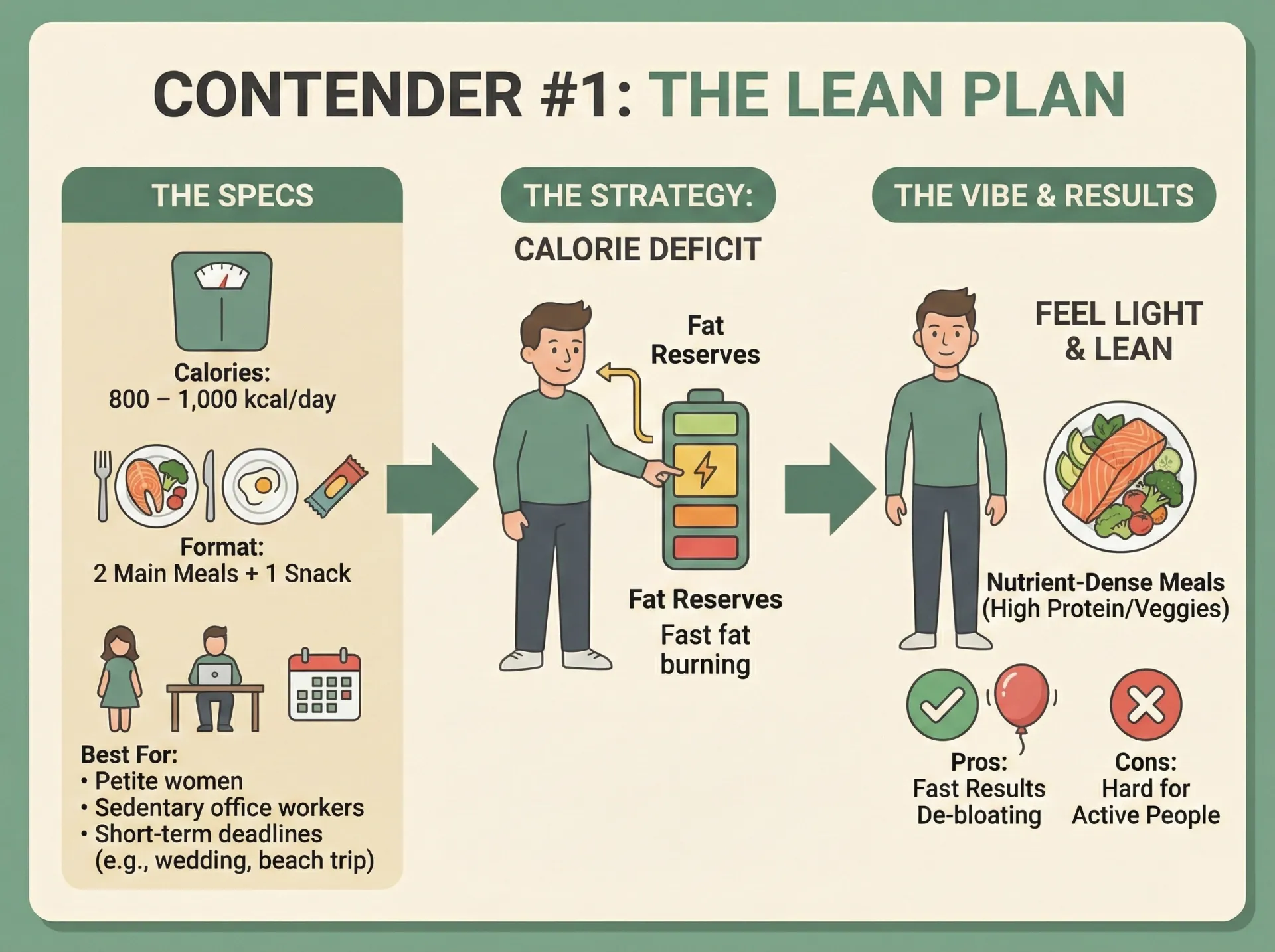
The Specs:
Calories: 800 – 1,000 kcal / day
Format: 2 Main Meals + 1 Snack
Best For: Petite women, Sedentary office workers, Short-term deadlines (e.g., wedding, beach trip).
The Strategy:
The Lean Plan creates a significant Calorie Deficit. By capping your intake at ~1,000 kcal, your body has no choice but to tap into fat reserves immediately.
Pros: Fast visible results. Great for "de-bloating" and resetting your appetite.
Cons: Can be challenging to sustain for months if you are very active.
The Vibe: You will feel light and lean. The meals are nutrient-dense (high protein/veggies) to ensure you aren't starving, but you won't be "stuffed."
Choose Lean If: You have a small frame (BMR < 1,300), you sit at a desk all day, or you want a 10-day "Kickstart" before moving to a higher calorie plan.
Contender #2: The Balance Plan (The "Sustainable Lifestyle" Master)
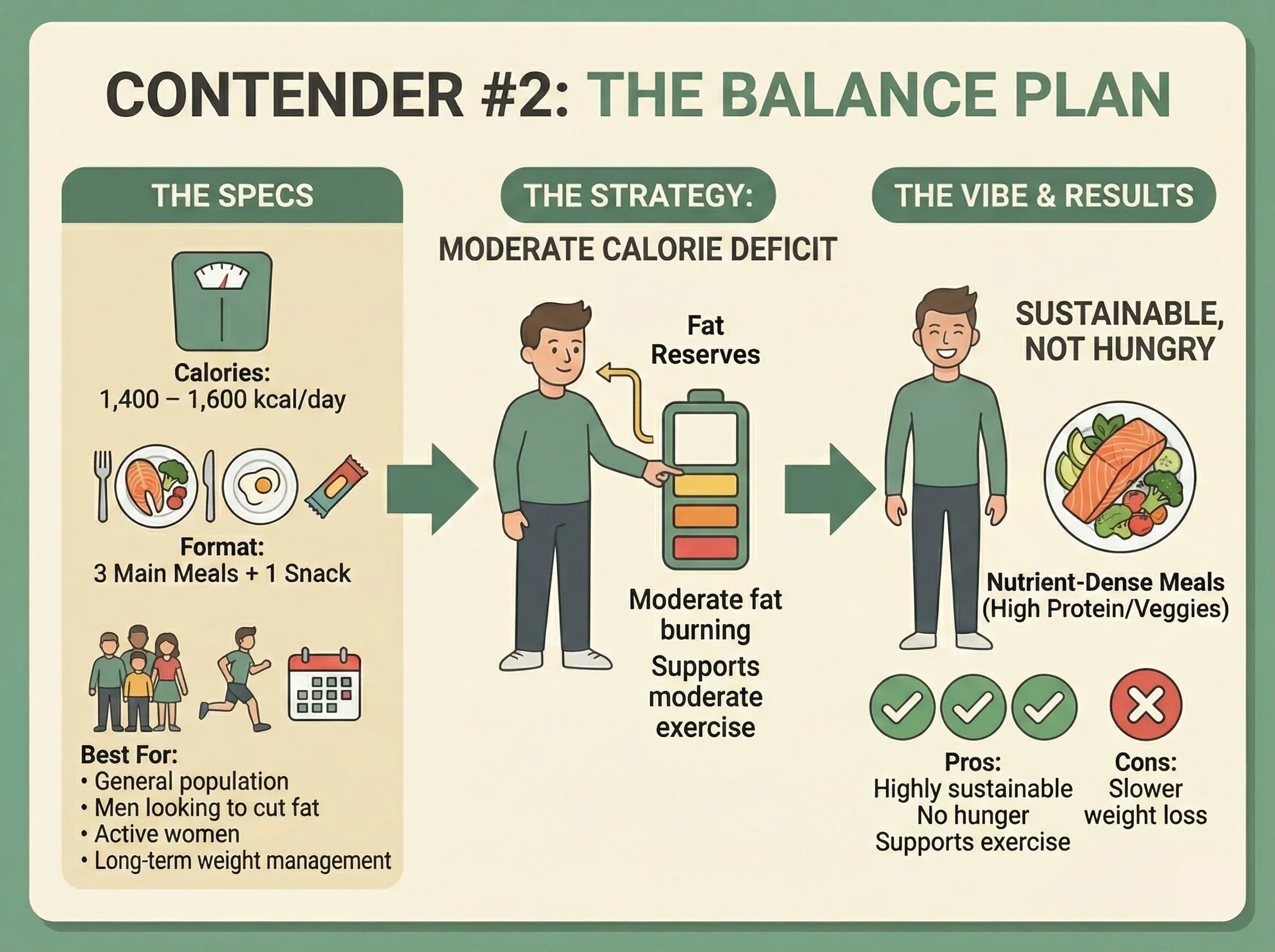
The Specs:
Calories: 1,400 – 1,600 kcal / day
Format: 3 Main Meals + 1 Snack
Best For: General population, Men looking to cut fat, Active women, Long-term weight management.
The Strategy:
The Balance Plan aims for a moderate Calorie Deficit. It provides enough fuel to power you through work and light exercise while still keeping you below your maintenance calories (TDEE).
Pros: Highly sustainable. You won't feel hungry or deprived. Supports moderate exercise performance.
Cons: Weight loss might be slower (0.5 kg/week) compared to the Lean Plan, but it's more likely to stay off.
The Vibe: You get to eat 3 full meals plus a snack. It feels like a normal, healthy life, not a "diet."
Choose Balance If: You are moderately active, you tend to get "hangry" easily, or you are looking for a plan you can stick to for 1-3 months without burnout.
Head-to-Head Comparison: Which Fits Your Life?
Feature Lean Plan Balance Plan Daily Calories 800 - 1,000 kcal 1,400 - 1,600 kcal Daily Protein ~80g - 100g ~120g - 140g Number of Meals 2 Meals + Snack 3 Meals + Snack Hunger Level Moderate (Requires discipline) Low (Very satisfying) Activity Level Best for Light/Sedentary Supports Moderate Exercise Weight Loss Speed Fast (Rapid Drop) Steady (Sustainable Fat Loss)
The Verdict: Which One Should You Pick?
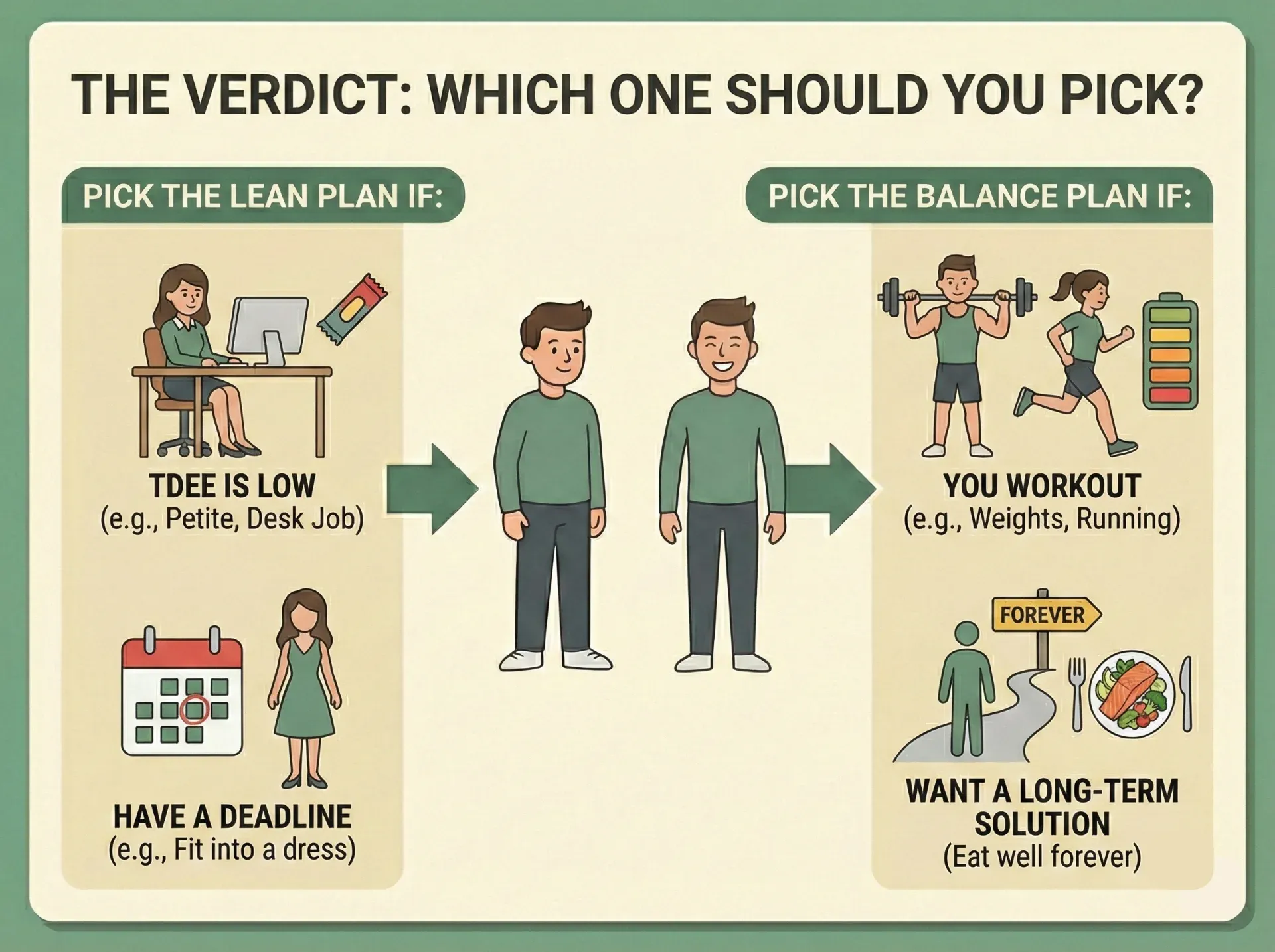
Pick the LEAN PLAN if:
You know your TDEE is low: If you are a petite female working a desk job, 1,500 kcal might actually be your maintenance level. You need the 1,000 kcal range to lose fat.
You have a deadline: Need to fit into a dress in 2 weeks? The Lean Plan is your best bet for quick deflation.
Pick the BALANCE PLAN if:
You workout: If you lift weights or run, 1,000 kcal is dangerous. You need the 1,500 kcal from the Balance Plan to fuel recovery and prevent muscle loss.
You want a long-term solution: If you are tired of yo-yo dieting, the Balance Plan teaches you how to eat well forever.
Still Not Sure? Let the App Decide!
Don't guess. Use the Easy Health App to browse the daily menus of both plans. See if the "2 Meals" of the Lean Plan fits your schedule, or if you prefer the "3 Meals" structure of the Balance Plan.
Start your transformation today:
Android: Download via Google Play Store
References
Mayo Clinic. (2024). Weight loss: Choosing a diet that's right for you. Retrieved from https://www.mayoclinic.org/healthy-lifestyle/weight-loss/in-depth/weight-loss/art-20048466
Healthline. (2024). 1,200 Calories: Is It Enough? Retrieved from https://www.healthline.com/nutrition/1200-calorie-diet-review
National Institutes of Health (NIH). (2024). Very Low Calorie Diets: What You Need to Know. Retrieved from https://www.niddk.nih.gov/health-information/weight-management/very-low-calorie-diets
Internal & External Linking Suggestions
Internal Links:
Link "Lean Plan" to the Lean Plan product page.
Link "Balance Plan" to the Balance Plan product page.
External Links:
Link "TDEE" (in Intro) to a trusted TDEE calculator to help users check their numbers.